Can Buying Hunting Licenses Help Save Florida’s Bears?
A creative solution to limiting the number of bears killed in the state’s newly approved bear hunt

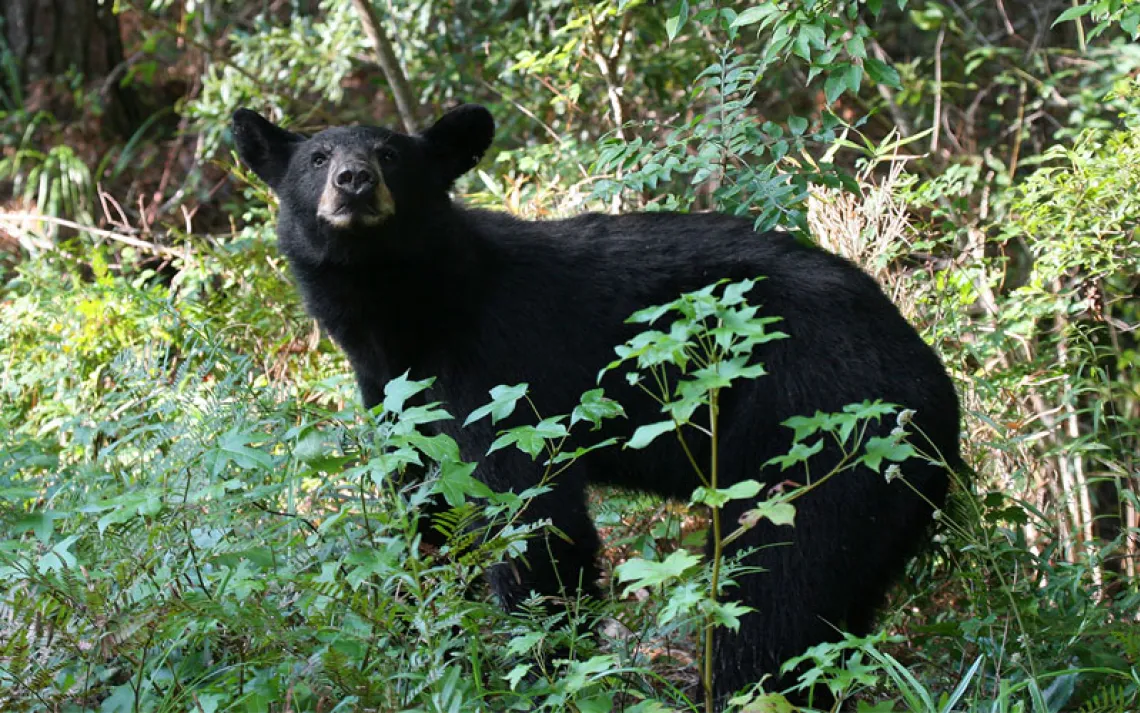
A Florida black bear in Ocala National Forest. | Photo by Jack Bond/iStock
In early September, I did something I never thought I would do: I bought my first hunting license. I intentionally purchased a home in an area where I could reside close to nature, including near Florida’s beloved black bears. But in August, the Florida Fish and Wildlife Conservation Commission (FWC) unanimously approved a controversial bear hunt. And in a distorted turn of events, I’m officially a card-carrying hunter.
The last bear hunt in Florida was in 2015. In just two days, hunters killed more than 300 bears, more than the FWC anticipated. Speak Up Wekiva, a local nonprofit, advocated to put an abrupt end to the massacre. The numbers spoke, and FWC stopped the hunt early.
The statistics reported by FWC showed that 21 percent of the female bears killed during that hunt were lactating. In other words, they were new mothers. This past August, Steve Lowe spoke at the FWC’s meeting about what he saw back then. With a disheartened voice, he shared, “We had one hunter brag that he had to drag the cubs off of the mother that they shot.”
Some supporters of bringing back the hunt say that bears are running out of habitat. They’ve also stoked fears of bears running rampant and attacking people. However, according to the state’s own information, both claims lack merit. In December 2024, FWC staff stated, “Our estimates indicate there is enough suitable bear habitat to support our minimum and current population numbers now and into the future.”
In addition, there has been only one fatal bear attack in the state’s history, and contact with bears is extremely rare. Some negative interactions occur when people get near cubs or food, but these are avoidable. FWC has acknowledged that a bear hunt won’t eliminate these types of interactions and has said bear-proof trash cans would be a better way to avoid some conflicts.
This leaves many Floridians scratching their heads and wondering why a hunt was proposed. Adding in other variables, such as hunting with dogs, allowing private landowners to obtain permits, bow hunting, and the ability to shoot bears when they are at feeding stations, has enraged wildlife-lovers even more.
Rhonda Roff is on the conservation committee for the Sierra Club’s Florida Chapter and is chair of the committee for the Calusa group. She said, “Sierra Club is not anti-hunting, but hunting has to be scientifically underpinned. And that is where we have a conflict right now.” She’s concerned about the population in some of the bear management units and said, “three of them are on the edge of being too genetically uniform to be sustainable.”
While pro-hunting groups are advocating for a hunt, Roff shared that she’s heard from hunters who have added another interesting perspective: “There are a lot of hunters that don't believe that the bears should be hunted.” Among those are former FWC commissioner Ron Bergeron and his daughter, Diamond. Even though their family hunts, they’re still opposed because of several components of the current plan, including the use of dogs and bait, as well as the lack of current data. In a letter to the FWC in August, they said, “The population estimates informing this proposal are based largely on data collected between 2010 and 2015. Updated studies have not been released for the majority of bear management units (BMUs).” According to them, “moving forward without the updated data is premature and irresponsible.”
An unexpected twist
Last December, FWC staff gave an update on Florida’s black bear management, saying that no action was requested at that time. They welcomed input from commissioners, who then directed staff to proceed with putting together a plan for a proposed bear hunt anyway. The commissioners said a hunt will help manage the population, even though the staff report didn’t allude to an overpopulation problem.
Roff shared her thoughts on why commissioners asked for a plan: “There's a lot of pressure coming from the hunting community, mostly the trophy-hunting community.” She shared that there’s another possible place pressure may be coming from. “There are some people who believe that if you get the bears out of the way, it makes it easier for the developers to develop the land,” she said.
The conservation commission voted 5-0 to approve the hunt, which is scheduled to take place over Christmas, from December 6 to 28. This season, however, will look different than any other. The FWC commissioners limited the hunt to 187 hunting tags, each affording its owner the right to kill a bear. The coveted tags can be obtained only via a random drawing. For conservation advocates, that presents a unique opportunity for wildlife lovers to get involved and, at the very least, limit the number of bears that are killed.
Through a random lottery to allot hunting tags, any licensed hunter who’s at least 18 years old can throw their name in the ring to win a tag, regardless of whether they plan to use it. Speak Up Wekiva and the Sierra Club’s Florida Chapter are hoping to capitalize on this aspect by encouraging nonhunters to purchase hunting licenses. The hope is that this will keep bear tags out of the hands of hunters, and each tag secured by a nonhunter equals a life that is saved.
The move mirrors a similar campaign launched in Wyoming in 2018, where conservationists, including Jane Goodall, urged people to apply for one of the state's 22 grizzly bear hunting permits. Dubbed "Shoot'em With a Camera," the effort would limit how many bears were killed in what would have been the first time the state held a grizzly hunt in 44 years. However, a judge quickly restored federal protections for grizzlies, and the hunt was called off.
But will it work?
Chuck O’Neal is the president and founder of Speak Up Wekiva and Speak Up for Wildlife. He said the potential success of the initiative in Florida comes down to math. “There's such a small percentage of Floridians who are hunters, so this is the ideal place to do this. Ninety-nine percent of people are nonhunters here, and that is rare in any of these states that hunt bears. I think we can take advantage of the numbers and make a statement that we don't approve of this.”
His goal is for nonhunters to obtain half of the bear tags, and based upon the response he’s received, he’s optimistic. Wildlife enthusiasts from outside Florida have expressed interest in helping as well. Up to 10 percent of the tags can be awarded to nonresidents. By purchasing a tag, “you’re saying there is something we can do,” O’Neal said.
From September 12 to 22, prospective tag holders can visit GoOutdoorsFlorida.com and pay $5 per application, plus handling fees, to apply for a tag. Each application serves as a chance to win one, and participants can buy as many as they’d like—but each licensed hunter will be able to win only one of the 187 total tags. O’Neal said, “We’re much better off having 1,000 people with one ticket than we are with one person having 1,000 tickets.”
O’Neal is hosting nightly Zoom meetings to walk bear lovers through the application process, and he’s shared another piece of advice: The application will ask people to choose an area where they’d prefer to hunt. Some zones will have more tags allocated than others, and he explained, “You don't have to select the zone where you live. Your odds are best in the Eastern Panhandle and in South Florida.” Roff also explained why it’s important for her to stop bears from being killed in the central region, saying, “I want that population to migrate out and help to bolster the more vulnerable populations.”
As for me, I recently spotted one of our cherished bears while I was cycling near a wooded area. I never felt threatened, and there was a genuine respect between the two of us that made me feel deeply connected to nature. I treasured that moment, and I’m fighting for that bear. I know I may not be able to save 187 on my own, but if I’m lucky enough to be chosen for a tag, I can save one—and that one bear’s life makes it all worth it to me.