ENVIRONMENT EXPLAINED
What’s the Best Salt for Both Flavor and Sustainability?
The tastiest and best options for the environment are often the least processed. Enter sea salt.
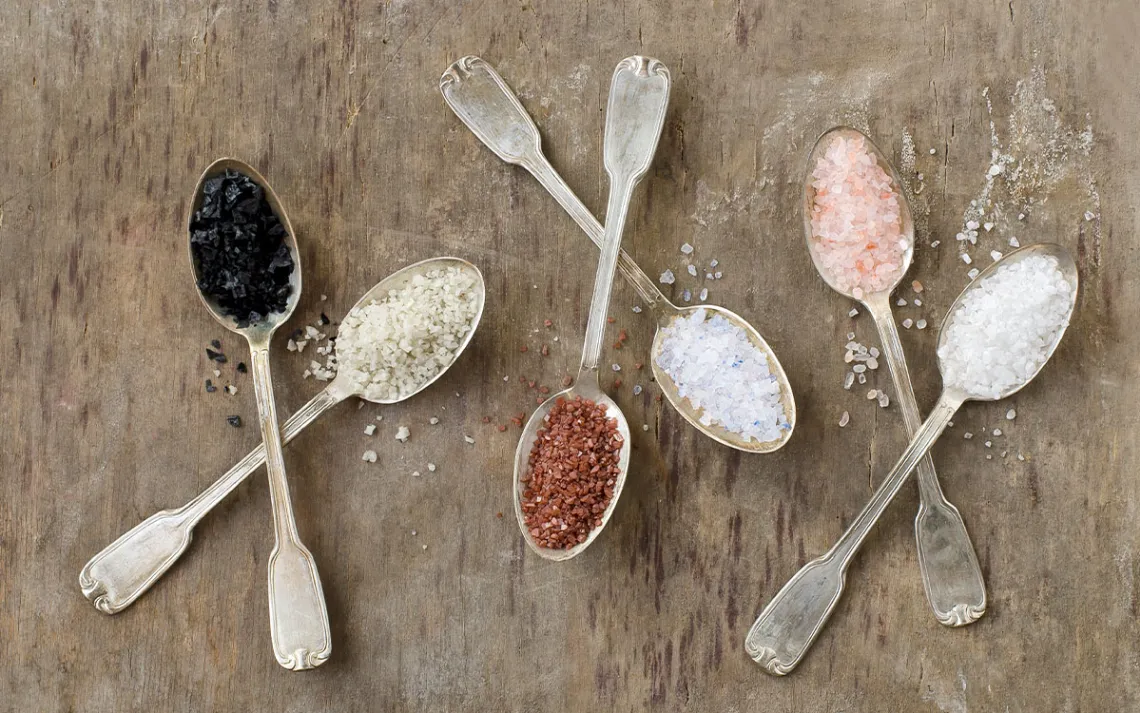
Photo by Tania Mattiello/Getty Images
It’s one of the most common sights on dinner tables, in kitchen cupboards, and on spice racks. Salt is ubiquitous in the United States; about 55 million metric tons of the mineral were consumed in 2023 alone. The US is the second-largest producer of salt in the world. But not all salt is created equal.
Table salt, one of the most commonly used options, is mined from underground deposits and often boiled down. It can be heavily processed: Natural impurities are removed, but this also strips it of nutrients. Anti-clumping additives like calcium silicate are often mixed in. This creates a much finer, uniform grain but takes away its distinctiveness. The process is much cheaper than harvesting sea salt and potentially more damaging to the environment: It can result in deforestation and erosion and contribute to carbon emissions.
That’s why many artisan farmers are specializing in sea salt instead.
“Our ancestors made salt burning timber and coal and boiling down brine on an industrial scale,” says Nancy Bruns, cofounder of West Virginia’s J.Q. Dickinson Salt-Works. The company collects water from the ancient Iapetus Ocean nestled beneath the Appalachian Mountains, relying on a large well 350 feet below. After scooping up the brine, it’s moved into sun houses, where it rests for about six weeks while being carefully monitored. “We wanted to have a low environmental footprint, which is why we take our time and let the sun do the work.”
The tiny translucent shards this method produces might not look like much, but sea salt has the power to bring out concealed notes in a tomato or melon slice or add a dreamy contrast to sugary caramel. While the salt doesn’t have prominent flavor differentiations, like apples or berries, there are still subtle notes—the secret being the minerals present in landscapes. J.Q. Dickinson’s salt is high in magnesium, calcium, and potassium. This results in a bright and almost tangy flavor with a slightly sweet finish.
These are flavor nuances widely lost due to how commercialized the salt industry has become, but something many artisan US sea salt farmers, like Anna Baglaneas Eves, strive to revive while keeping sustainability in mind. The founder of Cape Ann Sea Salt, Eves collects Atlantic seawater from around Cape Ann, Massachusetts, crafting salt faintly reminiscent of the ocean. “A friend of mine described it like swimming in the ocean and you lick your lips,” she says. “It’s very pleasant, not harsh and overpowering.”
The company uses solar evaporation to form crystals. Harvesting is done year-round, even on chilly winter days. “In the wintertime, it’s cold and dry, which is good to make sea salt,” she says. “[When it’s] really cold, you can skim ice off the top, which is fresh water, so it helps concentrate the brine even more.”
Over on Washington’s San Juan Island, Brady Ryan previously worked on vegetable farms building greenhouses throughout the Northwest. He learned of sea salt greenhouse farming in 2011. Ryan returned to the island and founded San Juan Island Sea Salt a year later. From April to early October, the company gathers thousands of gallons of the Salish Sea around a private beach on the island’s southern end.
“[We] go to the beach about three miles from the farm with a big old flatbed truck with a tank on the back and fill it with seawater,” says Ryan. The water is later filtered in what looks like huge socks and left alone to sunbathe in one of 14 greenhouses for about a month. “The cool thing about our process is how hands-off it is,” he says.
Salt is then shifted and sorted into natural, reserve, flaky, or raw options—all of which have distinct textures and culinary uses. “It comes out different every time,” says Ryan. “Every batch is truly unique.” He remembers one salt flake that grew to be the size of a silver dollar. “It was the most delicate thing ever [and when] munched on, it was pure crunchy air,” he says.
Down on Florida’s Gulf Coast, Tim Norwood of Sea Salt Florida focuses on sea salt from around barrier islands like Siesta Key, Anna Maria Island, and Longboat Key. He ventures around the islands at various hours of the day and night to harvest seawater—about 3,000 pounds at a time.
Norwood, who has an engineering background, quickly came to love the adventures sea salt offered. For over two years, he meticulously investigated water around the area, even evaluating it under microscopes, to narrow down the best sources before finally offering his goods in 2015.
“I chose to be a salt farmer, so I’m making that my quest to be the very best at it,” he says.
Humidity and temperature affect aspects like texture, size, flakiness, and how quickly the evaporation process occurs. There’s also the natural elements and the challenges artisanal farmers can face. When hurricanes strike, Norwood must wait until the flooded barrier islands are safe to visit again. Ryan recently faced a winter storm that blew over some of his solar greenhouses. Eves constantly checks in with the local shellfish constable hotline about any potential bacteria levels in the water or red tide (harmful algal bloom).
“We are at the whim of Mother Nature,” says Eves.
But sometimes convincing consumers to invest in their product can also be a challenge.
“People are used to paying [cheap amounts] for a small container,” says Bruns. “Our salt is much more expensive because it’s much more labor intensive to preserve its mineral content.”
What makes sea salt unique isn’t just its sustainability or flavor but how the sourcing and production of it restores a tradition. The Bruns family harvested salt on land from 1817 to 1945 before relaunching operations in 2013. Old wells still haunt the land, reminding of past endeavors.
“We’re not using fossil fuels and contributing to pollution,” says Eves. “It doesn’t make sense to take clean ocean water and pollute the environment to make salt. Someone might say, ‘Oh I got this tomato down the street’ or ‘I got an heirloom chicken at this farm,’ but when you ask where their salt comes from, they don’t know,” says Eves. “I think it’s one of the missing links in knowing where food comes from.”