Facing Apex Predators—and Fear—in the Name of Conservation
Photographer Tanya Houppermans gets within biting distance to capture the beauty of sharks and other maligned sea creatures
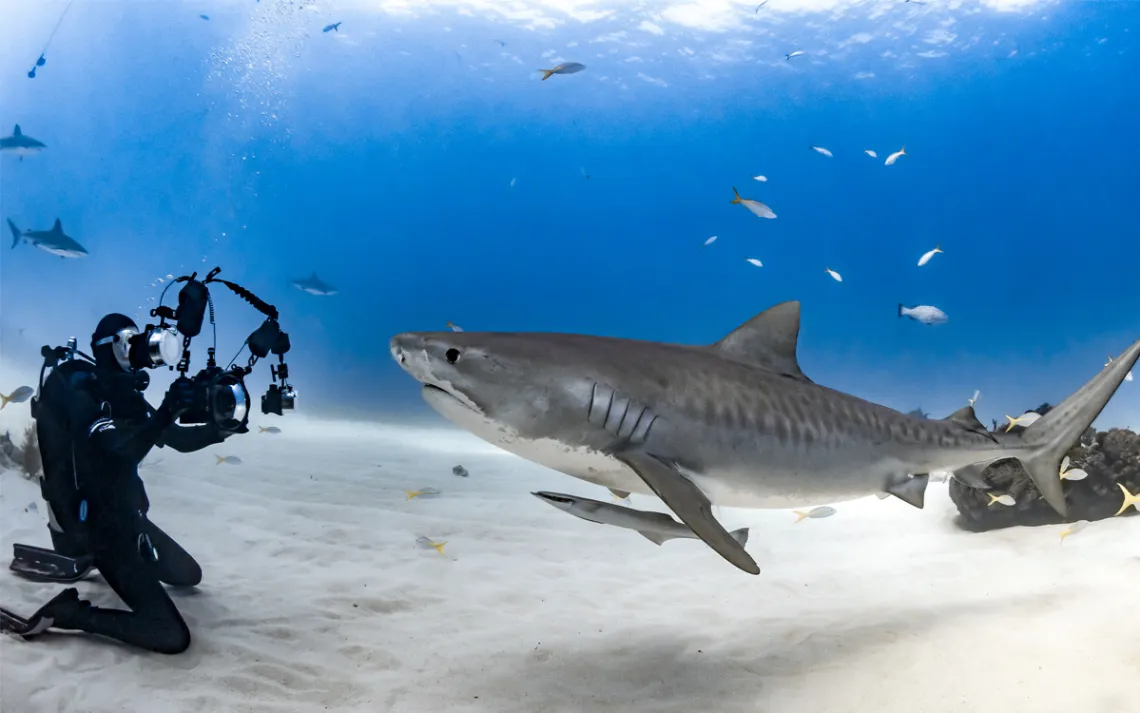
Tanya Houppermans with a tiger shark off the coast of Grand Bahama. | Photo by Pat Sinclair
On one of her diving trips, Tanya Houppermans was deep beneath the ocean surface in the Bahamas at night, hoping to see sharks. Contrary to popular belief, these animals usually steer clear of humans. To draw them closer, Houppermans and several other photographers had brought along a metal box filled with frozen barracuda.
It worked. “We had tiger sharks, great hammerheads, lemon sharks, and Caribbean reef sharks around us that night,” she said. The shoot was going well—until something shifted. “Their movements started getting a little bit more jerky and unpredictable. As experienced shark divers, we pick up on when vibes are off. And the vibes were off.”
The group slowly headed back to the surface, unscathed.
During her roughly 1,000 dives since 2008, Houppermans has come face-to-face with aquatic apex predators on many occasions, and she believes they often get a bad rap. Most pose little real danger. She first learned this during a wreck dive in North Carolina, when a shiver of sand tiger sharks surrounded the ship. “Instead of feeling any fear,” she recalled, “I was just immediately fascinated.”
Houppermans started learning more about sharks—and about the harm that humans were doing to them. In 2015, she left her corporate job as a mathematician and military defense analyst to fully focus on marine conservation. She taught herself to use underwater camera equipment and set out to educate the public about sharks and other so-called vicious monsters.
“More people are killed by vending machines falling on them than by shark bites,” Houppermans said.
Many of the roughly 500 shark species—including massive whale sharks that feed on plankton—are docile and want nothing to do with people. They prefer food sources with much more fat. According to Houppermans, shark bites are usually a matter of mistaken identity and often occur near fishing piers, where sharks are attracted to bait.
In reality, sharks have far more reason to fear humans.
“Around the world every year, between five and seven people are killed by sharks. And every year around the world, humans kill over 70 million sharks,” Houppermans pointed out.
Many species are now threatened by overfishing and shark finning—cutting fins from live sharks for use in soup and discarding the bodies at sea—as well as habitat disruption, pollution, and climate change. Over the past 50 years, shark populations have dropped by about 70 percent.
Houppermans hopes her photography will help change how people see sharks—portraying them as she sees them, as “beautiful, graceful, intelligent creatures that desperately need our help.”
“My hope was that through the photography, through the conservation work, I would get people to change their misconceptions about sharks and realize that these aren't just bloodthirsty monsters. That would be step one,” she said. “Step two would be starting to care about them. And not only care about the sharks, but care about the environment they live in. Because the ocean has a lot of problems of its own—pollution, especially microplastics, and global warming.”
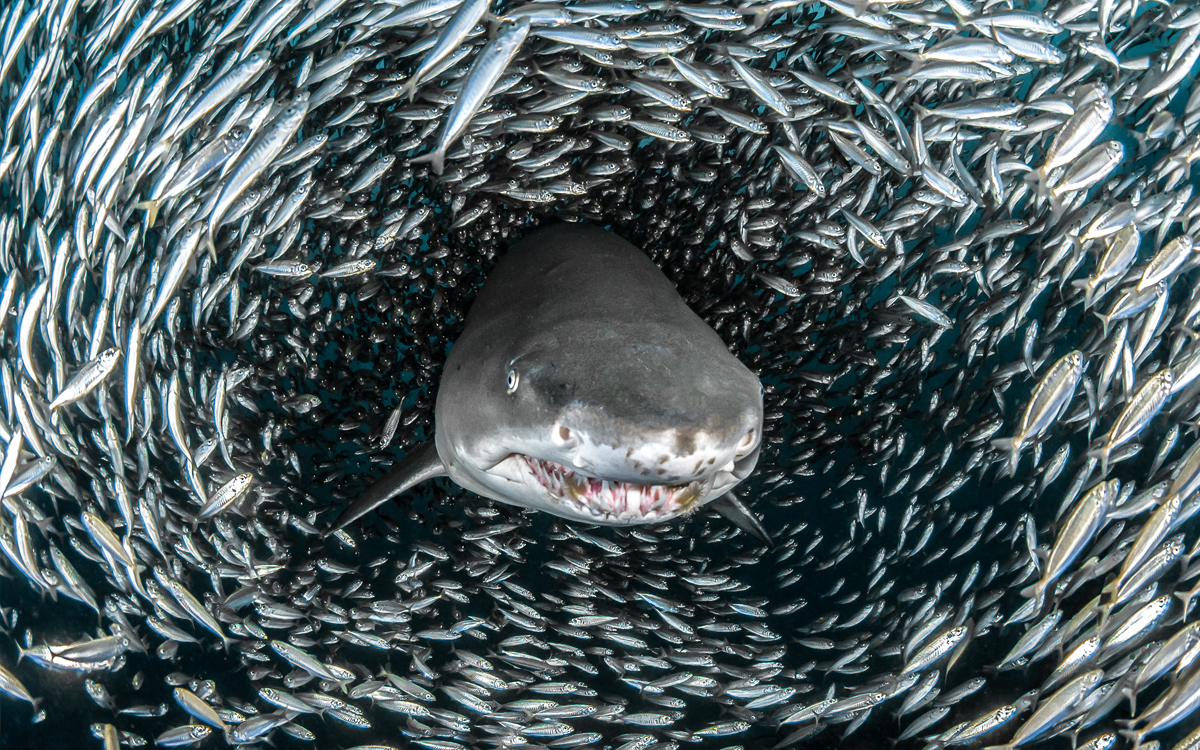
A sand tiger shark swims through a school of mackerel scad in the waters off North Carolina. | Photo by Tanya Houppermans
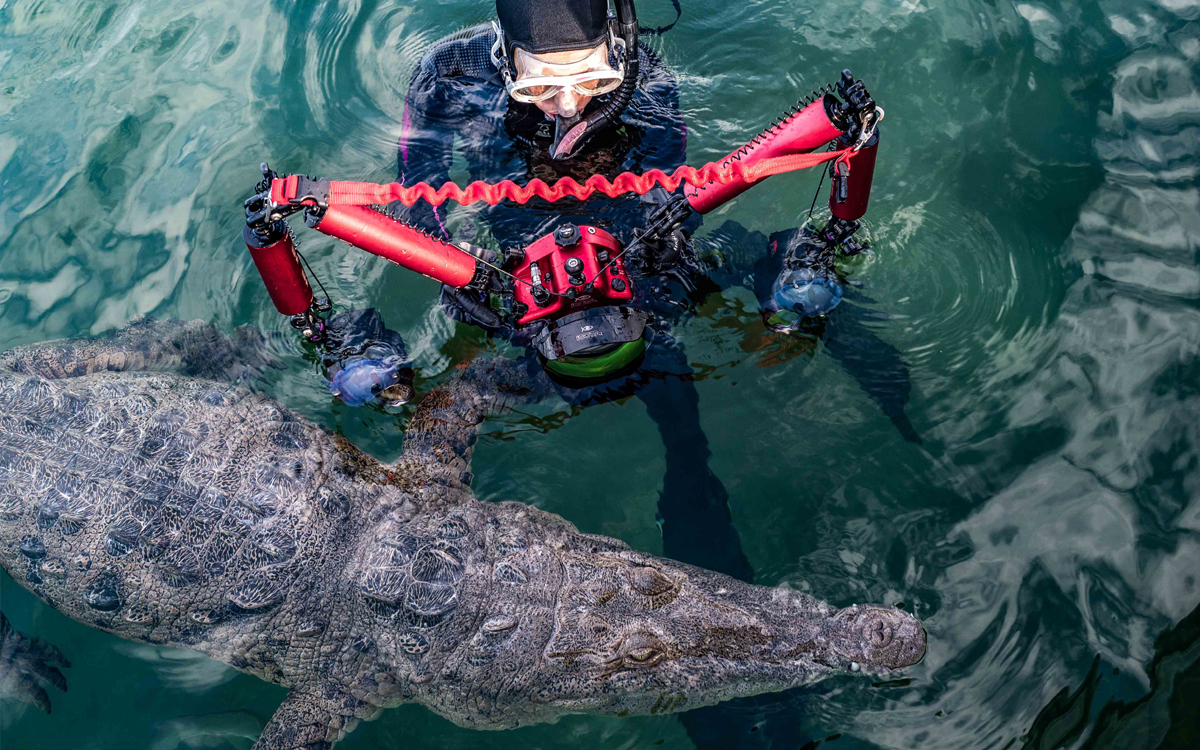
Taking an “over-under” image of an American crocodile in the mangroves of Gardens of the Queen, Cuba. | Photo by Scott Houppermans
By many measures, Houppermans appears fearless. She was once a sky-diving instructor. She has run multiple marathons in 80-degree heat. Yet growing up near the beach in Southern California, Houppermans was like everyone else who saw Jaws. As a child, she said, “I was scared to death to go into the water past my knees. So I was the last person anyone ever thought would be hopping in the water with sharks for a living.” Before interacting with any dangerous animal, Houppermans eases her fears by doing extensive research and taking careful precautions.
To create a close-up image of an American crocodile’s snout in Gardens of the Queen, a protected marine area in Cuba, Houppermans said, “I watched the crocodiles for about an hour and a half. I watched how they interacted. Then once I felt comfortable enough, I slowly got in the water and let them come to me. You have to remember, you're a guest in their home, and you have to respect that.” She knew that these crocodiles had a large food supply and would have little interest in her.
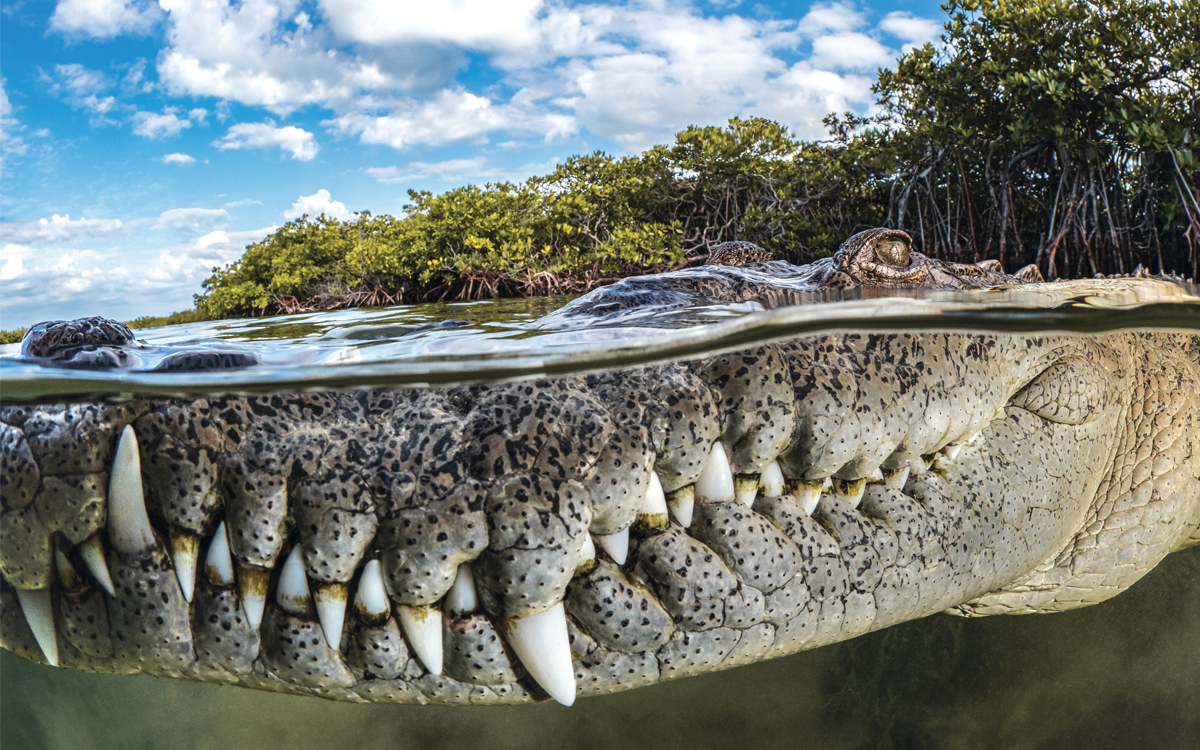
The resulting image of the American crocodile in Gardens of the Queen. | Photo by Tanya Houppermans
Houppermans’s favorite type of images are “over-unders”—split shots that show half the scene above water and half below. They’re difficult to pull off because the camera must focus on two different environments, and lighting can be tricky. Many people assume she uses a telephoto lens, but underwater photography doesn’t work that way. Instead, she uses a fisheye lens that requires her to get up close and personal with her subjects.
As science funding continues to shrink, Houppermans is now looking at another career shift, this time focusing on helping people as a physical therapist. But her passion for marine conservation and photography isn’t going anywhere. She will always be looking for original ways to capture the magnificence of creatures and their environment.
“There are plenty of shark photos with big open-gaped mouths and predation. I want to show the beauty of these animals,” she said. “Crocodiles are some of the most beautiful animals I've ever seen. Close up, their skin is like little geometric puzzle pieces that have been put together perfectly. Their eyes are like gemstones. These animals have been evolving over millions of years to be absolutely perfect in their little ecological niche. It’s incredible to see that up close and to share that with the public.”
How You Can Help
To help protect sharks, which play an important role in ocean ecosystems and the marine food web, consider supporting organizations such as Shark Trust, Shark Angels, and Bite-Back.