Forest Experts Warn Spending Bill Sets Up US Forest Service to Fail
The recently passed spending bill sets logging targets that federal officials don’t have the capacity to meet
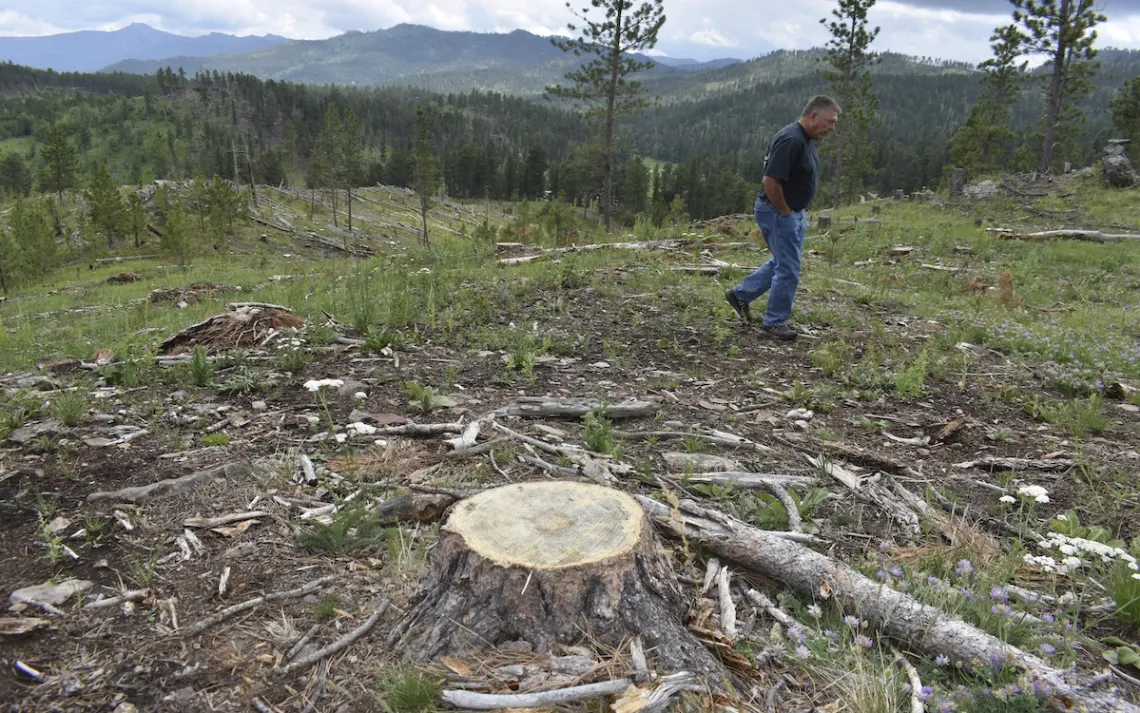
A logging site in Black Hills National Forest, South Dakota. | AP Photo/Matthew Brown
The recently passed One Big Beautiful Bill Act is likely to create a huge, ugly mess for our public lands. It mandates oil and gas leasing in the Arctic National Wildlife Refuge, requires routine oil and gas sales in eight western states and Alaska, and offers up millions more acres in the Gulf of Mexico to extractive industries.
But one of the most devastating impacts of the law will likely be on America’s forests. The new law sets aggressive timber harvesting goals and slashes spending for the Forest Service and Bureau of Land Management. Environmental advocates and industry insiders say those goals are contradictory and unworkable.
“You can’t say we’re going to increase the timber harvest then fire half the people who go out and do all the work,” said Dale Bosworth, who served as chief of the Forest Service under President George W. Bush. “The capacity for the Forest Service to do some of that work was down anyway. And when you come in and do the RIFs [reductions in force], it doesn’t make a lot of sense.”
Bosworth was one of six former chiefs who recently authored a statement decrying the staff cuts and the Trump administration’s push to sell off public lands.
“Are these drastic actions the first steps toward crippling the agencies so they cannot carry out their congressionally mandated mission? If so, they portend a cynical effort to divest and transfer federal public lands to the states and private interests,” the former chiefs wrote.
Sierra reached out to the Forest Service public affairs office several times for this piece but did not receive a response.
At over 1,000 pages, the One Big Beautiful Bill Act touches everyone from child care providers to professional gamblers to renewable energy developers. The bill—President Trump’s top legislative priority—passed by a slender majority in the House and required Vice President JD Vance’s vote to break a tie in the Senate. It expands coal and oil leases in multiple states, cuts support for renewable energy projects, and rescinds hundreds of millions of dollars in funding for numerous programs aimed at ecosystem protection, wildfire risk reduction, and climate change resilience. Additional cuts were made to the National Park Service for park maintenance, visitor services, education programs, and law enforcement.
This big, bazooka of a bill also takes aim at the 193 million acres of national forest, with a mandate, starting in 2026, to sell an additional 250 million board feet more than the previous year, every year until 2034. A similar provision sets a 20 million board feet annual harvest increase for Bureau of Land Management holdings.
The law builds on earlier Trump administration actions and executive orders to repeal the “roadless rule”—which limited tree cutting in roadless areas—and to mandate a 25 percent increase in timber sales on public lands. Another executive order targets the National Environmental Policy Act (NEPA), which requires federal agencies to review the potential environmental consequences of their actions.
“The bill certainly layers onto these executive orders to increase timber production and to gut NEPA regulations,” said Christophe Courchesne, director of the Environmental Law Center at Vermont Law School who directs a legal clinic that has challenged harvests on national forests. “I think there’s a real policy reversal from the approaches of prior administrations, and a real doubling down on this timber sale approach to public land management.”
Forest Service veterans are also concerned. Steve Ellis spent 38 years at both the US Forest Service and the Bureau of Land Management. With a career that includes work as a wildland firefighter and supervisor of national forests, Ellis lives in western Oregon and chairs the National Association of Forest Service Retirees. Like former chief Bosworth, Ellis questioned how the Trump administration can meet its ambitious goals to gut regulation, cut more trees, and simultaneously purge key staff.
Ellis said he talked to several former colleagues at the 9th Annual American Forest Congress held in mid-July in Washington, DC. “They indicated to me that since Elon Musk hit the Beltway, their staffing is down 27 to 29 percent,” he said. “This timber target, whether it’s 25 percent, 35 percent, or 5 percent—you still have to have people to get the job done.”
Despite the new law and executive orders, Ellis said the Forest Service and BLM still must follow federal laws such as the Endangered Species Act, the Antiquities Act, and the National Forest Management Act, all of which help to determine where and how management can occur on national forests. Meanwhile, public lands face new threats from climate change and development along the wildland urban interface, Ellis said.
“Just because it’s erased from the BLM and Forest Service websites isn’t going to make climate change go away,” he said. “And I think the American public knows that.”
Ellis said Forest Service chief Tom Schultz spoke at the recent Forest Congress about a new era of “cooperative federalism.” Under this concept, the Forest Service would authorize states to handle timber sales on federal land through decades-long deals. Schultz, who worked as a timber industry lobbyist for the last seven years, recently unveiled a plan for Montana to manage 200,000 acres of federal lands. At the recent Forest Congress in Washington, Schultz spoke about replicating the Montana model in 40 states.
Ellis is skeptical. “Are they literally turning the keys over to Montana to do its national forests for 20 years?”
Michael Snyder is a former commissioner of Vermont’s Department of Forests, Parks, and Recreation who served under Democratic and Republican governors. He said Schultz’s plans don’t make much sense, especially since the agency’s proposed budget would cut funds for states to manage federal land. “States don’t have the capacity,” Snyder said. “We don’t have enough [federal funding] now to do what we’re supposed to be doing.”
Environmentalists and outdoors enthusiasts—including many hunters and fishermen—successfully lobbied against an amendment pushed by Utah Republican Senator Mike Lee to sell off millions of acres in 11 western states. But while that language is gone, the bill still contains a proposal to study the sale of public land for housing. And many other, equally damaging provisions, made it into law, said Zack Porter, executive director of Standing Trees, a forest protection group based in Vermont. For example, a mandate for the government to sign 20-year timber sale contracts will essentially turn over vast swaths of public lands to private corporations, he said.
“What has gotten through under the radar of most Americans is the further privatization of public resources,” he said. “No one remembers a point in Forest Service history when there’s been so many changes coming in such a short period of time.”
‘It’s a bit of a nightmare, really,” agreed environmentalist John Rader, public lands manager at the San Juan Citizens Alliance in Durango, Colorado. “The timber provisions in particular are really shortsighted.”
From his base in southwest Colorado, Rader has watched the assault on public lands with concern and skepticism. He said no edict from Washington can change how timber markets operate in the real world.
“We mostly have ponderosa pine, and our mills have limited capacity,” said Rader. “We operate in the global market in response to demand, and those mills can only haul timber from a certain radius before it becomes uneconomical.”
Rader said his organization participates in stakeholder collaboratives with government and industry that have improved harvests on public land. “It actually gives us the opportunity to address issues before the objection period, before litigation.”
He said the collaborations have resulted in harvesting plans that cull trees from fire-prone areas. “We need to be able to manage the forest intentionally, and the timber industry is part of that,” he said. “But if we ramp up domestic production on the national forest, especially if we start cutting mature and older trees, that’s going to increase our wildfire risk. Those trees are rare, and they’re important for carbon sequestration, for watersheds; they help wildlife habitat and provide other ecosystem services.”
Everyone interviewed for this story—from environmentalists to former Forest Service chief Bosworth—agreed that the timber industry faces real problems, including an acute worker shortage and the lack of production facilities. They said the spending bill fails to address these issues.
Mandating more harvests won’t work if there’s no one to cut the trees and nowhere to mill the lumber, said Snyder, the former Vermont forestry commissioner. In addition, national forests are never going to compete with private operations, which essentially grow crops.
“The amount of timber available is not the barrier to domestic wood production,” he said. “It’s workforce; it’s closure of mills.… These [timber targets] are not the buttons and knobs to push to reignite American forestry.”