 The Magazine of The Sierra Club
The Trees That Grew Us
As Earth Month gets underway, a look back in time to how forests shaped us
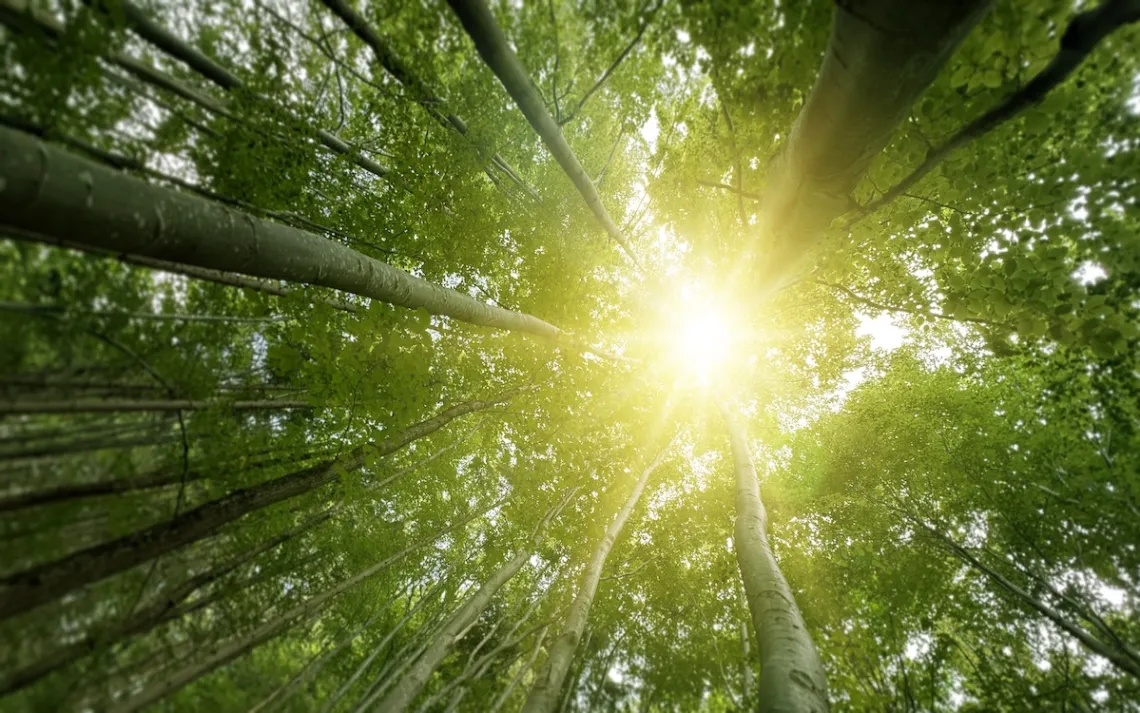
Photo by Alex Cristi/iStock
We are creatures of the forest. That fact is wrapped in our very bones.
Of course, everyone has their own intimate landscapes where they feel at home. I feel most grounded when I’m wrapped in desert silence. Out there, among the bubbly domes and canyons of slickrock, a lone cottonwood jutting up against a wedge of Jurassic sandstone is pretty far from anything that might be called “the woods.”
And yet, all the gifts of this world come to us, in some way, from the forest. Even in the way we see or the way we move. We were made by the ancestors of the trees that inhabit our planet today. With each passing year, they are increasingly at risk from human activity, whether it be deforestation, burning fossil fuels for energy, or war. At this moment of pressure and worry in our world, it is vital to think back to the relationship that allowed something like us to exist in the first place, and why it must be protected.
The catastrophic arrival of an asteroid is as good a place to start as any.
Approximately 66 million years ago, when dinosaurs were at their peak and the planet was filled with all manner of creatures, an asteroid about six miles wide struck our planet. Upwards of 75 percent of living species at the time vanished in practically a geologic instant. Some lineages, like the leathery-winged pterosaurs, were wiped out entirely. Others survived in some form. The numerous, disparate dinosaurs were shorn down to one single group, beaked birds, while all others went extinct during three years of environmental upheaval.
But this extraterrestrial impact also led to something new. The asteroid was a carbonaceous chondrite, an ancient piece of space debris with a significant amount of iron and other metals. These materials were pulverized and blasted all over the planet by the impact. In those soils, the seeds of flowering plants that survived the fires and the impact began to grow and form new forests. Not only was the composition of this new growth different—mostly made up of flowering angiosperms like magnolia and the first legumes, as opposed to the conifer and ginkgo forests of the dinosaur heyday—but they could finally begin to grow thick over a warm planet. It was in these forests, among the canopies of the Paleocene, that the earliest primates set the foundation for what we have become.
New and denser forms of forests grew tall and close in the warm Paleocene world, soaking up so much sunlight that the understory below became sparser. Nourished by Earth’s greenhouse climate and the enriched soils, plant evolution had its own big bang and, for the very first time, warm and humid rainforests began to spread over the planet’s surface. Peppers, cacao, bananas, avocados, sumac, dogbane, soursop, and more, all growing vibrantly. A perfect place for the tiny primates that survived the mass extinction.
Purgatorius—known from tiny bones that can be traced back to before and after the asteroid impact—is the earliest primate known. The mammal did not look all that much like us. The beast resembled a tree shrew, a snouty little mammal that chased through the trees after crunchy beetles and sugar-packed fruits. Such mammals had already been doing so during the dinosaurian prime, but now they could make their homes in vast, tightly connected swaths of forest bursting with new species of insects as well as plants. Early primates flourished, shaped generation by generation by the possibilities and requirements of the generous forests.
Running over tree branches can be a dangerous task, especially when grasping for skittering insects or ripe berries. The way primates moved through their new home added evolutionary pressures that, generation by generation, favored eyes that faced forward. The two overlapping fields granted primates depth perception—the ability to better gauge distances. And while the paws of early primates like Purgatorius were more like squirrel paws, being able to grab, grasp, and hold led primates to evolve thick opposable thumbs and toes that were as good for wrapping dexterous fingers around branches in the air as juicy leaves. By about 10 million years after the time of Purgatorius, lemur-like primates such as Teilhardina, which lived in the forests of the ancient Northern Hemisphere, were leaping through the trees.
The eyes that allow us to see each other are gifts from ancestors more than 55 million years old. As are the hands I’m typing this essay with—opposable thumbs handling the space bar. These critical parts of ourselves, these innate parts so essential to our perceptions and manipulations of the world, formed in the forest primeval.
Many of our ancestors and relatives stayed close to the forests even as Earth’s climate cooled and grasslands began to break up what were once semitropical forests. By about 4.5 million years ago, when the earliest humans were living in what’s now eastern Africa, they found themselves on the edges of nourishing forests that were nowhere near as vast as those of the post-impact world. Where our chimpanzee and gorilla relatives stayed close to the forest, our own ancestors took more than 60 million years of evolutionary adjustments and began to venture out onto open ground. The move, as we well know every time our backs hurt, led us to bipedalism, a new set of changes and adaptations related to walking on the ground.
And yet, we carried the gifts of the forests with us: not only our forward-facing eyes and grasping hands, but also the flexibility of our arms and shoulders. We now have the range of motion that allows us to do everything from rock climb to throw a softball to hug each other, molded by a need to grasp and climb through forests given new uses on solid ground. Look at a human skeleton and you’re looking at the top half of a tree-dweller jammed onto the bottom half of a long-distance walker. Both the influence of the forest, and our departure from it, go down to our bones.
The forests that grew us were shaped by shifts in global climate. The growing warmth and humidity allowed such dense woodlands to thrive. And yet, as we modern humans have learned, major and sudden changes to climate can also threaten life on Earth. Our thirst for burning fossil fuels for energy—the pressed and heated marine microorganisms that became oil, or the primordial swamps that transformed into coal seams—is contributing to an unstable future for life here today. Even deforestation contributes to the warmer world our species is creating. Forests offer carbon sinks that take up greenhouse gases like a sponge. The more we cut them down, the more they turn into carbon sources. We’re making a greenhouse climate, not unlike the one our earliest primate ancestors knew, but without the spread of trees that would shelter so many living things under the umbrella of their canopies. Will we look back and learn from our history, and from our relationship to the trees that helped form us, for guidance before it’s too late?
Earth’s forests have never just been stands of wood and leaves. A forest can be an accumulation of plants stretching toward the light, or a multilayered setting that shapes the lives within. A forest can be a thick line of coal in ancient rock, or a place where we can hear life sing with pings and buzzes. Our history, and our future, are twined with them. Wherever we find ourselves, wherever we feel home, we are carrying bodies molded by the trees to these places. No wonder some of us feel at home in the shadow of redwoods or strolling by cedars.