These Tiny Owls May Reveal Big Clues About Forest Health
Researchers track saw-whet owls to see how forests and creatures are responding to climate change
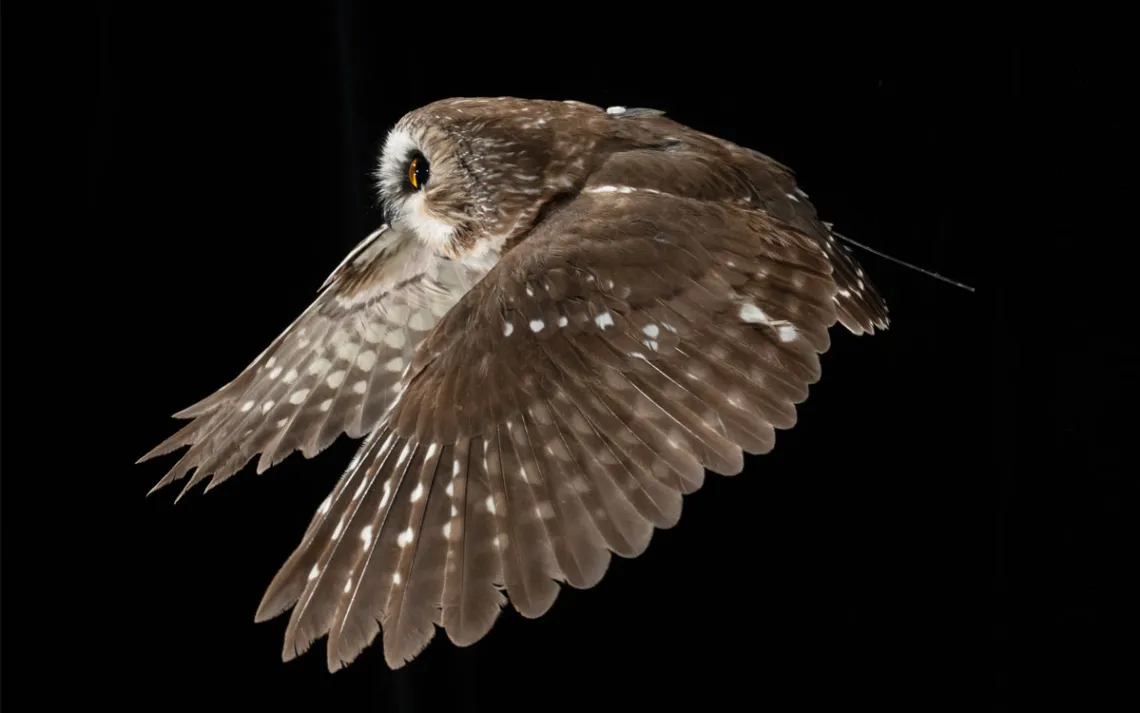
A northern saw-whet owl. | Photo by Brock and Sherri Fenton
It is rare to see woodland creatures in an urban setting. This is especially true of northern saw-whet owls, which are masters of hide and seek. Their small size (between eight and nine inches in length) makes them vulnerable to predators, so they hide during the day and hunt under the cover of darkness. To see one at all is an exciting thrill.
As such, when I noticed one lying motionless in my courtyard this past December, I knew it was an emergency. Like an investigator solving a crime, the wildlife rescuer who arrived took pictures and notes of the surroundings before leaving with the frightened, cold bird. The information obtained could provide clues about the species overall. Sightings like these can reveal information about migration patterns, habitat preferences, and how climate change is shaping their behavior and the ecosystem they rely on to survive.
On the archipelago of Haida Gwaii in northern British Columbia, for example, a subspecies of the northern saw-whet owl (Aegolius acadicus brooksi) is signaling an ecosystem under duress. Here, north of Vancouver and south of the Alaskan Peninsula, logging of mature trees has led to unprecedented habitat loss, causing a reduction in the number of nesting sites. And introduced deer have munched and trampled the forest’s undergrowth. This has affected food sources for the owl, such as mice. The results have been cumulative and dire. According to government reports, the population of this distinct subspecies, which only lives on the Haida Gwaii islands, has fallen by 40 percent since the mid-20th century.
This decline has led researchers to study their more common cousins—Aegolius acadicus. While the more common species boasts a robust population of approximately 2 million throughout Canada and the US, the information gleaned could help these owls from experiencing the same fate as their endangered kin. “Even though they're a common species, you don't want to just dismiss them,” said Emily Buck, the program and engagement coordinator for the Long Point Bird Observatory (LPBO) on Lake Erie. “You still need to look at those species because if they’re common, that means that the habitat left must be healthy, and then that's habitat for less common species.”
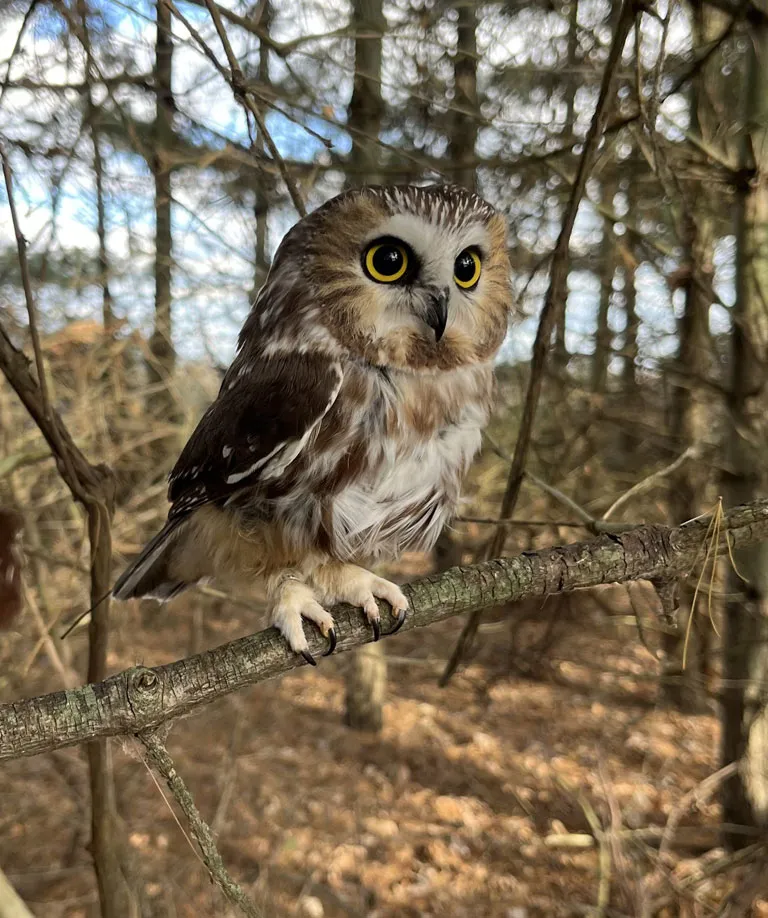
A northern saw-whet owl. | Photo by Emma Buck
To unravel the secrets of the northern saw-whet owl, a group of researchers started Project Owlnet in 1994. The network consists of 125 banding stations spread across North America. “The purpose of Project Owlnet is to collaborate,” Buck said. “So, we're not just looking at Long Point’s data; we're looking at everyone’s data so you can get a better picture of what's happening.”
The work of collecting that data often begins on cold, frosty fall nights during the owl’s migration cycle. At the LPBO, staff set up nets and turn on recordings of their calls to attract them. Each owl receives an aluminium leg band stamped with an identification number. When a bird is recaptured, researchers can look up the number on a central database and see how far the bird has come. One owl recaptured in Pennsylvania was originally banded 1,500 miles away in Alberta.
Some bands have transmitters, which show the routes the birds are taking during migration. The information is available for anyone to see through MOTUS, an international research community that allows the public to access the data gathered. Tracking has unlocked many of the owl’s secrets. Juvenile owls, for example, often migrate later than adults. Meanwhile, males remain on or near their breeding territory, while females migrate in greater numbers over distances.
Whether the owl is an indicator species for forest health is something Randy Lauff, a lab instructor at Nova Scotia’s St. Francis Xavier University, who has focused his research on northern saw-whet owls, questions. “To the best of my knowledge—and I don’t think this has been directly tested—forest health cannot be predicted by the abundance of northern saw-whet owls,” he said.
However, one of the most interesting things about a northern saw-whet owl is its dependence on woodpeckers. “They nest in cavities,” Lauff said. “So there typically had to have been a large woodpecker (such as northern flicker or pileated woodpecker) around somewhere in the last few years.”
This arrangement can cause ecological tension, as both species compete for resources in a crowded housing market. Ironically, the northern flicker population has declined due to competition for nesting cavities and habitat loss, and without the woodpeckers to build the saw-whet’s home, the owls may be rendered homeless.
Climate change is amplifying and accelerating these threats to the owls' success. As temperatures warm, summers last longer, and spring arrives earlier. Birds are adapting by altering their migration times—leaving later or arriving earlier. Using banding data, researchers have learned that the peak fall migration time of the northern saw-whet owls in Alberta has shifted one to two days later per decade since the early 2000s. These changes may seem small, but if the raptor arrives too late in the autumn and snow falls, they may find it harder to hunt. This, in turn, limits their ability to act as a natural pest control, since they can kill up to six mice a day. And this, too, has an impact since hunting prevents rodent populations from taking over the forest. Buck described how, during a cold winter, LPBO staff will find raptors who have starved, unable to locate food sources, such as voles or mice, under the snow.
These connections between food sources and owl health culminated in the outcome of the tiny owl in my courtyard. The wildlife rescuer said it may have been hunting and dove toward the concrete stairs to grab its prey, but instead rammed the stairs, knocking itself out. Alternatively, it may have struck a window. A reminder, Buck said, to have window stickers that warn birds of danger. The little owl didn’t have a leg band indicating where it was last seen and sadly succumbed to its injuries.
The wildlife rescuer noted that it was probably living in the nearby forested park. Finding the owl could also indicate that the area is a wintering habitat for the saw-whet. “Everyone's looking at their breeding range, making sure they have enough breeding habitats, but people have also got to think about their wintering,” Buck said. “That's another reason for tagging them. So we can look where they are going in the winter and try to protect those habitats as well.”
Lauff agreed, noting that long-term monitoring now may help the owl later. “To create a recovery plan for an endangered species, we have to know its biology,” he said. “And that’s easier to do if we do it before they’re endangered.”