Glowing Plankton Light the Way
A nighttime kayaking trip leads to a world of one-cell wonders
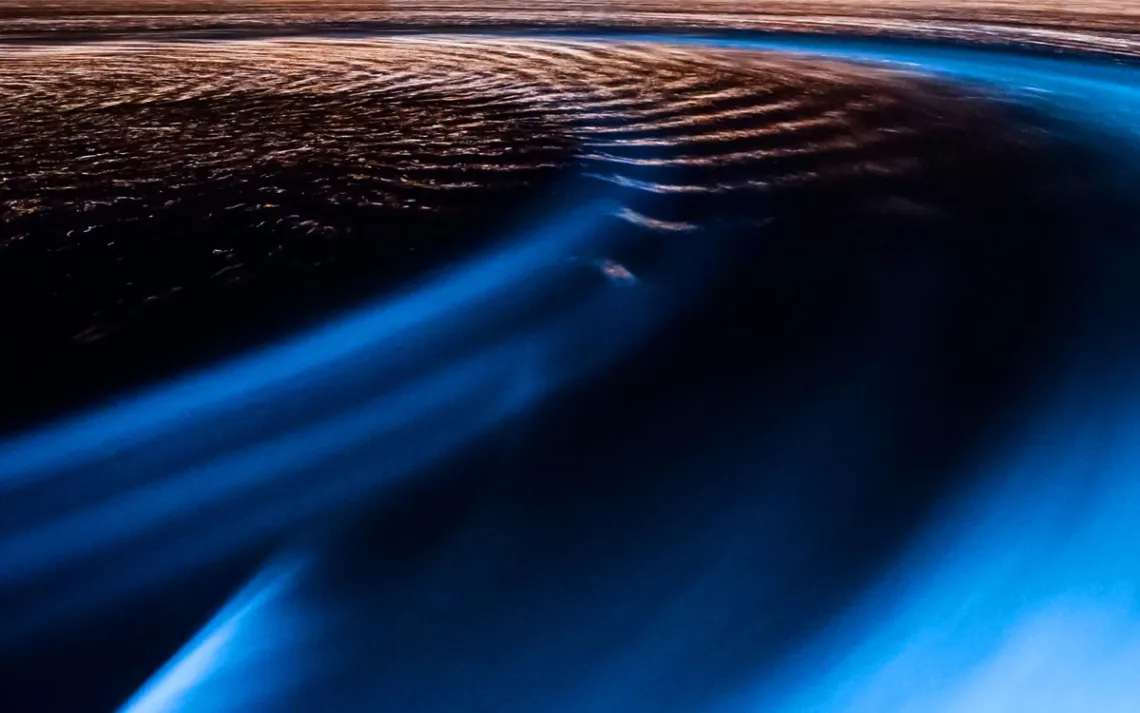
Water glistening in a lagoon filled with dinoflagellates. | Photo by GummyBone/iStockphoto
In the fading light of one evening this past January, I embarked on a journey to witness one of the wonders of the natural world. I was joined by my husband and two adult sons as we glided on two-person kayaks through the waters of Laguna Grande, a bay at the tip of Puerto Rico’s northeastern corner. With only a blinking scarlet light secured to the kayaks in front of us, we snaked along tethered to guides.
Hundreds of bays carve the perimeter of Puerto Rico, but curiously, only Laguna Grande and two others are consistently filled with bioluminescent organisms that light up the waters at night. As I paddled along with my youngest son, Ryan, I wondered about this aberration; was it a random act of nature or something more complex but explicable?
As sunset faded into twilight and twilight into dusk, our paddles rhythmically sliced the water while night creatures turned up their volume. Like 2 a.m. barflies seeking companionship, the persistent call of tiny coqui frogs cried out: “Ko-kee! Ko-kee!” The high-pitched chirp of the night heron created even more ruckus while the nearby plunk of a jumping tarpon startled everyone in the vicinity. One girl cried out, then nervously laughed when told it was just a fish.
Overhead, giant mangroves linked their sinewy arms with those of the trees on the opposite shore, providing a canopy under which to glide. It was coal black, with illumination from the stars blocked by the canopy. We followed each other one by one through the curves and around the bends. At one point, our blinking beacon went wayward, its human navigators missing a turn and winding up entangled in the branches along the shore. Slapping back the branches and using our might to push away from the bank, Ryan and I waited for the kayak cop to pass, then zipped ahead to join my husband, John, and older son, Will.
As we paddled on, Ryan's silhouette slowly grew brighter, and I could now make out several kayaks in front of us as the canopy of mangroves receded to the background. A faraway, starry dome opened above. I realized that the channel, and we along with it, were spilling into Laguna Grande, our destination. Paddling to the lagoon’s center, we gathered near our guide, who introduced us to the glowing plankton we would soon see.
Known as dinoflagellates, these popular little lagoon denizens are single-celled phytoplankton that, through a chemical reaction, respond to movement by glowing. While bioluminescence occurs worldwide, the magnificent marine light show happens consistently in only five places. Puerto Rico is home to three.
While our guide educated us on some basic facts, I still didn’t understand why three Puerto Rican “bio bays,” as they’re known colloquially, are more conducive for the plankton. I would later learn more from a local expert.
The unique quality of the bio bays is due to a “complex system and a combination of factors, “ said Maria F. Barberena-Arias, an associate professor at Inter-American University of Puerto Rico. Present in all three are mangrove trees that encircle the water. Each of the three is also enclosed, allowing the plankton to accumulate. Additionally, the condition of the water and the interaction of the water and the mangroves likely impact the concentration of dinoflagellates, Barberena-Arias added.
Even within these three bio bays, variations in the concentration of dinoflagellates can occur due to seasonal changes and natural events. For example, in 2025, a macroalgae called sargassum inundated Laguna Grande. After dying, it decomposed, depleting the bay of oxygen and causing the dinoflagellates to die. The result was no bioluminescence for several months.
Humans impact the bio bays too. Each of the three bio bays is managed differently, according to Barberena-Arias, and as is true with ecotourism, human interaction comes at a cost. Laguna Grande has moderate restrictions; the lagoon can only be accessed by kayak or small boat through a tour operator. La Parguera is less restrictive, allowing larger boats and swimming in its waters, which “sometimes impacts the organisms,” Barberena-Arias said. In contrast, Vieques Bio Bay, the most luminous, is also the best preserved. The Vieques Conservation and Historical Trust and the Puerto Rico Department of Natural and Environmental Resources, which co-manage the bio bay, restrict movement in its waters and provide training to tour operators before access is allowed.
Still, Laguna Grande, along with La Parguera and Vieques Bio Bay, continues to provide the richest habitats for the organisms.
Toward the end of our tour, I dipped my arm into the water, and as if my fingers had turned into magic wands, bluish-white sparkles trailed in their wake. Like a sorcerer, I traced curly cues in the water, and poof! Tiny sparkles appeared. I swiped my arm broadly. A glowing current swooshed behind.
The sky was practicing its magic too. The twinkling stars and planets were as bright as the water below. Our guide helped us identify Saturn, Jupiter, Orion, and the North Star. The thinnest of layers, our very being was sandwiched between the immense mysteries above and below. Only at nighttime—and the darker the better—did these life forces come alive to our senses. Ryan and I kicked up our feet and floated. Rocked by the lagoon’s gentle waves, my kayak cradled me as I gazed upward.
Staring at the faraway planets, the beckoning stars, and the human-faced moon, the depth of the universe—its unknowable immensity—made me feel tiny, an insignificant product of evolution’s complexity. And yet, these creatures (one-celled!) below the surface of the water entice people from around the world with their simple ability to glow.
While the heavens above reminded me that I am but a speck in this universe, a sea full of teeny creatures spoke to me of my bigness. I silently prayed that my sons, readying themselves to launch, were considering their important places in the world too.
I glanced over at Will, his arm slung over the edge of the kayak, studying intently the one-celled critters below. I learned about others his age who were also studying them. Centro TORTUGA (Tropical Oceanography Research Training for Undergraduate Academics), founded in 2016 by Maryland Sea Alliance, in partnership with several universities, provides opportunities to undergraduates in Puerto Rico, as well as the US mainland, to explore coastal science.
“Even in Puerto Rico, you can find people who have never seen bioluminescence,” Barberena-Arias said. “So, by opening that door, they go there, see, and then go back to their families and communities and talk about it.”
Ending our journey, I reluctantly began paddling. As we crossed the lagoon, I watched as the eddies sliced by our paddles created whirling glitter in the dark water. Re-entering the channel, the glitter dimmed, and the stars retreated from view. Nature's light behind me, I had only a red blinker to once again light my way.