As Shutdown Drags On, Public Lands, Programs, and Jobs Hang in the Balance
The longer federal agencies are shuttered, the more the damage will spread
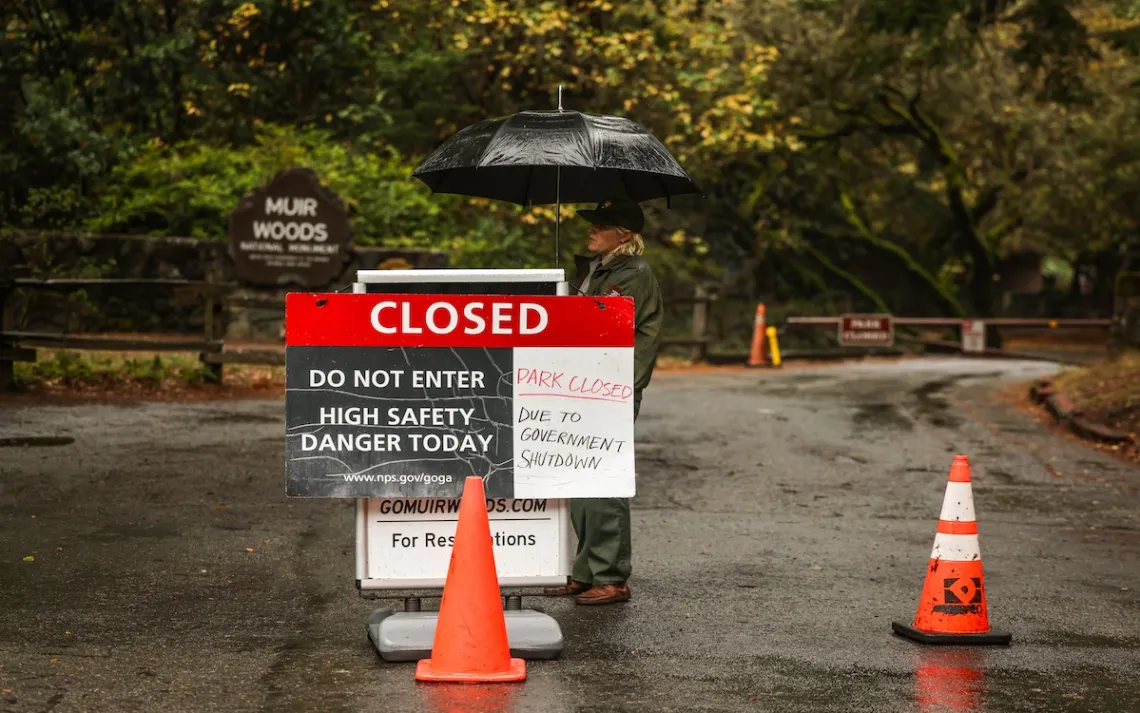
Photo by Gabrielle Lurie / SF Chronicle / via AP
About halfway through the first Trump administration, Stephen K. Bannon, former White House chief strategist, explained to me that the president’s aim was to flood the zone—to overwhelm his political opponents, including, of course, the media, with a storm of policy announcements and moves.
Or, as another White House staffer explained to me, “What you see as chaos is our method.”
The government shutdown that began last Wednesday after Congress failed to agree on a federal funding deal has been a perfect illustration of that approach. President Trump has promised to eliminate “Democrat agencies” wholesale—a nod to the Project 2025 program of gutting everything from the Environmental Protection Agency to the Department of Education—while budget chief Russell Vought has threatened mass layoffs of federal workers and canceled federal funds that were already appropriated by Congress.
Much of this may be illegal. Some of it may be counter to Trump’s own agenda. Still, the administration appears to believe that the confusion will ultimately redound to its benefit.
According to Jacob Malcom, a former Interior Department official, the devastation will be widespread—and felt by millions of Americans. “So much for family camping trips, so much for learning about our history ... and so much for the science that is critical to making decisions for all those lands and many other lands.”
Here is a guide to what the administration has—and hasn’t—done so far as the shutdown nears its one-week mark, with no signs that a resolution is at hand.
The national parks
During the 2018-19 government shutdown, national parks stayed open, though bathrooms overflowed and sensitive sites were vandalized. Parks are open this time around too, operating with only a fraction of their normal staffing. Keep in mind that those staffing levels had already been under assault from the administration, which fired 1,000 park workers in February (the workers were supposed to be rehired, pursuant to a court order, but it is not clear that the Trump administration has complied).
About two-thirds of the 14,500 people who work at the National Park Service have been furloughed, meaning that they are temporarily out of work. Given that the NPS manages 85 million acres of land across 433 different sites, from rugged Yosemite peaks to the National Mall in Washington, DC, and that its remit includes scientific research, educational programs, trail upkeep, rescue operations, and wildlife management, operating at bare-bones levels could have enormous impacts.
Other public lands
The US Forest Service manages 193 million acres of public land, which includes 154 national forests and 20 national grasslands. The Bureau of Land Management, meanwhile, looks after 245 million acres, nearly all in Western states.
The BLM’s contingency plan for a shutdown calls for furloughing close to half of its 9,250 staffers. “While it is our goal to provide visitors access to public lands, we cannot provide a full range of services at all locations,” the plan says.
High Country News reports that the Forest Service has halted wildfire prevention work.
Malcom pointed out that the nation’s 570 wildlife refuges, which are run by the US Fish and Wildlife Service, would also suffer. “There will be enough staff to protect buildings, but all the work of managing those lands for fish and wildlife will basically halt,” he wrote. “Nature loses out, people lose out.”
“During the last prolonged shutdown, we saw an increase in vandalism, damage to sensitive resources, and disrupted visitor services. This year we could see even greater impacts,” Jackie Feinberg, the National Lands Conservation campaign manager for the Sierra Club, said. “Public land agencies were already stretched thin from DOGE cuts, and shutdown furloughs will mean there are even fewer federal workers to maintain trails and recreation sites, safeguard wildlands and cultural areas, remove trash, and ensure the safety of visitors.”
Environmental regulations
Environmental Protection Agency administrator Lee Zeldin has spent the last nine months dismantling the agency—and the shutdown seems to present him with an opportunity to keep taking apart the framework for keeping the nation’s land, water, and air free of pollutants (something Trump has said he would ensure, though it’s not entirely clear how).
At first, it appeared as if Zeldin—someone who has no experience in either environmental regulation or high-level corporate management—had furloughed about 89 percent of the agency’s staff. But then it appeared that nearly all those staffers were called back to work.
“Workers at the EPA are highly confused by the behavior of this administration,” an official for a union representing government workers told The New York Times.
Green energy
As soon as the shutdown began, the Department of Energy—now headed by billionaire oil and gas entrepreneur Chris Wright—cut nearly $8 billion in clean energy projects across 16 blue states.
Budget director Vought, one of the chief architects of Project 2025 and a Christian nationalist, wrote in a social media message, “Nearly $8 billion in Green New Scam funding to fuel the Left's climate agenda is being cancelled.”
In its contingency plan, the Bureau of Ocean Energy Management, which is part of the Department of the Interior, said that work would continue on “priority conventional energy projects,” meaning those related to extraction and transport of oil and gas. At the same time, the agency would “cease all renewable energy activities.”
In general, oil and gas permitting is expected to continue despite the shutdown.
What’s next
Trump is now threatening to nullify back pay for furloughed federal workers, despite having signed a law in 2019 that makes such back pay mandatory. Meanwhile, millions of acres of public lands are threatened by the real possibility of misuse or neglect.
How bad will the damage get?
“It’s probably too early to say,” said Kurt Repanshek, editor of National Parks Traveler, a parks-themed news site.
But for many, it’s not too early to worry.