How to Predict an Avalanche
Here’s a look at the science behind preventing catastrophe on the slopes
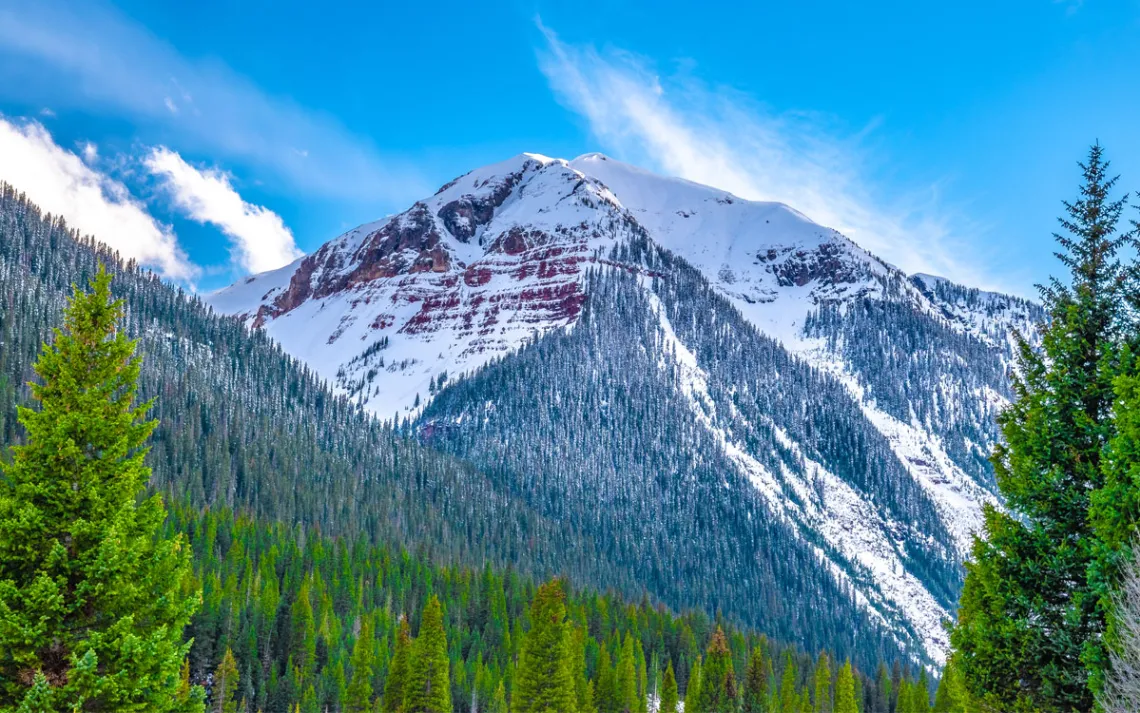
Evergreens framing a mountain peak in Silverton, Colorado. | Photo by iStockphoto/Jeremy Janus
An avalanche once buried Keith Roush to his waist. As an avalanche ski patroller, he was able to use his radio to call for help. But the event highlighted that even experts get into trouble.
“I’ve been playing in the snow professionally since ’69,” said Rouch, who lives in the San Juan Mountains in southern Colorado. Over subsequent decades, he added avalanche instructor, search-and-rescue volunteer, and outdoor gear specialist to his list of professions. Now retired, he serves on the board for the Center for Snow and Avalanche Studies in Silverton, Colorado.
Rouch co-led a snow science event this past January, hosted by the San Juan Mountains Association and Mountain Studies Institute. He and other instructors fought to stay upright against the wind as they taught residents about avalanche safety and Colorado’s mountain snowpack, the layers of snow that accumulate over the winter. He lamented how little people understood snow behavior when he first started working several decades ago. Thanks to the work of industry pros like him, that has started to change.
However, the tragic loss of lives this winter in California, Utah, Idaho, Wyoming, and Washington underscores how, even today, a day of fun and exploration can turn disastrous. Warming temperatures and an increase in weather variability are making it harder to predict snow behavior, just as more people than ever are hitting the slopes. With so much riding on how researchers assess the snow, snow experts say it’s important for the public to understand how avalanches are predicted.
“We want people traveling in the backcountry to have the best information possible,” said Ethan Greene, an avalanche scientist and meteorologist, in a January press release from the Colorado Avalanche Warning Center (CAIC). And part of this is understanding what goes into making predictions.
The center issued the country’s first public avalanche forecast in 1973, when it was known as the Colorado Avalanche Warning Center. Greene, who is the CAIC’s director, said that scientists must predict avalanche risk for a given day, week, and even entire season. They do this by using high-tech weather stations and computer-based weather models to track snow and weather conditions.
One of their primary tools is the snow telemetry (SNOTEL) station, which tracks real-time snow depths, temperature, and snow-water ratios as snow falls. These “snotel” stations, as researchers call them, are solar-powered and networked to one another throughout the mountains, creating real-time snapshots of what conditions look like across landscapes. In total, there are hundreds of them across the West. Scientists are able to use the data collected from these stations to run computer-based simulations of how the snowpack might evolve through the winter.
But sometimes, going outside to poke and prod the snow can tell researchers just as much as fancy equipment, said Greene. Students at the snow science event this past January did some of that manual work by digging a snow pit, a deep hole in the snowpack that allows forecasters to study its layers. Using their eyes, gloves, fingers, fists, and even pencils, participants were able to check the stability of each layer of snow.
It seems old-fashioned, but snow pit analysis is critical for forecasting. It’s from within these dug out holes that forecasters from CAIC release video updates about Colorado’s live snow conditions. It’s one way that they’re able to provide viewers, near and far, a window into the science behind avalanche prediction, giving the public a vital tool to assess conditions for themselves.
Colorado’s snowpack, especially in the San Juan Mountains, is notoriously riddled with weak layers, and the student’s snow pit showed this. These layers often consist of snow crystals that are structurally altered by high elevation, frequent sunny weather, and cold nighttime temperatures—the combined effects creating a recipe for frail snowpack layers. On a slope, these layers can fracture when new snow adds weight. Roush likened it to a cake with meringue. When tilted, the heavier cake layers will slide from the weaker meringue layers.
He also said that snowpack stability can differ from section to section, especially in the San Juan Mountains, where the terrain is steep and complex. “That’s what gets recreationalists in trouble all the time,” he said. It’s also why he pokes his ski poles deep into the snow as he heads up a slope he wants to ski back down. He’s probing for changes that indicate danger.
However, one of the most robust tools has historically been using past events to predict future events. Yet climate change is throwing this vital practice out of whack. Colorado’s climate is warming fast, especially the western portion, including the San Juan Mountains. This past winter saw temperatures that were 30 degrees higher than normal in some towns. Temperature spikes like the ones that occurred this past winter increase avalanche risk.
Greene noted that events are happening in Colorado that are outside of what he and colleagues, present and former, have experienced before. In 2019, for example, CAIC recorded more than 1,000 avalanches in two weeks, including an abnormally high number of large ones. Some avalanches were the biggest the CAIC staff had ever seen.
The extent to which this extreme avalanche cycle can be attributed to climate change remains unclear. It’s challenging to disentangle the influence of climate warming from that of long-established weather patterns. One of them is this year’s La Niña, a weather phenomenon that influences temperatures and precipitation globally. This is partly because they’re not independent of one another, and such complexity complicates predicting what’s to come in any given winter.
Despite this variability, experts like Roush caution that avalanches are here to stay. And forecasters are continually working to perfect the art of getting people out of the way. Advanced warnings, new technology, and a greater understanding have all led to fewer lives lost. Continued rapid advances and expanding educational opportunities, like the snow science event, are meant to better prepare forecasters and the public for what comes next. This is good news for everyone who spends time in the snow, be it snowboarding at a resort, skiing in the backcountry, or driving over mountain passes.
For many in Colorado and other mountain states, the high country is home on a deep level. Roush sums it up perfectly: “This is my backyard.”