Hurricane Melissa Is a Reminder of Our Dangerous New Reality as the Climate Crisis Accelerates
Scientists warn that “we are now pushing the limits of extreme rapid intensification”
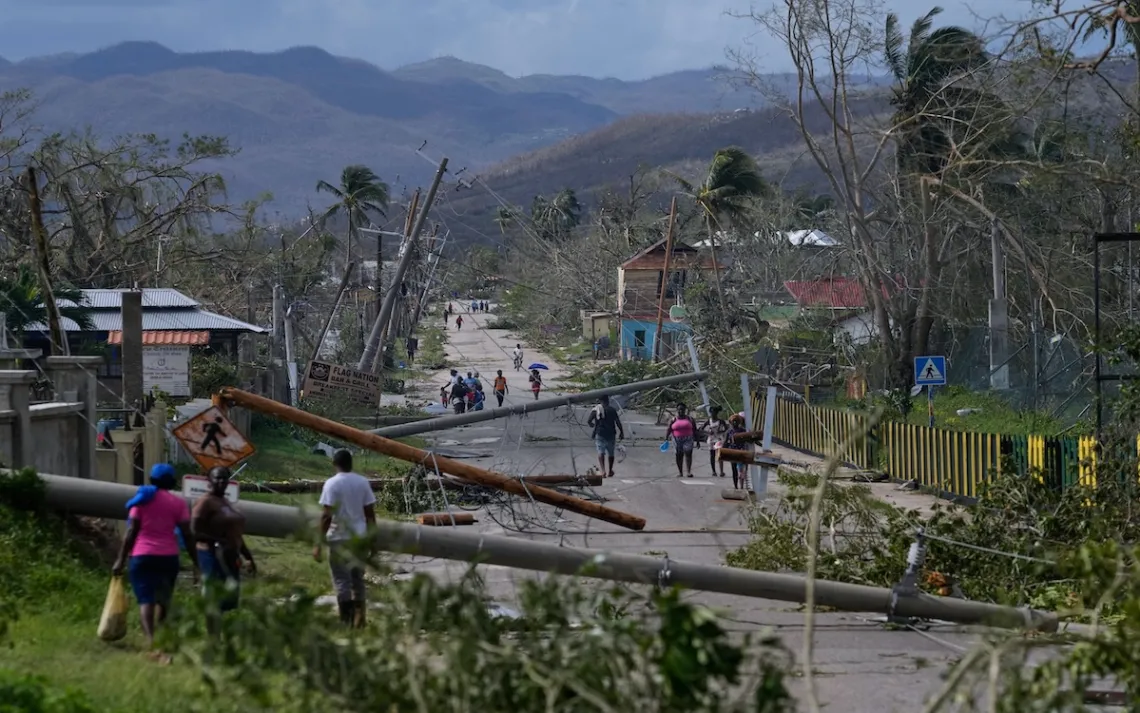
Residents walk through Lacovia Tombstone, Jamaica, in the aftermath of Hurricane Melissa on October 29. | Photo by Matias Delacroix/AP
When Hurricane Melissa slammed into Jamaica on October 28, it unleashed torrential rainfall, life-threatening storm surge, and catastrophic winds that reached a peak speed of about 185 miles per hour—making it among the most intense storms ever to make landfall in the Atlantic basin. The human toll has become clearer with time: Dozens dead, tens of thousands more displaced, and widespread damage to homes, farmland, infrastructure, and livelihoods.
These types of massive storms—and the devastating impacts that result—are a sign of what is in store as the fossil-fueled climate crisis accelerates, scientists warn.
“Manmade climate change clearly made Hurricane Melissa stronger and more destructive. These storms will become even more devastating in the future if we continue overheating the planet by burning fossil fuels,” said Ralf Toumi, co-director of the Grantham Institute–Climate Change and the Environment at Imperial College London.
Researchers examining the influence of anthropogenic climate change on Melissa estimate that it amplified the storm’s maximum wind speed by 7 percent (11 miles per hour) and rainfall around the center or eye wall by about 16 percent, while increasing economic damage by 34 percent. Damage costs are likely to be over $7 billion in Jamaica alone, which equates to more than a third of the country’s GDP.
The science is clear that climate change is supercharging hurricanes, which gather strength as they move across warmer waters. Oceans absorb over 90 percent of Earth’s excess heat, providing fuel for storm systems that are becoming more intense and destructive as the climate heats up.
Oceans absorb over 90 percent of Earth’s excess heat, providing fuel for storm systems that are becoming more intense and destructive as the climate heats up.
That is precisely what happened with Melissa, which started out as a tropical storm before it exploded in intensity as it traveled across exceptionally warm Caribbean waters, ratcheting up to a Category 4 within 24 hours. Meteorologists use the term rapid intensification to describe the increase in a tropical cyclone’s maximum sustained winds by 35 miles per hour within a 24-hour period. In the case of Melissa, its wind speeds of 70 miles per hour doubled in just 18 hours.
“We are now pushing the limits of extreme rapid intensification, which is 58 miles per hour [increase] in that 24-hour segment,” Bernadette Woods Placky, chief meteorologist at Climate Central, said during a press briefing. Melissa made landfall in Jamaica as a Category 5 hurricane with maximum sustained winds of over 180 miles per hour.
“Hurricane Melissa's catastrophic landfall in Jamaica is not an anomaly; it is the canary in the coal mine,” said Jayaka Campbell, senior lecturer at the University of the West Indies in Jamaica and coauthor of a new study examining the influence of climate change on the hurricane. “When a storm can explosively intensify from 70 to 185 mph in less than three days over ocean waters that are around 1.5°C warmer than normal, we are witnessing the dangerous new reality of our warming world.”
The above-average ocean temperatures along the storm’s path were made up to 900 times more likely by climate change, according to Climate Central.
Scientists working in a field known as climate attribution are able to discern the role that climate change plays in specific extreme weather events. World Weather Attribution, an international collaboration that conducts these analyses using peer-reviewed methods, typically is able to release their findings within a week or two of an extreme event like a major storm or flood. Last year, for example, WWA reported in the wake of Hurricane Helene—the deadliest hurricane to hit the United States since Katrina in 2005—that climate change made the storm’s rainfall about 10 percent heavier and its winds some 11 percent more intense.
The collaborative’s attribution study of Melissa, released last week, similarly found that climate change influenced the rainfall and wind speeds and that it made the conditions under which the hurricane developed about six times more likely.
“This study found all aspects of this event were amplified by climate change,” Ben Clarke, researcher at Imperial College London and lead author of the analysis, said at a press briefing. “We’ll see more of the same as we continue to burn fossil fuels,” he added.
“What we see with Hurricane Melissa and other recent monster storms is that they are becoming so intense that they will soon push millions of people beyond the limits of adaptation.”
Hurricane Melissa’s damage was not limited to Jamaica, as it also impacted other Caribbean islands such as Cuba and Haiti. In Cuba, the storm affected more than 60,000 homes, and over 120,000 people remained displaced more than a week later, Arnoldo Bezanilla, a researcher at the Center for Atmospheric Physics in Cuba, told reporters. He said it would take years to recover from the severe damage.
In Jamaica, the destruction from the strongest hurricane to ever strike the island has been staggering. “It was catastrophic loss and damage,” Una May Gordon, former principal director of climate change for the government of Jamaica, said during a press briefing on Monday at the start of the COP30 UN climate summit in Belém, Brazil.
“Within a day of Melissa’s passing, Jamaica became the world’s symbol of climate devastation,” Gordon said. “I am here to ask, where is the accountability? I am here to ask, who should pay?”
Such questions are becoming even more salient with scientists warning that, in an era of increasingly severe climate-fueled disasters, adaptation has its limits.
“What we see with Hurricane Melissa and other recent monster storms is that they are becoming so intense that they will soon push millions of people beyond the limits of adaptation,” said Friederike Otto, a climate scientist who leads World Weather Attribution. “Unless we stop burning coal, oil, and gas, we will see more and more countries reaching these limits.”