New Cub Offers Hope for Jaguar Conservation
A Mexican state just south of Arizona has a new jaguar family
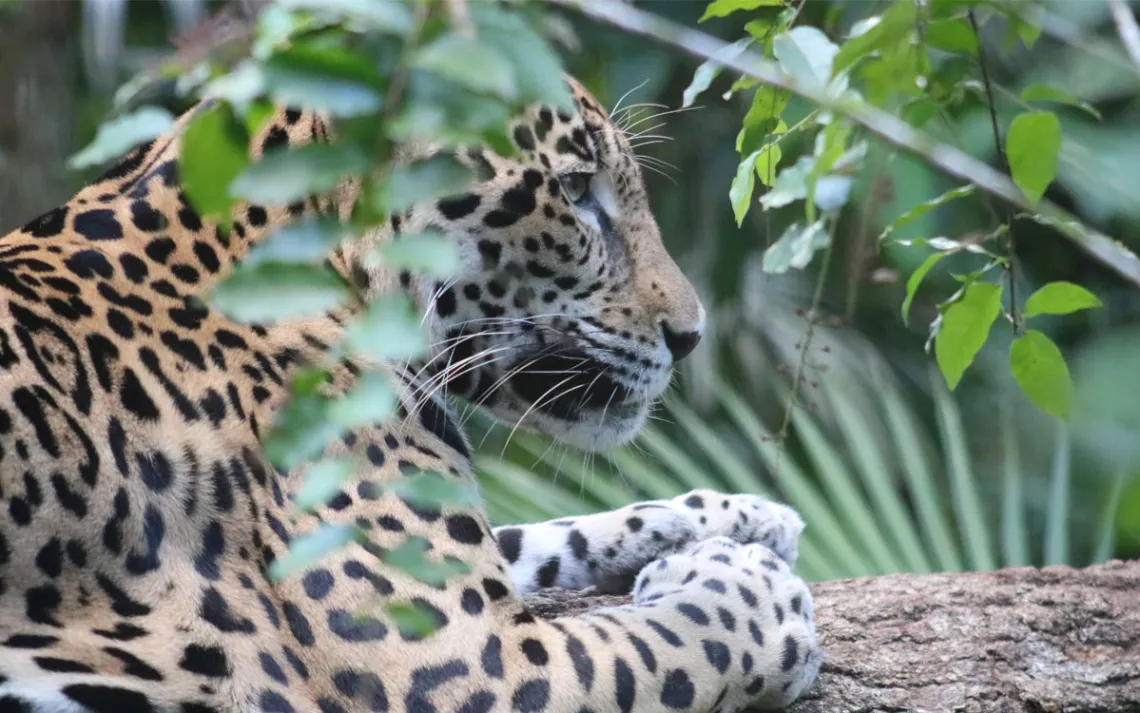
A jaguar relaxes on a branch. | Photo by Levi Novey/USFWS
In March 2025, residents of a small ranching and agricultural community in rural northern Mexico caught a big, muscular cat on their CCTV cameras. To raise the alarm, they contacted Carlos Castillo, the Northwest Mexico program director at the Wildlands Network, a nonprofit focused on reconnecting wildlife habitat on a continental scale. Castillo is responsible for coordinating relationships with landowners and monitoring wildlife on their lands. However, even he was stunned by the sighting. Jaguars hadn’t been seen in the area in almost 40 years.
He alerted his colleague, Juan Carlos Bravo, a senior adviser of transnational initiatives at Wildlands. Bravo assumed it was a roving male, doing what male jaguars often do—wander. They thought perhaps that the adventurous cat had left the Northern Jaguar Reserve, a 56,000-acre protected area in northern Mexico. Perhaps that cat was exploring new territory. But they couldn’t be sure.
To solve the mystery, Castillo and a Wildlands volunteer followed up the next month by placing four cameras in the area where the image of the male cat was recorded. However, soon after, a second jaguar appeared. It was a female with a distinctive pizza slice rosette just behind her right shoulder. The two delighted in the fact that the male might have a potential mate.
Three months later, Juan Haro, a Wildlands field technician, visited the site and added additional cameras. When Haro returned to retrieve the memory cards, serendipity struck again. His camera had captured an electrifying new image.
What seemed to be a cub popped into the frame. The photos showed the young jaguar alertly surveying the area. It had a large head, a slender body, and an unforgettable rosette pattern with two unusual horseshoe spots on its left flank. Behind its left shoulder was an oversized oval rosette with two small dots inside (jaguar markings are unique to each cat).
After scrutinizing the photos and focusing on the head-to-body ratio, Bravo and Castillo were almost certain it was a cub.
“I had to look at the pictures again and again to make sure I wasn’t being misled by my enthusiasm,” admitted Bravo. “Not in my wildest dreams did I ever think we’d capture a cub on camera.”
To be certain his excitement hadn’t led him astray, Bravo consulted with Carmina Gutiérrez, a research coordinator for the Northern Jaguar Project. Gutiérrez confirmed the assessment.
Although the perambulations of Sonora’s rare jaguars are largely a mystery, even to the biologists who study them, it was clear to Bravo and his associates that these three jaguars were not just passing through. The Wildlands staff gave them Indigenous Yaqui names. The male named Kawi (Mountain), the female Ania (Foster, as in fostering the next generation of jaguars), and their offspring, Naawa (Root), perhaps nine months old and still under its mother’s watchful eye, were unquestionably resident jaguars and not transients. Ania was the key to determining whether the cats were residents.
“Males ramble, but females just don't move as much,” said John Polisar, a wildlife conservationist who has worked on jaguars for 30 years. “They stay close to where they started.”
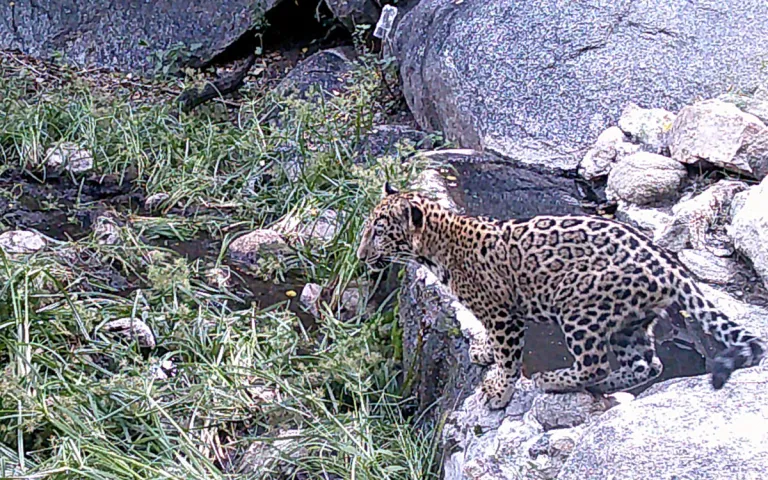
Naawa preparing to take a drink of water. | Photo courtesy of the Wildlands Network
In Sonora’s rugged Northern Jaguar Reserve, where biologists have identified 60 separate jaguars in the last 20 years, the presence of a jaguar cub is a joyful event. The area's perennial streams, sharp cliffs, and lonesome canyons provide ample food and space for predators to thrive. But in the communal lands outside Hermosillo, the appearance of a mother and her cub seemed, until now, more of a fantasy than a real possibility.
In 2010, conservationists in Mexico staged the country’s first national jaguar census, the largest wildlife monitoring initiative in the history of Mexico and Latin America. Using nearly a thousand camera traps, 49 researchers sampled 23 sites, covering almost 1 million acres across 15 states. They repeated their study in 2018, and again in 2024, recording a 30 percent increase over 2010’s numbers.
“The fact that the country has managed to maintain and increase its population over the last 14 years is extraordinary,” effused Gerardo Ceballos, a senior researcher at the Institute of Ecology at the National Autonomous University of Mexico and president of the National Alliance for Jaguar Conservation. “It’s great news for the country.”
For Sonora, one of the northernmost points in the Jaguar Corridor, which extends from Arizona to the Ibera of Argentina, the 2024 census showed an average density of 1.83 jaguars per 100 km² (nearly 40 square miles), the highest recording yet. The region with the largest number was the Yucatán Peninsula.
Jaguars are often thought of as rainforest animals. But, according to Joares May, a Brazilian veterinarian who has captured and collared more than 100 jaguars for conservation purposes, they are an amazingly adaptable species, capable of living in a variety of ecosystems, including arid and mountainous ones, as long as they have access to habitat, water, and prey. Originally, it was this versatility that allowed them to flourish in the New World, while other big cats of the Pleistocene tumbled over the precipice of extinction. Opportunistic eaters, the jaguar’s diet consists of 85 different species, from skunks to deer, and, in rare cases, cattle.
For hundreds of years, jaguars have been persecuted because of real or perceived threats to livestock, particularly in cattle country like Sonora, where ranching is a bone-deep, heartfelt tradition. People in the small community where the three jaguars recently appeared have mixed emotions about the iconic cat. The question now is coexistence.
Viviendo Con Felinos, an imaginative program that has successfully kept the peace in other areas of Sonora for almost two decades, requires its participating ranchers to sign contracts not to hunt, poison, bait, or trap jaguars, mountain lions, ocelots, bobcats, or their prey. Motion-triggered cameras are placed on ranches, and when they capture photographs of one of the four wild cats, ranchers receive financial compensation.
Bravo, who was one of Viviendo’s principal designers and co-managed it along with Turtle Southern, the current executive director of The Rewilding Institute, said that while contracts work for private property, implementing the same model on communally held lands poses challenges. But he explains that the Wildlands Network is developing a collaboration prototype designed to protect large predators on lands shared among many owners. It would also include range riders to monitor grazing cattle and the creation of extra water sources that would reduce opportunities for conflict between jaguars and cattle.
The good news is that the range of the species seems to be extending north. On Cuenca Los Ojos lands, just south of the US border, where the environmental nonprofit is working to restore fully functioning ecosystems, cameras have captured a female jaguar, dubbed Adela. And in southern Arizona, cameras from the University of Arizona Wild Cat Research and Conservation Center have captured a scintillating video, as well as 20 images, of a male jaguar named Cinco, who seems right at home in the Sky Island mountains south of Tucson.
Some biologists believe that jaguars are attempting to recolonize former territory in northern Mexico and the American Southwest. And conservation organizations have taken notice. Hoping to lay out welcome mats for the keystone species, their aim is to offer roaming jaguars renewed ecosystems, as well as the riparian corridors that connect them. Jaguars, it seems, are responding positively to their invitations.
“This is not a random detection,” said Susan Malusa, director of the center, whose group collects data on wild cats in Arizona to inform conservation decisions. “It is part of a long-term pattern.”
Editor's note: This story has been updated to include the work of Turtle Southern."