Jaguars Have Survived the Test of Time. Can They Persist in a Warming World?
Paleontologists are still piecing together the deep origins of the spotted cat
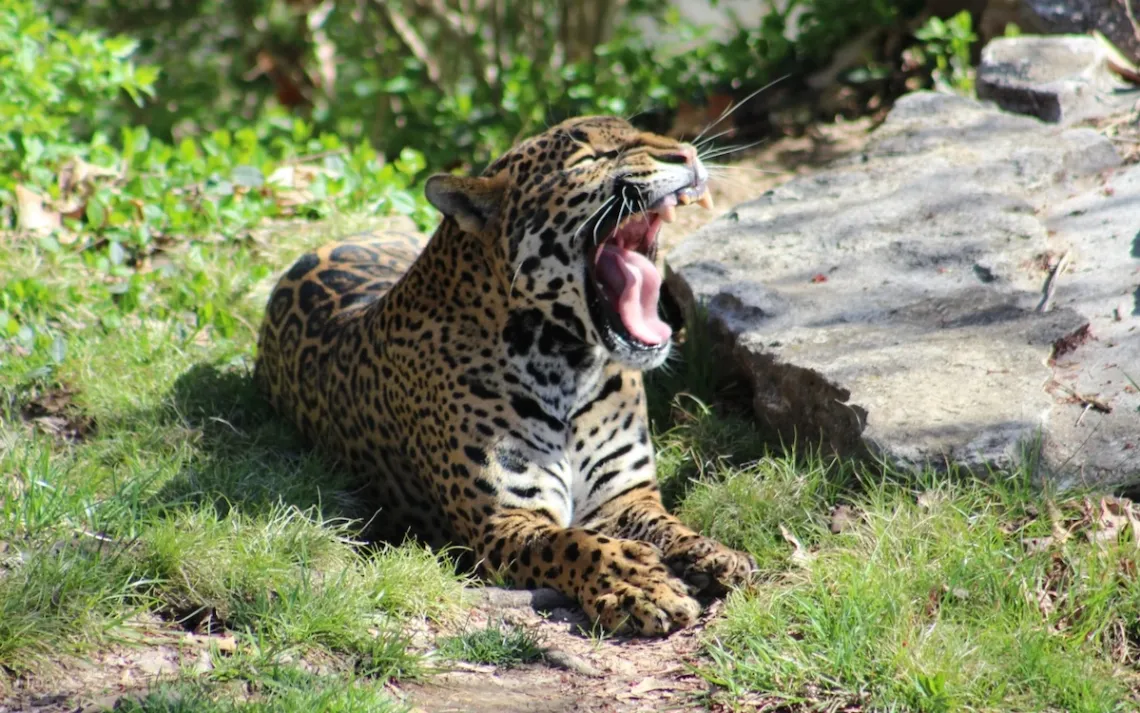
A jaguar in captivity at St Louis Zoo.
The skull isn’t much to look at. The bones suspended behind glass at the McClung Museum on the University of Tennessee, Knoxville’s campus are from a jaguar’s cranium and its bone-crushing lower jaws. This cat once prowled the Volunteer State more than 11,700 years ago. If you know your anatomy, you can make out the heart-shaped nasal opening behind the Ice Age predator’s snout and the notch between cheek and jaw that helped cradle its nocturnally attuned eye. Only a few of this jaguar’s bones were uncovered. But it’s not the completeness of the cat that matters most. It’s where the felid was found.
Jaguars are most often associated with sweltering jungles and habitats like the expansive wetlands of Brazil’s Pantanal. And, of course, El Tigre still defies border barriers to dwell in spots of the Southwest like southern Arizona. But what we know of the cats today is not how things have always been. During the Ice Age, in the times of woolly mammoths and saber-toothed cats, jaguars were not only larger than their 21st-century counterparts, but they also roamed much more widely over the planet. They are Pleistocene beasts that are still here—survivors that hung on even as the dire wolves and giant armadillos of the Ice Age disappeared.
Paleontologists are still piecing together the deep origins of the spotted cat. Close predecessors of today’s jaguars evolved around 2 million years ago in Africa, eventually spreading into Eurasia. From there, early members of the jaguar lineage sauntered over the Bering Strait into what’s now North America, spreading broadly over the continent. The cat inhabited places like the grasslands of Nebraska and deciduous forests of ancient Tennessee. They arrived as the relatively new connection between North and South America allowed creatures like jaguars, canids, mammoths, and other creatures that had evolved in the Northern Hemisphere to move south and the giant sloths, immense armadillos, and other Ice Age animals of the south to move north.
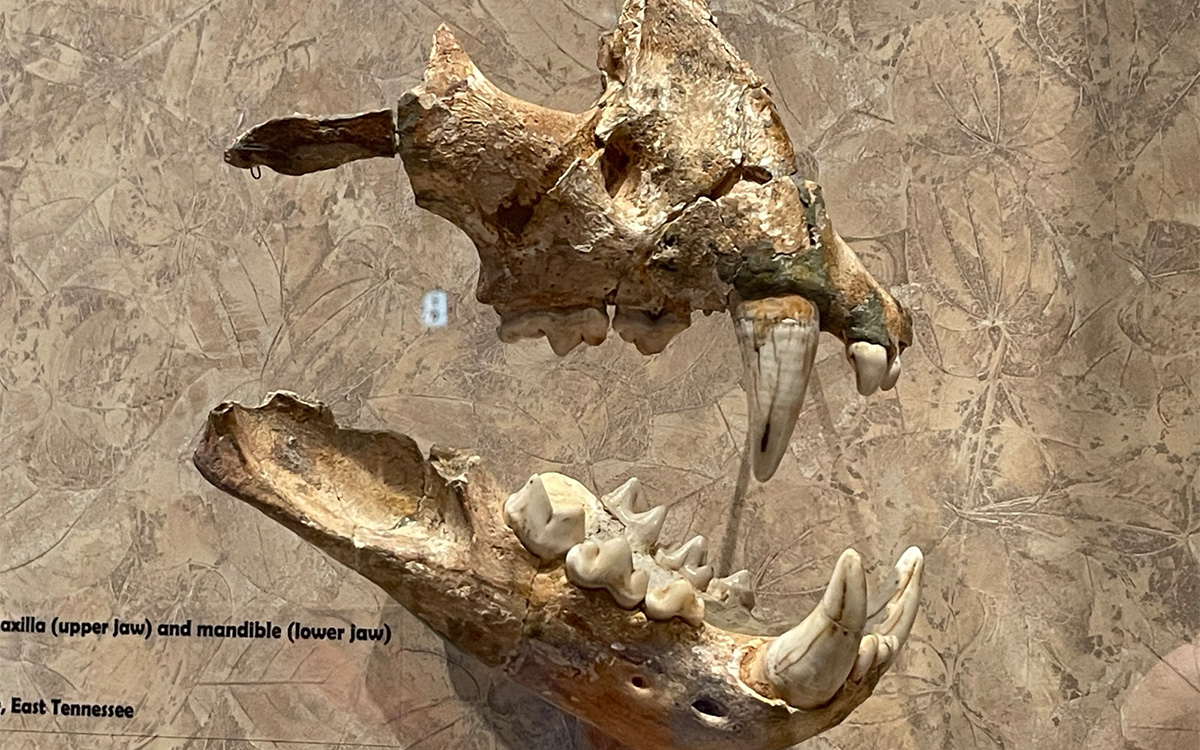
The jaguar skull at McClung Museum.
Some genetic evidence suggests that today’s jaguars are survivors from a remnant population. When the big cats disappeared from North America, they hung on in South America, expanding once more sometime before 280,000 years ago. This is long before the wave of extinctions near the end of the Ice Age, by which time jaguars were expanding again to the north. Given that modern and recent jaguars are smaller than their more ancient counterparts, jaguars may have survived by being flexible enough to favor smaller prey like capybara, giant anteaters, and collared peccaries as the mastodons and glyptodonts vanished. “The decline in range since the mid-Pleistocene was accompanied by a 15 to 20 percent reduction in body mass and a change in limb proportions,” wrote University of Newcastle zoologist Matthew Hayward and colleagues in a study of the big cat’s history.
The rosette-covered cats are not the only megafauna to have survived the Ice Age. Despite the popular impression that virtually all large animals died out across the planet as the Pleistocene closed, likely from a combination of factors relating to climate shifts, use of fire, and the way ecological dominoes can topple when keystone species disappear, we are surrounded by the descendants of Ice Age survivors that inexplicably held on.
Across the continent from Tennessee, the La Brea asphalt seeps in Southern California bubble and stink just like they did in the time of the saber-tooth Smilodon. And in those tar-soaked deposits are not just towering mammoths and shuffling sloths, dire wolves galore and vulture-like teratorns, but animals still familiar to us. Black bears and mountain lions, mule deer and pronghorn—the fossil site contains the bones of Ice Age representations of these species and more, to say nothing of smaller creatures such as striped skunks and California ground squirrels. Jaguars, too, became folded into the bubbling asphalt. And while some of these representations are sparse compared with now-vanished species, some were incredibly numerous. The third most common mammal species at the La Brea is not a mastodon or Ice Age tapir but our familiar yapper Canis latrans—the coyote.
Many of these surviving species not only persisted, but some have thrived to the point that they are considered synanthropes—animals that demonstrably benefit from living near humans. The raccoon messing around in your trash? An Ice Age survivor now benefitting from how the world has changed. Such creatures are often treated as familiar, recent, and even a nuisance, but each one is a potent reminder of how we are still living in the shadow of the Pleistocene.
It may not feel that way. For millions of years prior to the end of the Pleistocene, the diversity and sheer biomass of many Ice Age species was much greater than what we see around us now. Many species populating the planet today are survivors representing distinct lineages hundreds of thousands, if not millions, of years old.
The big cats, however, have not been able to work out such an amenable relationship with us. The felids survived the same conditions that cut back the American lion, Smilodon, and scimitar-toothed cats, only to struggle with deforestation, hunting, and human-made barriers. Jaguars are presently listed by the IUCN Red List as near threatened, their populations decreasing. Fragmentation of their habitats—by ranchland, border walls, and other human creations—have split their habitats, not only making it harder for the cats to hunt but hindering the ability of the cats to find each other and make more heavily spotted kittens.
We can’t return to the Pleistocene. But parts of that age have come along with us, still here and requiring our attention. The next time you see a coyote trot across the street at night, or watch a video of a jaguar sinking its teeth into a caiman, you’re seeing a neighbor that has evolved over time with us for more than a hundred thousand years.
“The knowledge that such a large cat is out there somewhere, or at least ought to be,” write David Brown and Carlos Lopez González in Tigres de la Frontera, “invokes the depths of our imagination.” The cat is both ghost and reality, a beast that slides between the realms of science, mythology, and the cat’s own natural reality. If we wish to honor the Pleistocene, perhaps we should give its remaining ambassadors the space to thrive.