New Federal Panel Wants to Delegate Disaster Recovery to Local Governments
Experts fear that smaller towns could suffer under new aid guidelines
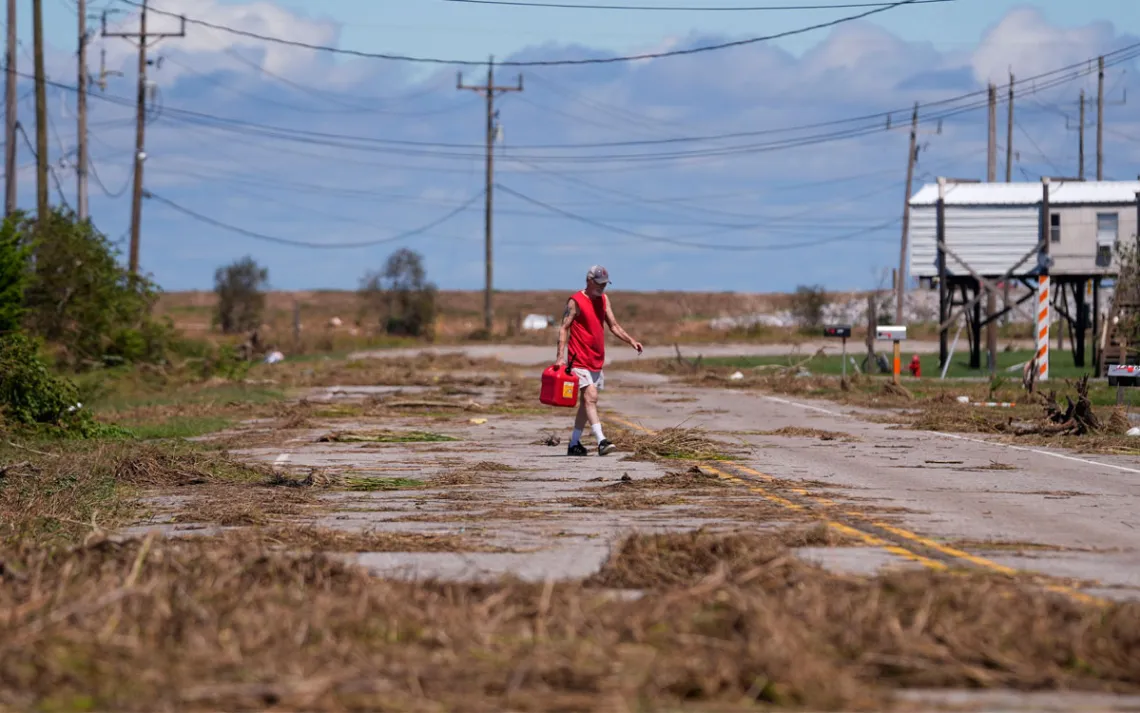
Bill Andrews walks to a store 1.5 miles away after Hurricane Francine flooded his truck in Louisiana in 2024. | Photo courtesy of AP Photo/Gerald Herbert
Eliza McDermott, a Louisiana-based disaster recovery expert, said that many residents were still recovering from Hurricane Ida when Hurricane Francine struck in 2024. She added that Francine’s wreckage was indistinguishable from Ida’s, which hit the coast three years prior. Because receiving federal assistance often requires residents to connect personal damage to specific disasters, many of them ditched their federal disaster aid applications after the more recent hurricane destroyed their homes.
From McDermott’s experience, many people were already struggling to apply for aid from the country’s primary national disaster relief agency, the Federal Emergency Management Agency (FEMA). “It's complicated, it's confusing, and it's inaccessible,” said McDermott, who is officially the deputy director of Emergency Legal Responders, a nonprofit that trains communities to navigate the complex bureaucracy of federal disaster aid.
Now, the Trump administration is recommending a suite of changes that experts expect will make the federal aid application process even harder to navigate. Last month, a 12-person FEMA review panel recommended that the agency reduce staff, pass disaster response onto states, and transform FEMA into a "payer of last resort." It also recommended that the federal government raise the damage threshold that would trigger federal assistance. The totality of these actions, say disaster aid organizations, would mean that long-standing response and aid from the federal government would be shifted onto local, and in some cases, ill-prepared governments.
“FEMA is truly insufficient as it is,” said McDermott. “Nobody has faith that the states will be able to administer the programs in that way.”
Currently, FEMA has a lengthy federal disaster declaration process that requires states to survey storm damage before tabulating the value of the destruction and cleanup efforts. Then, if FEMA determines a state government is incapable of responding to a storm's impacts, the president may declare it eligible for federal funds.
The process typically took around a month during the Biden and first Trump administration, according to E&E News, but it now takes 62 days on average. Complicating this process even further, the council also wants federal aid tied to weather conditions, such as wind speed, rather than costs. Consequently, payouts to local governments and disaster survivors could become even smaller and less frequent, according to a recent analysis from Sabotaging Our Safety, an advocacy organization.
“If implemented, the review council’s recommendations will leave entire communities struck by disaster without ample federal assistance,” the group’s report states.
Grady Joseph, a former official for FEMA and California’s Office of Emergency Services, said he’s sympathetic to the council’s criticism that local governments have long-deferred disaster duties to FEMA. He saw those disparities firsthand when he was deployed to major disasters with FEMA’s Office of Response and Recovery and then again as assistant director of logistics management in California in 2021. There are sizable rifts in disaster response, he cautioned, as evidenced in the aftermath of wildfires in California.
Take, for example, Los Angeles. In the aftermath of the fires that ravaged the city and county last year, the local government brought in pricey consultants and dispatched an armada of crew members to help remove debris. The majority of the cleanup was completed within a matter of months. Meanwhile, a similar operation in the rural town of Paradise, after the Camp Fire, took well over a year. That same disparity is also seen from state to state, Joseph added. For instance, while California, as a whole, tends to be well-resourced, smaller states with infrequent disasters, such as Maine, have been less inclined to dedicate personnel for year-round emergency management.
“There's a lot of places that functionally have not budgeted funds and resources towards their own disaster preparedness and kind of offloaded that to the federal government over the years,” Joseph said.
Without massive federal investments in local emergency management programs, the council’s proposals wouldn’t level the playing field as written, according to Joseph. He understands FEMA recovery efforts are bogged down in bureaucracy but said council policies to cut red tape are not well conceived.
For example, the council wrote that states “must take on greater program management responsibility” for local hazard mitigation projects. Yet, the Trump administration canceled a popular $4.5 billion FEMA resilience grant last year and, after a federal judge ordered the program reinstated in March, is now prioritizing construction projects that are already in the works. That is a notable shift from programs that covered project design and construction costs, such as the Building Resilient Infrastructure and Communities (BRIC) program. The new stipulation could put smaller tribal, state, and municipal governments at a disadvantage compared with those with large planning departments and project blueprints in-hand.
It’s also unclear whether the restructured BRIC program will prioritize hard infrastructure, including seawalls, or nature-based resilience projects that might use vegetation to mitigate flooding, according to Joel Scata, a senior attorney for the Natural Resources Defense Council. Either way, cash-strapped communities may have to look for municipal or state grants to fund those designs. “States are going to have to be kind of innovative in how they are moving forward with hazard mitigation programs and create their own revolving loan funds … where they give low interest loans to communities to do these projects,” said Scata.
Maine faced a similar dilemma when a slew of winter storms flooded the state’s mountain and coastal communities in the winter of 2024, causing tens of millions of dollars in damage.
After residents and local officials said Maine did too little to prepare and arrived too late in its emergency response, the state legislature and Governor Janet Mills passed legislation to create a new state resilience office. Its primary aim is to strengthen emergency communication systems and allocate millions of dollars for local flood mitigation projects.
The state is now far better prepared than before the storms, yet budget shortfalls and the cancellation of BRIC last year have hamstrung major resilience projects. That includes a $50 million plan to restore miles of southern Maine dunes demolished by the 2024 storms. Without BRIC funds, the local county settled with a scaled-down, $5.1 million design for far smaller storms.
The council’s proposal to raise the damage threshold for when federal disasters are declared especially worries Art Cleaves, who has served as the director of FEMA’s New England Region 1 office and the Maine Emergency Management Agency. The new scale could leave the state on the hook for a disaster that would incur comparatively small damages to large states but has an outsized impact on rural Maine, according to Cleaves.
Recently, York County, where Cleaves lives, has struggled to qualify for more common FEMA funding, such as the public assistance program that funds local infrastructure repairs in the wake of major disasters. The fact that York County’s dunes were not man-made infrastructure meant that the county was only eligible for funding to protect against five-year storms that have a one in five chance of happening in any given year, not the catastrophic 100-year storms Cleaves fears.
That means that even with the new dune fortifications, a storm of the same size as those that hit Maine three years ago could knock back the county’s defenses and decimate coastal towns, Cleaves said. It’s a cause that he’s frequently called attention to in the state legislature and raised with FEMA amid protracted grant applications.
Cleaves understands the need to optimize the agency’s efficiency. He just worries about what the council’s proposal would do to Maine. “FEMA is very bureaucratic and extremely slow in executing, but … you simply can't cut FEMA in half,” Cleaves said. “Don’t throw the baby out with the bath water.”