This Species of Pine Tree Is Working to Save Itself From Blister Rust
Conservationists are helping support a tree known as “the water tower of the high mountain”
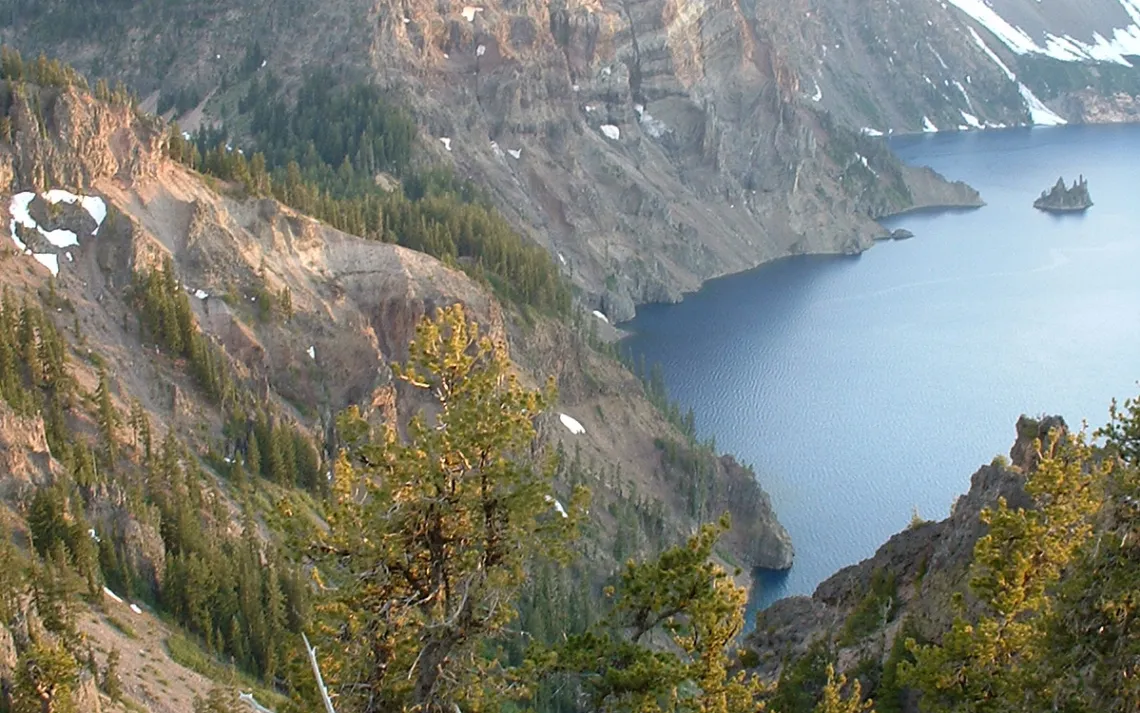
A stand of whitebark pines within the rim of Crater Lake, Oregon. | Photo courtesy of Michael Murray
In 2008, forest pathologist Michael Murray climbed the Kootenay Mountains. He was searching the treeline for a particular pine, its needles growing in bunches of five, its cones heavy and sealed, with a trunk twisted into fantastic shapes by the wind. The domain of this tree—at least here in southeastern British Columbia—was anywhere above 5,000 feet.
Whitebark pine is a poor competitor at lower altitudes, where spruce and fir bully it off the landscape. But up here, whitebark is king. Hardy and patient, it puts down roots in exposed and meager soils, thriving at the hostile extremes of the high subalpine in British Columbia, Alberta, Montana, Idaho, Wyoming, Washington, Oregon, Nevada, and California.
It shades snow up here, keeping water on the landscape deep into scorching summers—“water towers of the high mountain,” they’re sometimes called. They also remediate battered soils, making it possible for a plethora of plants to follow them uphill into otherwise barren ground. This phenomenon is pronounced following wildfires, sterilizing the subalpine until this one stubborn tree reclaims it.
Whitebark has one more responsibility on the treeline, and that is to feed the hungry. Its nuts are the largest of any in the subalpine, raining readily digestible proteins and fats down on birds and mammals throughout lean winters, especially on grizzlies—the survival of their cubs often proportional to the generosity of whitebark.
“They’re magnets for wildlife,” said Murray, who’s explored healthy stands in the Chilcotin Ranges of BC’s central west, the signs and sounds of wildlife absolutely everywhere.
But not in the Kootenays. In 2008, Murray found whitebark above 5,000 feet, as expected, but the overwhelming majority—over 80 percent—were dead, their fantastic trunks bleached and naked, the subalpine ecology they once supported slowly retreating downhill. Many of them, perhaps most, had been like this for decades.
White pine blister rust, a fungal pathogen native to East Asia, was accidentally imported to western North America in 1910, and found a ready host in whitebark pine. It infects first the needles, worming its way from there into branches, then the trunk, where it forms grotesque orange cankers. More often than not, these cankers kill the tree, all the while spitting out new spores that ride the jet stream up to 300 miles, perpetuating its long and complicated lifecycle on the next mountain over.
“Southeastern BC is ground zero,” said Murray.
But even here, among the Columbia and Rocky Mountains, where blister rust has been working for over a century, the collapse is still very much ongoing—a sluggish fire, burning without smoke. Whitebark pine is slow to grow, slow to die, and if it’s ever going to recover, it’ll do that slowly too.
“That’s why it’s imperative we start our restoration efforts now,” said Murray.
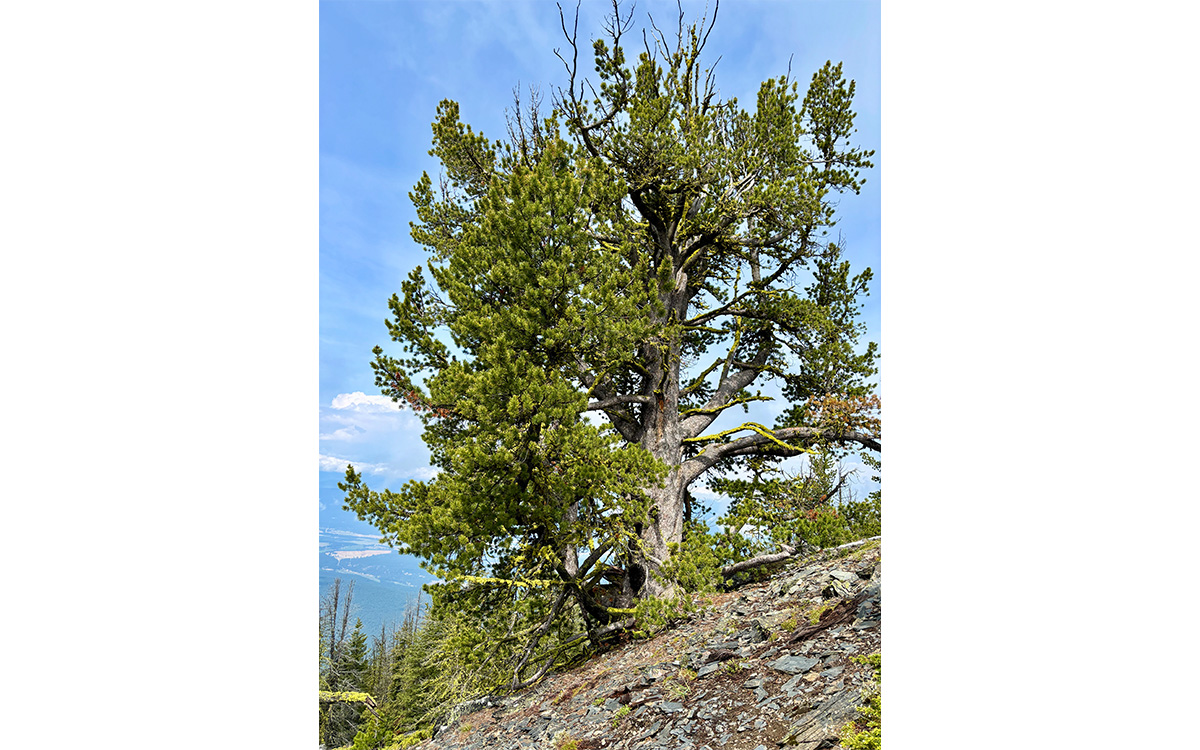
Whitebark pine. | Photo courtesy of Randy Moody
To plant a forest
In 2025, a platoon of volunteers climbed the Kootenay Mountains and a half dozen other ranges across British Columbia. Sometimes they carried rope and harness, sometimes shovel and spade. Always a boxed lunch. Always bear spray. They belong to the Whitebark Pine Ecosystem Foundation of Canada.
Murray wasn’t alone in 2008. Next to him was ecologist Randy Moody, both men studying the severity of blister rust across the province. What they found was whitebark pine in various stages of collapse, but they also found a few trees in more or less perfect health. These survivors grew wicked and robust in spite of their cankers, or had no cankers at all, benefitting from some serendipitous, inborn resistance to the invasive blister rust.
Moody established the Whitebark Pine Ecosystem Foundation in 2009, a small group of volunteers reconnoitering the mountains of British Columbia in search of these healthy trees. From them they collect seed, transmogrify that seed into seedlings, then march right back up mountainsides to put those seedlings in the ground. Sometimes they work under the watchful eyes of grizzlies, an unspoken agreement between mammals to live and let live. Sometimes they fly in by helicopter, planting on hopelessly remote peaks in the crunchy soils of recent wildfires. Often, they are treated to the finest views in some of the last true wilderness left in North America. In 2025 alone, they planted 104,000 whitebark pines.
“We’re harvesting seed from hundreds of healthy trees,” said Moody, “from Smithers to Manning Park, from Jasper to Fernie.”
In a very real way, they’re shooting from the hip. The trees from which they harvest certainly appear resistant to blister rust, but some might just have gotten lucky, possessing no more genetic resilience than their dead neighbors. Even where there is genetic resistance, there remains no guarantee it’s being inherited by seedlings.
“You also don’t know who’s pollinating your tree,” said Moody. “Sure, this tree looks resistant, but maybe the tree pollinating it is highly susceptible to rust.”
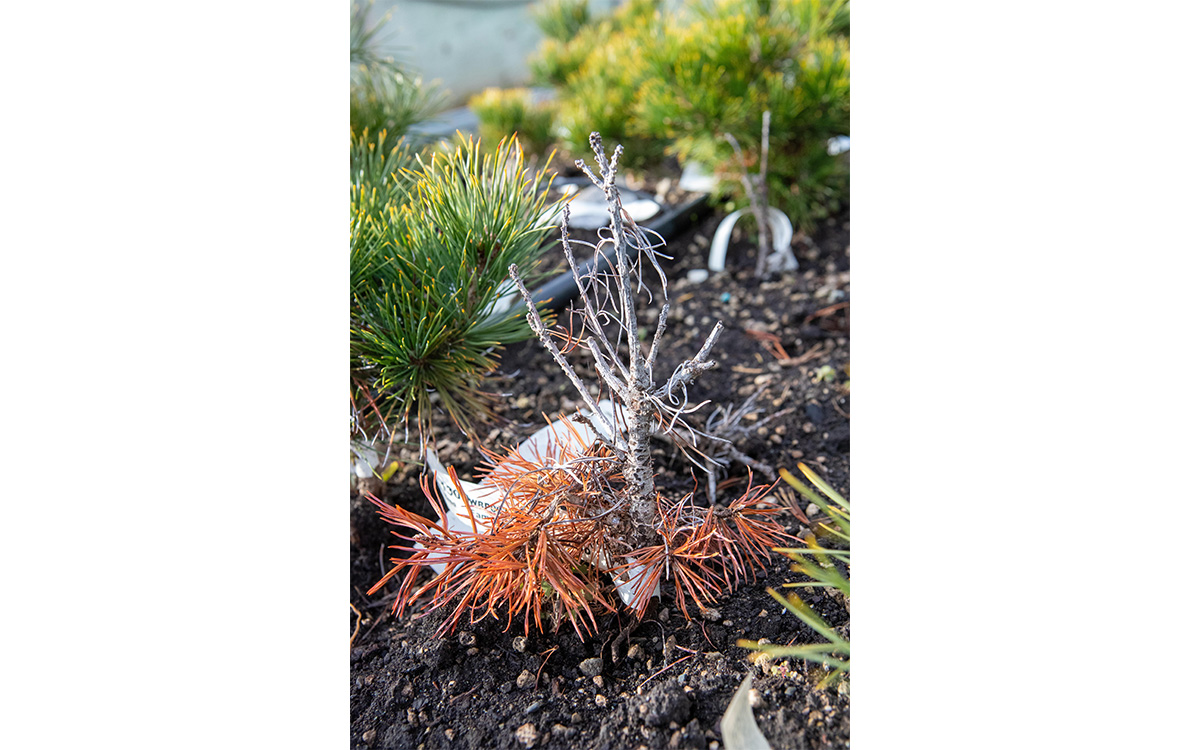
A dead whitebark pine seedling at the Kalamalka Research Station, BC. | Photo courtesy of Zack Metcalfe
To distinguish truly resistant trees from the merely lucky, Murray—working then and now with the province’s Ministry of Forests—helped launch a screening program at the Kalamalka Research Station in Vernon, BC, back in 2011. They’ve accepted seed from about 70 wild trees annually, germinated them, raised them, infected them with blister rust, then diligently monitored the results. The dozens of seedlings from a single tree—called a “family”—receive a score based on their overall performance, everything from bona fide resistance to catastrophic and universal fatality. Beginning to end, seed to score, this process takes eight years.
“We use their response to the pathogen to draw conclusions about their parents,” said Sebastian Jimenez, who’s managed the screening program at Kalamalka since 2021.
In this way, they’ve screened seed from 476 wild parents, of whom 5 to 10 percent receive the highest possible grade: an A. It’s upon these “A-Trees,” with true and inheritable resistance, that the Whitebark Pine Ecosystem Foundation has focused its efforts. At least, for the most part.
“You can’t screen every tree,” said Moody. “It’s too expensive, so a lot of the time you’re going, 'OK, this tree here is rust resistant, and that tree over there is showing many of the same characteristics.' We’ll plant its seedlings too, not on a whim, but on an informed guess.”
It takes vision to work with whitebark, he said. The foundation’s volunteers—everyone from engineers to a mortician—are searching and propagating and hiking and planting with no guarantee of success, carrying an uncertain future on their backs up and down the same old mountains, often several times a day. It’ll take lifetimes for their labors to pay off, if, indeed, they pay off at all. And yet somehow, the vague prospect of recovery in the subalpine has been enough for them.
“The seedlings we plant in the field,” said Moody, “aren’t going to produce seeds of their own for many decades. The people planting them will never get to see them achieve their full ecological potential.”
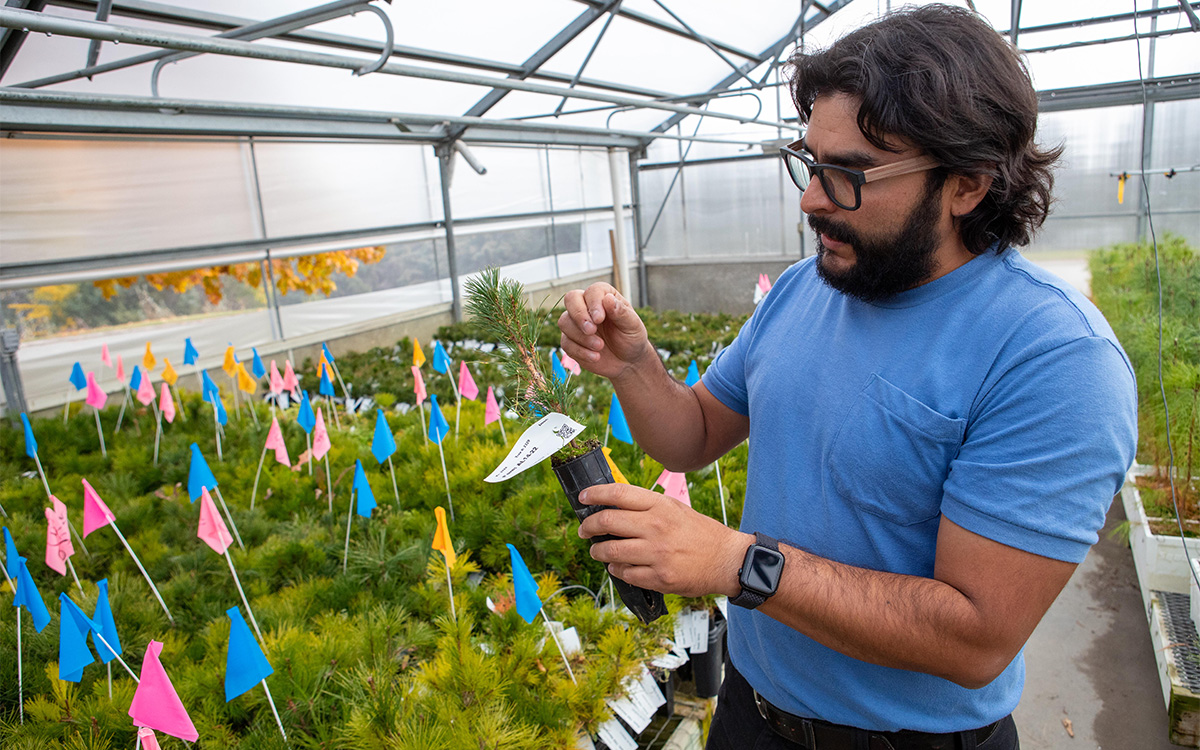
Sebastian Jimenez, a research scientist at the Kalamalka Research Station, BC. | Photo courtesy of Zack Metcalfe
The seed banks
On Berg Lake, British Columbia, deep in the wilds of Mount Robson Provincial Park, there stands a lone whitebark pine, rooted among mountains, rivers, and waterfalls for longer than Canada or the United States have been nations. This is an A-Tree, screened and scored, enduring blister rust with inexplicable grace for over a century now, and passing that grace down through its seedlings. It’s a rare breed, and a vulnerable one.
Sometimes it's from an avalanche, sometimes a wildfire, sometimes mountain pine beetle, sometimes a chainsaw, but these precious few trees can, and have, been killed. While no individual is indispensable to the overall recovery effort, each death is a measurable waste of money, time, genetic diversity, and wild calories.
So in 2019, the Whitebark Pine Ecosystem Foundation decided to establish two seed orchards, one near Elkhart Lake, another in Prince George. These orchards are populated with clones—cuttings from resistant trees across the province, grafted onto rootstock and planted in neat and orderly rows. Here, their resistant genes are preserved in relative safety. In time, these genes will be mixed together.
“It’s going to be big,” said Moody.
In a decade or so, these orchards will produce a new kind of seedling, each born of two resistant parents, combining, and perhaps exceeding, the strengths of the previous generation. With such seedlings in their roster, the work of the Whitebark Pine Ecosystem Foundation will be that much more refined. It’ll also save them the hike to Berg Lake.
“I’m confident the tree won’t go extinct,” said Murray, “with our continued screening and recovery actions, but the impacts on wildlife and other high mountain resources is becoming significant.”
The importance of a keystone species might seen abstract to human beings, but the lost water retention, soil amelioration, shelter, and food are only too real to subalpine flora and fauna. Murray’s walks through mountain ranges where blister rust has done its work, like the Kootenays, and where the pathogen is just getting started, like the Chilcotin, paint a clear and troubling picture.
“We’re going through a bottleneck,” said Murray, “and here, in southeastern BC, the bottleneck is at its narrowest.”
There are lean years ahead for dozens of mammals and birds, as mountaintops bald for lack of whitebark, and it’s going to stay that way until hundreds of thousands of resilient seedlings reach maturity at more or less the same instant, most of a human lifetime from now. Even this won’t be nearly enough.
“People often think that once you find a certain number of resistance trees, the program is a success. That it’s done. But that’s not true. This pathogen will always try to adapt, to overcome the defenses of these trees. So we need to keep monitoring, keep screening, and we need to find more resilient trees. The ones we have aren’t going to last forever.”