Tree DNA: For Conservation, For Solving Crime
Plant genetics can help solve cases of poaching and illegal logging

Illustration by shaunl/Getty Images
For decades, scientists have studied the invisible signatures embedded in tree rings to track climate shifts and understand forest history. But in recent years, advances in plant genetics have unlocked the potential for trees to give scientists solutions to questions that may otherwise go unanswered—from tracing stolen timber to linking a suspect to a crime scene.
“Trees, like humans, are all genetically unique,” says research geneticist Richard Cronn, who works for the US Forest Service. Like in humans, animals, or insects, the data contained within each strand of DNA is the result of the raw material of genetic inheritance getting passed down from generation to generation, organism to organism. Examining the genetic data collected from stumps, bark, limbs, and leaves can give biologists a lot of answers.
Tree DNA can tell us where the wood came from when it was cut down, who its siblings, parents, and grandparents are—even what it’s been through historically. It can relate what resistance the individual plant has inherited to combat pests and survive extreme weather like heat, aridity, or flooding.
Plant genetics, a precursor to human genetics, has been around since the 1860s. But sequencing plant DNA used to be extremely time intensive and required equipment the size of a chest freezer. In 2005, the invention of massively parallel DNA sequencing changed that. Now, Cronn can’t help but chuckle when fellow scientists misplace the handheld devices used to take samples and read DNA in record time, including once impossible-to-sequence conifers with their genomes five to 10 times longer than a human’s. The technology required to study the genetic makeup in trees has come a long way in the last two decades, and so has conservation.
Cronn’s research team, for example, started using quantitative genetics—what he calls “old school genetics”—to identify the best sources of trees for reforestation after wildfires and timber harvest. These "locally adapted" sources have higher resistance to localized threats like pathogens and weather extremes, and they offer the best way to ensure a healthy forest during replanting.
“It’s essential to get it right in the beginning,” Cronn says. Reforestation is a costly and time-consuming effort. Planting large swaths of land with trees that can’t handle local threats could be—and has been—a disaster.
Two experiments that took place in Oregon and Washington showed that trees, when moved out of their adapted zone, grow slowly, develop bad form, and often die. After large wildfires in the late 1800s and early 1900s, before USFS seed movement guidelines, the Forest Service replanted seedlings to restore more than 8,000 acres. Because the seedlings came from distant sources, today these trees are mature, but smaller and less healthy than trees that were naturally regenerated in zones where fires didn’t destroy all the local seed and seedlings.
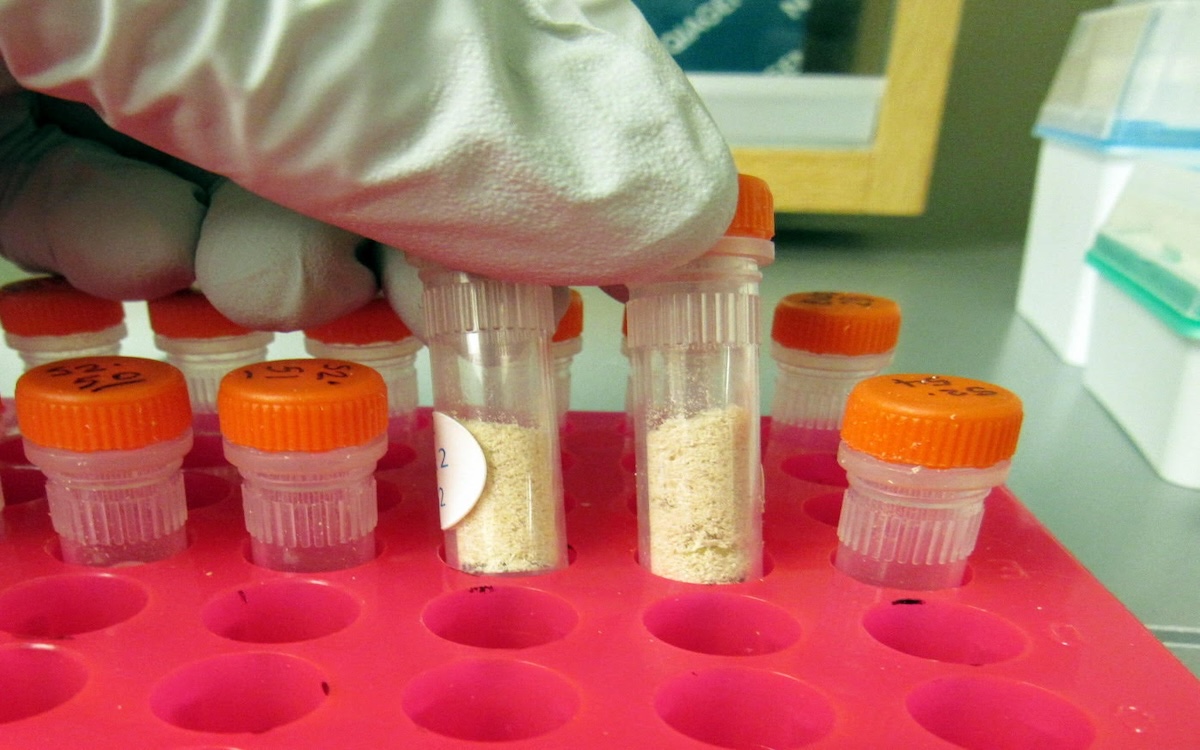
To extract DNA from wood, researchers use tools like dremel drills or saws to grind wood into sawdust. Photo courtesy of Richard Cronn.
Now that there are more stringent USFS guidelines for replanting and more advanced technology, scientists can quickly and easily search for similar DNA markers between the old and potential new plants, which indicate adaptation to the exact location the Forest Service is replanting, in what Cronn calls “a unique combo of woodshed and molecular biology lab.” That information is also implemented in evaluations of forest regeneration as researchers use genetic data to build a database that predicts optimal planting sources and local adaptation.
Reforestation efforts aren’t all DNA information can be used for. Much like human DNA at a crime scene, tree DNA can be used to prosecute criminal activity. Cronn has personally worked with law enforcement to do so.
In 2018, tree DNA was used to charge and fine Lake Louise Ski Area in Canada after the resort cut down a section of threatened white bark pines. Twenty years ago, identifying those trees as separate from near-identical species lookalikes would have been difficult, if not impossible.
DNA has also been vital in cases involving tree poaching and illegal logging, like in a 2018 illegal logging incident that resulted in an Olympic Peninsula forest fire. According to the US Customs and Border Protection, illegal logging is the most profitable natural resource crime on the planet, the third-most profitable transnational crime behind counterfeiting and drug trafficking, Cronn explains. Stealing high-value trees from national park or forest land can result in an estimated $500 million to $1 billion lost from the forest products industry annually. “The costs from the associated damage [to forests] almost always exceed the value of the stolen wood,” Cronn says.
Prior to the advances of the last decade or two, little could be done to charge suspected perpetrators unless they were caught in the act of illegally harvesting trees. Now, biologists can use DNA to match detached parts to a source tree, determine the number of trees that were cut down in a shipment of boards, and even confirm where the tree was growing within a five-to-30-mile range, depending on the species.
Location matters, because the geographic source of the material can mean the difference between a tree that was illegally cut on national forest land or legally cut on adjacent private land, Cronn explains. What’s more, when investigators and prosecutors know they have enough concrete evidence to charge a suspect, DNA evidence can be a deciding factor that helps a case not only move forward but also result in a conviction.
It’s not just timber-related crimes plant DNA has helped solve. In 2021, a man in Missouri was convicted of murdering his wife thanks in part to a DNA match of pine needles that were stuck to his boot and needles where the woman’s body was discovered.
“The goal is to help law enforcement officers learn about evidence items—where they came from, how they are related—so that they can build strong cases for prosecutors to enforce our nations’ laws. Laws without enforcement are just suggestions. What we’re doing is helping to make timber theft laws enforceable,” Cronn says.