Trump’s Plan to Eliminate FEMA Could Spell Disaster for Impacted Communities
Here’s what’s at stake if Trump shutters the nation’s leading disaster-response agency
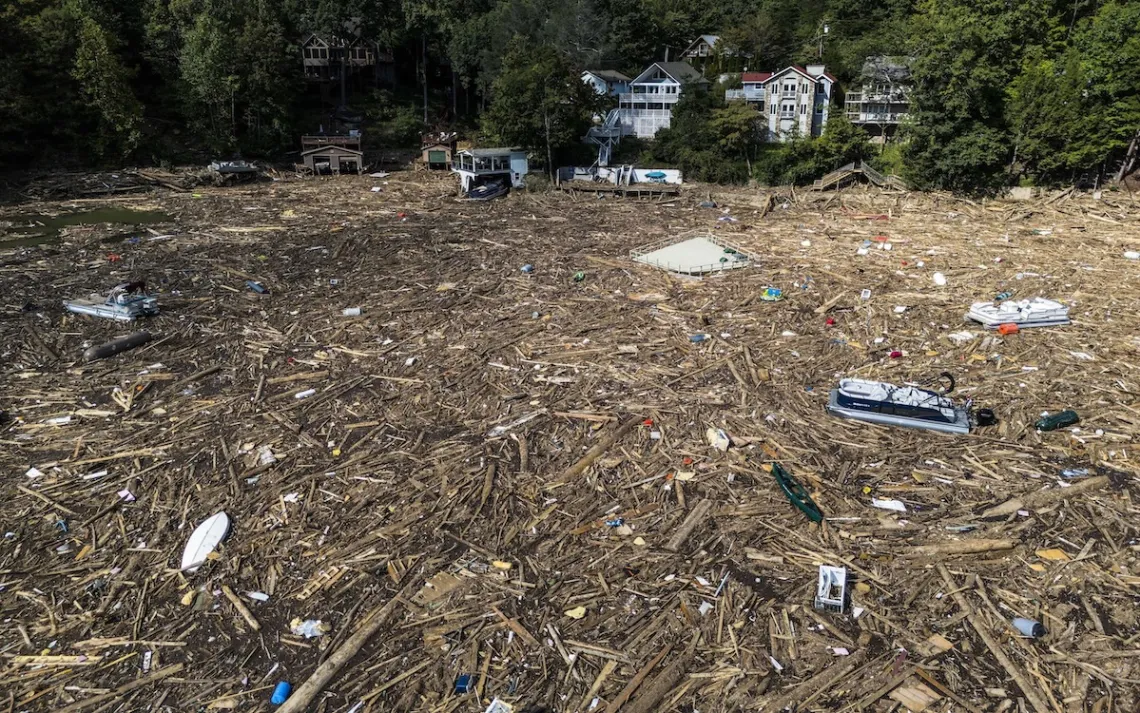
Lake Lure, North Carolina, in the aftermath of Hurricane Helene in 2024. | Photo by Mike Stewart/AP Photo
Over nine months after Hurricane Helene devastated Western North Carolina, survivors of the state’s deadliest and most destructive storm continue to face a long road to recovery. “Through no fault of our own, our lives and livelihoods were upended by a natural disaster that tore at the seams of our communities,” Western North Carolina residents and Helene survivors Moriah Cox, Claire McCoy, and Dolly Reaves said in a joint statement. “Our neighbors are still working shoulder to shoulder to recover and rebuild.”
Now Trump is actively floating the idea of eliminating the federal agency tasked with disaster management and response—the Federal Emergency Management Agency, or FEMA—altogether.
When Trump visited Western North Carolina in January to survey the storm damage, he criticized the agency and suggested that it should be eliminated. That would shift the entire burden of disaster recovery onto the states. “I think, frankly, FEMA’s not good. . . . FEMA’s turned out to be a disaster,” Trump said.
FEMA was officially established in 1979 by former President Jimmy Carter. Since then, the agency has been on the front lines of major disasters, responsible for everything from coordinating recovery response to assisting impacted families. It is the primary way the federal government mobilizes on behalf of those in need after a disaster.
In January, Trump signed an executive order creating a FEMA Review Council to make recommendations on overhauling the agency and, potentially, scrapping it altogether. Homeland Security Secretary Kristi Noem, one of the chairs of the review council, has also called for axing FEMA. During a June 10 Oval Office briefing, for example, Noem said that FEMA “fundamentally needs to go away as it exists.”
Trump also said during the June 10 briefing that he plans to start phasing out FEMA following this year’s hurricane season, which runs through November. The plan appears to match Project 2025’s recommendation to largely gut the agency, shifting the majority of its disaster preparedness and response costs onto states and municipalities. “We want to bring it down to the state level,” Trump said from the Oval Office.
His comments drew sharp criticism from policymakers and experts as well as storm survivors.
“It really shows his lack of understanding of emergency management and how things actually work,” Shana Udvardy, senior climate resilience policy analyst at the Union of Concerned Scientists, told Sierra.
“His proposal to eliminate FEMA will be disastrous for the communities still rebuilding and the communities that will be affected by this hurricane season.”
Deborah Ross, the US representative for North Carolina’s second district, noted that her state and states across the Southeast are still recovering from Helene and could benefit from more federal assistance, not less. “It’s completely disgraceful that Donald Trump would sit in the Oval Office and claim his administration has successfully helped Western North Carolina rebuild from the devastation brought by Hurricane Helene,” she said. “His proposal to eliminate FEMA will be disastrous for the communities still rebuilding and the communities that will be affected by this hurricane season.”
Jon Council, another Hurricane Helene survivor from Western North Carolina, noted that Trump’s denial of an extension request from the governor for federal assistance to aid the recovery is not helping the situation. “We’re already seeing the ways in which our debris removal and repair have slowed down,” he said.
“We can’t carry the load alone—nor should we be expected to,” Cox, McCoy, and Reaves said in their joint statement. “To lay the burden solely at the feet of survivors and states is shortsighted and ignores the need for a responsive, functional, and caring federal system that prioritizes those of us who have lost so much.”
“States do not have the resources”
Experts and disaster survivors say that while they recognize a need to reform FEMA, it makes no sense to eliminate the agency and leave states to fend for themselves when disaster strikes. Sidelining FEMA would be especially troublesome for smaller states like Vermont that lack the resources to effectively respond to and recover from major disasters. States and municipalities are already on the front lines of disaster response, and FEMA typically only gets involved when disasters are so big or catastrophic that states cannot manage them on their own, Udvardy explained.
“We’re seeing more climate-related disasters that are getting so extreme they become catastrophic,” she said.
Ashley Shelton, a Louisiana native who has worked on community resilience in the aftermath of Hurricanes Katrina and Rita, said that having a functioning federal-level response to disasters is critical, especially with storms becoming more intense as the planet warms. “We understand [FEMA] is absolutely necessary if we want our communities to be able to rebuild,” she told reporters during a recent media briefing. “Our states do not have the resources to be able to make people whole; nor do they have the infrastructure and capacity.”
Trump does not have the legal authority to completely eliminate FEMA. “He is limited in some of the changes he could make to the agency without congressional action,” Michael Coen, who served as FEMA’s chief of staff under the Obama and Biden administrations, told Sierra.
But planning for a dramatic downsizing and overhaul of the agency already appears to be underway. Under an order from Noem, former acting head of FEMA Cameron Hamilton prepared a memo outlining FEMA functions and programs that could be curtailed, significantly reformed, or eliminated. The memo was titled “Abolishing FEMA.” Hamilton was forced out of the agency in May after testifying before a congressional subcommittee that he was opposed to the complete elimination of FEMA. Trump has since tapped David Richardson, a Homeland Security official and former military officer with no previous emergency-management experience, to lead the agency.
Hamilton’s ousting is far from the only staff shake-up at FEMA since Trump took office. FEMA has already lost a quarter of its full-time staff, The New York Times reports. Senior officials have also departed the agency. MaryAnn Tierney, FEMA’s second-in-command official, recently resigned, stating in a message to staff that she “will not be complicit in the dismantling of this agency,” the Times reported. And the head of FEMA’s National Response Coordination Center, Jeremy Greenberg, resigned on June 11, just one day after Trump said he would begin to shutter the agency at the end of the year.
The central command center that Greenberg directed plays a critical role in FEMA’s coordinating function. “It’s really the nerve center for FEMA in coordinating with other federal departments and agencies, and also coordinating with all the states,” Coen explained. “Congress has given FEMA the authority to mission-assign federal departments and agencies to support states in times of crisis,” he added. “And losing staff at FEMA that have experience overseeing that is a loss for the country.”
In addition to staff departures, FEMA under Trump 2.0 will likely be scaling back on disaster aid and reducing or terminating some of its grant programs. During the June 10 Oval Office briefing, Trump said the federal government will “give out less money” to states reeling from major disasters and suggested that disaster relief funding would come directly from the president’s office.
These remarks from Trump, Coen said, “gave me the impression that he doesn’t really have a full understanding of what FEMA does. It’s a relatively large organization managing grants and working with grantees,” Coen told Sierra. “I don’t think he could do that out of his office.”
Trump’s FY’26 budget proposal would reduce FEMA grant programs by $646 million, claiming the programs are “wasteful and woke.” Coen said these grants are essential to supporting states and municipalities as they prepare for and recover from major disasters.
Losing FEMA support will end up hurting communities, Coen said.
“I think there will be a lot of examples where communities hit by disasters—the trauma will continue for months and years because they’ll never fully recover.”