Western Snow Drought Threatens Ski Season and Much More
Record-low snowpack could have downstream effects on rivers, farms, and cities that last long beyond winter
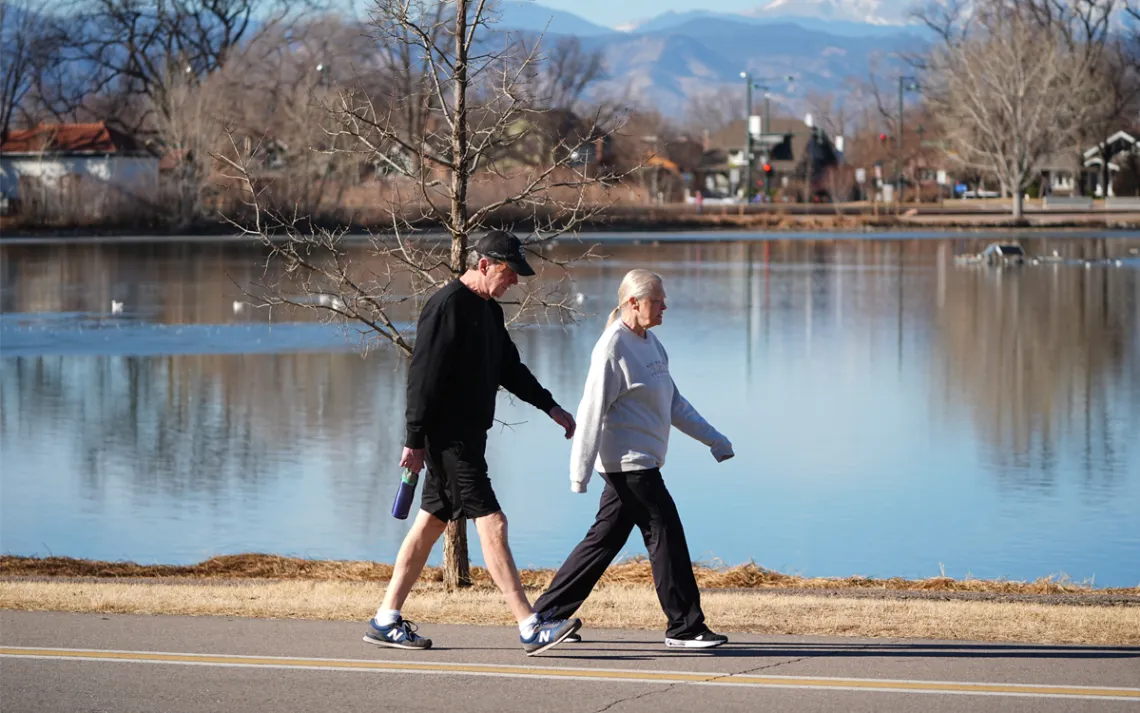
Snowless mountains in Denver in February 2026. | Photo courtesy of AP Photo/David Zalubowski
Amie Engbretson knows snow. The daughter of a professional skier, she was on skis almost as soon as she could walk. Now a ski pro herself, Engbretson spends as much time as she can on mountains around the West, in Canada, Europe, and beyond. In her 38 years on mountain snow, she has never seen anything like this winter season.
“It's been the weirdest and most challenging winter of my life,” she said. Science backs up that statement. Data from NASA and other agencies show a clear pattern: It has been one of the worst winters for snow in the recorded history of the American West.
On February 1, NASA’s Terra satellite measured the total area of snow across the West. Researchers concluded that it covered 139,322 square miles. That sounds like a lot. But the average this century is more than three times that. Two-thirds of the normal western snow cover was missing, an area the size of Utah, Idaho, and Montana combined. It’s the lowest total in 25 years of the satellite measurement.
The historically low snow makes climatologists and forecasters nervous, not just for this winter but for the year that follows.
“Right now, it's just looking very dire,” said Oregon state climatologist Larry O’Neill. Oregon has been particularly hard hit. As of February 22, the state’s snowpack, the accumulated snow, was at 37 percent of normal.
Elsewhere across the West, records have been shattered all winter. At the Salt Lake City Airport, a mid-February storm finally ended an 11-month streak without an inch of snow, a record drought going back over 130 years. Across the region, over 8,500 high temperature records have been tied or broken since the start of December 2025. While the East Coast has been battered by one snowstorm after another, the West has been incredibly hot and dry.
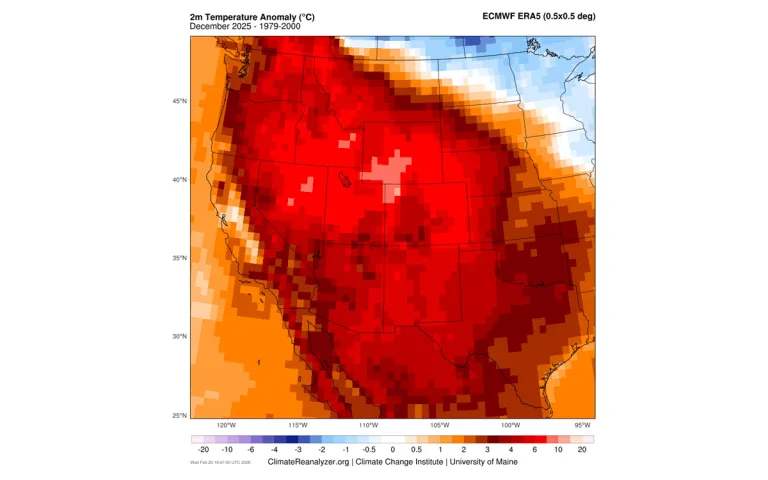
A temperature anomaly map of the western US, showing the unusually high temperatures in the first “wet” phase of the drought. | Climate Change Institute, University of Maine
A tale of two droughts
This winter’s snow drought came in two phases. It started with what researchers call a “wet snow drought.” November and December were, if anything, unusually wet, especially in the Pacific Northwest. Atmospheric river storms dumped feet of rain on Washington state, causing record floods that damaged or destroyed almost 4,000 homes. Storms like that should have gone a long way to recharge the snow up in the mountains, even as it inundated lower-lying areas. But it was just too warm. Idaho was an astonishing 6.3°F warmer than average, and the Northwest in general had its warmest November and December ever recorded, a dataset going back to 1895. Even at the highest elevations, almost all the precipitation fell as rain.
“And then we got to January,” said O’Neill, “and the tap completely shut off.”
In the Rockies and Pacific Northwest, January is usually a time when snow accumulates and snowpack recharges. But even when temperatures finally dipped below freezing, there was no more precipitation at all. A high-pressure system parked off the northwest coast blocked any new storms from coming in. The West had entered the second phase, a “dry” snow drought.
This one-two punch has left the Western US in a deeper snow deficit than some areas have seen in living memory. The effects are going to take months to play out and add a new layer of uncertainty to a region already experiencing a drying and warming climate.
The impact on the ground
The West depends on snowpack. For much of this half of the country, the spring, summer, and fall can be very dry. Rivers, forests, and other ecosystems depend on snowmelt to fill that long gap. Rain falls and quickly runs off, but in normal conditions, snow works like a reservoir, melting over months to dole out water when western states need it most. Low snow in February can mean lower, warmer rivers in June, which can hurt threatened fish, such as salmon and trout. It can also affect irrigation and agriculture. In 2015, the last time a low snow year led to a widespread drought in the Northwest, agricultural losses topped $1 billion.
In the Pacific Northwest, low rivers could impact the reliable supply of power, as well as water, because of Oregon and Washington’s reliance on hydropower.
“We have this system of hydroelectric dams,” said O’Neill, “and a massive amount of water to supply those, so that we keep our power cheap and clean.” In 2023, low river flows caused hydropower outputs in Oregon and Washington to both fall by more than 20 percent.
Such a historically low snow year is also likely to impact communities and businesses all over the West. The first to feel the economic pinch, not surprisingly, is the ski and snowboard industry.
Outdoor recreation in general is a massive business in the United States, totaling over $1 trillion in economic activity. Downhill snow sports account for about $60 billion a year of that, according to a report by the National Ski Areas Association. The same report estimates that skiing and snowboarding support 533,000 jobs. Those jobs and dollars aren’t evenly distributed around the country. They are concentrated in towns and counties whose economies are built around the slopes.
The economic fallout goes far beyond those jobs that work directly in the industry. Engbretson has seen it in her own backyard in Truckee, California, as well as mountain towns around the country.
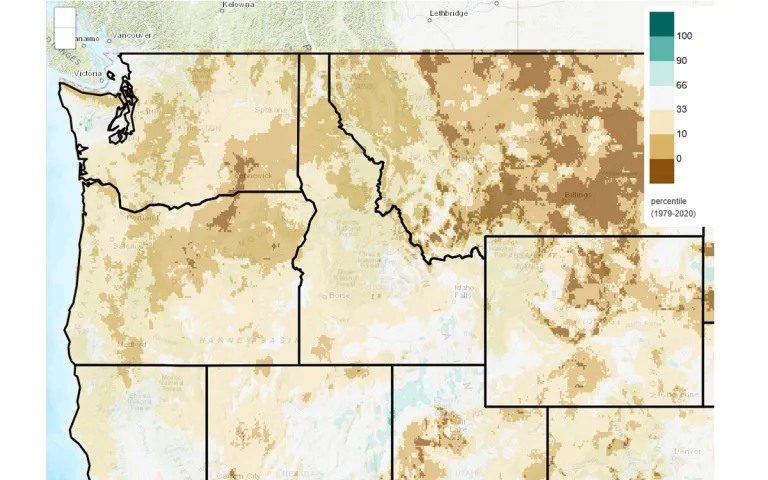
The “dry” phase of the drought brought some relief in temperature but one of the driest Januaries on record. | Image courtesy of The Climate Toolbox
“Wages are down across the board,” she said. “If the ski patrollers and the people who work at the resorts aren't working, if we're not having tourists come into town, then they're not eating at restaurants. They aren't spending in the shops.” It doesn’t take long for a town dependent on ski dollars to experience a much wider downturn.
“For the ski industry, low snow isn’t just fewer powder days,” said Erin Sprague, CEO of Protect Our Winters, a nonprofit organizing the outdoor sports community for climate action. “It means shorter seasons, higher operating costs, and real safety consequences. Drought creates unstable snowpack and, tragically, we’ve seen record avalanche deaths this season.”
That link, between climate, low snow conditions, and avalanches, is still being explored. Some studies point to fewer avalanches overall in a warmer climate, but more at higher elevations. Engbretson’s hometown of Truckee is mourning the loss of nine backcountry skiers in an avalanche on February 17, one of the deadliest in recent California history. That avalanche followed the heaviest snow of the year, after a January with almost none. She said that this kind of huge storm, coming after a long drought, is becoming more common, replacing the steadier winters of her youth.
The winter isn’t over, but time is ticking away fast, and every day, the chance of snowpack reaching anything like normal becomes less and less likely. That leaves many of us in the West holding our breath, hoping for the best, but preparing for the worst.