What Can We Learn From Australian Wildfires?
Australia’s big trees have survived terrible fires. They have lessons for the American West.
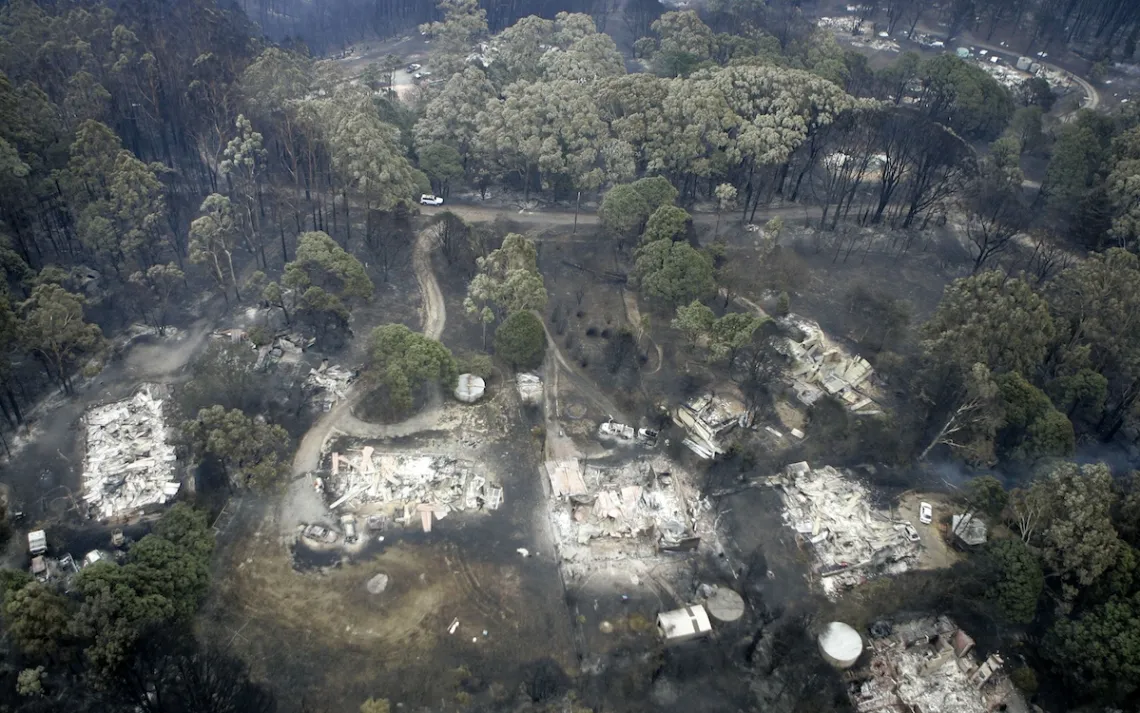
The remains of homes after a wildfire in Kinglake, northeast of Melbourne, in 2009. | Photo by Rick Rycroft/AP Images
Looking up into the misty canopy in Toolangi, Australia, you’d be forgiven for thinking you’ve wandered into a redwood grove. The towering crowns of the area’s mountain ash trees create a cathedral out of leaves and air, and their imposing trunks are too big to wrap your arms around. Many even feature the “goose pen” hollows so characteristic of California’s big trees, proof they’ve survived at least one fire.
Like their Yankee counterparts, mountain ash can live several hundred years. Their bark is thick and spongy to the touch. And like redwoods, the ecosystem in which mountain ash trees live needs fire—but an extreme fire event can also mean their destruction.
In February 2009, an unprecedented bushfire swept across Victoria state, burning 450,000 hectares of land. The blazes ripped through towns and up mountains, too fast even for some residents to reach their bushfire bunkers. Ultimately, the fire killed 173 people and wounded 414. More than a million domestic and wild animals died. The event became known in Australia as Black Saturday.
The region has spent the subsequent 15 years learning hard-won lessons about recovery for both forests and humans in an ecosystem that both needs and is deeply vulnerable to fire—lessons that might be put to use this fire season in the American West.
Concentrate on life cycle particulars
Mountain ash are shade intolerant and need small fires at least every several decades to ensure regeneration and reduce competition. But they don't reach sexual maturity until age 25, so more frequent fires in one area can result in localized extinction. That can prove disastrous in a warming era when fires tend to ignite more frequently—and burn with more intensity. “That's what’s unnatural; that’s what’s out of sync with the ecology of this place,” says Chris Taylor, a spatial conservation expert and research fellow at the Australian National University.
Similarly, sequoias need fire to open their cones, distribute their seeds, and thin out groves so those seeds get the sunshine and bare mineral soil they need to germinate. Some fire-suppressed groves in the Sierra Nevada are so thick with trees that they can support no seedlings or juveniles, says UC Berkeley fire ecologist Kristin Shive. But sequoias are still vulnerable to too-hot or too-intense fire; California’s recent firestorms have killed many thousands of mature, multiple-centuries-old trees, between 13 percent and 19 percent of the population. Shive suggests that following selective mechanical thinning with prescribed fire is one solution, to reduce severity of the blaze once a fire does come and ensure the resulting flush of seedlings can access that key soil and light. “You wouldn’t want to do all of it, but if you did none of it, that would be problematic too,” she says.
In contrast, coast redwoods can survive for decades with minimal sun; they are also able to resprout from their bases and up and down their charred trunks after fire, rather than from seed. For this reason, they boast extremely high post-fire survival rates—up to 97 percent even in the hottest parts of northern California’s recent CZU Lightning Complex fire, according to San Jose State University forest ecologist Will Russell. For Russell, that means thinning in this context is not only ecologically unnecessary, it’s counterproductive. And since coast redwoods are clonal, “the dense stand you might see after fire will self-thin, and resources can return to the group,” Russell says. Meanwhile, thinning opens up the forest for greater airflow, fanning wildfire flames. (It’s worth noting that Shive’s take here is slightly different. Because coast redwoods were logged so heavily, many formerly clearcut areas are now choked with juveniles. She believes thinning could be effective in helping nudge those ecosystems toward their former old-growth structures.)
Regardless, despite coast redwoods’ remarkable fire adaptation, “we suspect that if they reburn in high severity too frequently, it’s still knocking back resources for each tree,” Shive says. That makes other approaches for decreasing fire severity, like prescribed fire, even more important for coast redwoods. “We have so little old growth left. Even if they can survive a high severity fire, is that what we want them to experience?”
Reconsider salvage logging
Within a week after Black Saturday, logging companies arrived to begin clearing burned mountain ash forests near Toolangi. But although salvage logging might sound practical, Taylor argues that it’s deeply damaging for an ecosystem in a vulnerable state. (“Would you take a newborn baby whitewater rafting?” he says. “That’s kind of what salvage logging is.”) Plus, he explains, many native animals rely on hollow trees for habitat—and because Australia has no woodpeckers, dead tree “stags” stay standing long after they’ve died. But when they are logged or disturbed, “that wildlife just simply is no longer to be found at those sites,” he says.
Similarly, Russell notes that northern California’s endangered marbled murrelet nests exclusively in the large, lateral branches of old trees. The first murrelet nest in Big Basin State Park was found in an old growth Douglas fir within a redwood-dominated forest. He says he saw “significant” salvage logging in similar ecosystems after the CZU fire, which scorched almost all of the park.
Although he was glad to see it concentrated in areas deemed hazardous to humans or structures, Russell still found the practice concerning. “You can have a tree that’s lost every bit of green foliage and looks like it needs to be removed, but six months later it’s revived,” he says of coast redwoods. He often spotted logging trucks loaded down with redwood covered in epicormic sprouts, the dormant buds that allow the trees to regrow after fire.
Build unity through disaster planning
A more human Black Saturday lesson: communities with high levels of unity before a disaster recover more easily afterward, says Toolangi fire brigade captain Dawn Hartog. During the firestorm, Hartog stayed to fight the flames with her neighbors, narrowly saving her own home. Later, while helped with statewide clean up, she noticed a pattern: the fire “either made a community stronger or it highlighted the divisions.”
For Hartog, one key takeaway is that disaster preparedness can help build that unity. For several days after Black Saturday, her region was completely isolated, cut off by live wires, fallen trees, and destroyed cars. Now, she and her colleagues have been helping their communities create Local Emergency Action Plans, which lay out how they will care for each other in future crises—identifying possible telecommunications and power backups, designating rallying points, and planning for who will alert and support local vulnerable populations.
One American equivalent is a Community Wildfire Protection Plan (CWPP), says Bob Roper, who advises the Western Fire Chiefs Association on wildland fire policy. Beginning in the 1990s, organizations like Roper’s used CWPPs to help communities make hyper-local preparations for prevention, survival, and recovery. Although CWPPs became less common in the1990s—Roper estimates only 40 percent of communities update and maintain theirs—he predicts that the recent high-profile fires in Paradise and Los Angeles will goose the program’s popularity. The process “can be done anywhere that a community gets together and forms that bond—and that bond is the key ingredient to success,” he says.
Look to refugia for both human and wildlife recovery
On Black Saturday, two massive wildfires raged around Toolangi but left a swath of the town and its environs unscathed. This fire refugia became known as the “Toolangi donut,” an important haven for wildlife fleeing flames during the fire and a sort of Noah’s Ark for repopulation afterwards. Yet, soon, Taylor and his team were hearing reports of logging inside the donut. The fight to protect the area is ongoing.
Russell says he’s seen similar moves stateside, including in protected and old growth areas. “If there’s a few pockets where wildlife and rare and endangered plant species survived, and we go in meaning well to reduce fuels, we’re actually stomping on the remaining members of the species,” he says, suggesting refugia should get more careful post-fire treatment.
And, it seems, refugia can promote more than simple ecological recovery. In the wake of the firestorm, the towns around Toolangi struggled through waves of depression, suicide, domestic violence, and addiction. For many residents, spending time in burned areas where nature had suddenly become a source of threat was painful. “Their relationships with forests had been fractured,” says local conservationist Sarah Rees. She wondered: “How do we reengage people’s love of this landscape when they feel this sense of betrayal?”
Russell found one source of comfort during a recent post-fire visit to Butano State Park. “Our understory indicator species were bouncing back really well, and it was like seeing a lot of old friends,” he says. And in Victoria, Rees looked to the Kalatha Giant, a craggy, sixty-feet-around and 400-year-old mountain ash inside the donut. People from surrounding communities were already visiting Toolangi for a breath of fresh greenery in a sea of char. So, Rees and other locals worked to develop the area around the tree into a hiking trail—a symbol of community recovery and resilience that, despites its scars from fires past, still reaches into the sky.