Why New York’s Governor Is Sinking Her Own Climate Policy
Kathy Hochul seeks to hook the state on fossil fuels while forgoing cheaper renewable energy
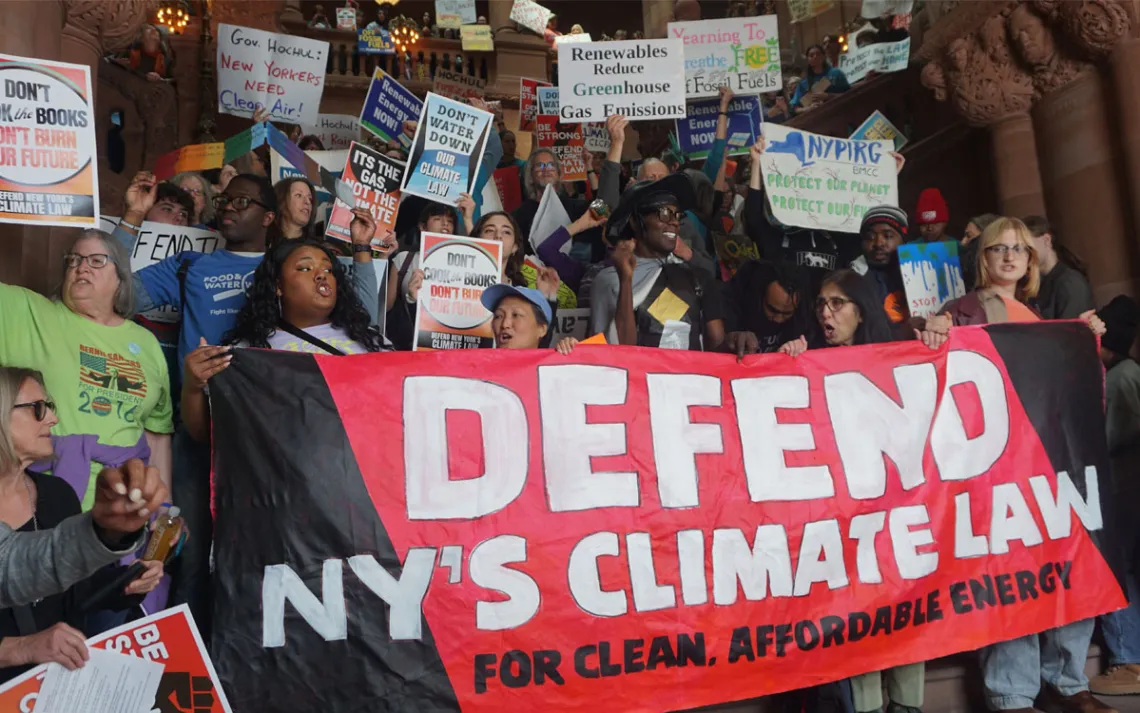
New Yorkers hold an event at the state capitol to urge lawmakers to stand firm on climate law commitments. | Renewable Heat Now/Lorenzo Mohammed
New York’s 2019 climate law was supposed to mark the dawn of a new age of climate leadership. President Trump had just withdrawn the United States from the Paris Agreement—a global pact to cut fossil fuel pollution—and Democratic lawmakers were eager to take the lead.
With the passage of the Climate Leadership and Community Protection Act (CLCPA), New Yorkers did just that—passing one of the most comprehensive climate bills in the country. Under the CLCPA, the state is required to reduce greenhouse gas emissions to 40 percent below 1990s levels by 2030 and at least 85 percent below 1990 levels by 2050.
Last week, New York’s Democratic governor, Kathy Hochul, unveiled a plan that would torpedo the law. The plan, if passed, would move the state’s initial emissions reduction obligations to 2040. It would also alter the way that methane, a powerful greenhouse gas, is accounted for so that its impact seems less threatening—at least on paper. But perhaps the most noticeable change, say the law’s proponents, is Governor Hochul’s proposal to push back the deadline to develop enforceable regulations for cutting planet-warming emissions by more than half a decade.
According to climate activists, Governor Hochul has waged a campaign of delay and disinformation, following millions spent to convince her to stymie the law in 2021. After that, she started to dither, first trying to change it in 2023. That failed after a resounding outcry from environmentalists and progressives. More recently, her administration just failed to execute the law, and this year, officials called the provisions expensive. With affordability top of mind for Americans, the governor has used that reasoning as justification to rein in the climate goals.
Conservation groups and lawmakers are calling foul. Some have called the governor's price concerns misplaced and instead laid the blame for the rising cost on fossil fuel, which continues to rise daily as war intensifies in Iran. They’ve also questioned the way in which she’s pushing for changes to the law, through the final days of the annual budget process, which happens behind closed doors.
On Wednesday, hundreds of New Yorkers gathered outside the state capitol building in Albany to call on lawmakers to reject the governor’s proposals. What’s needed most, they say, is new renewable energy that’s not subject to price volatility and gives New Yorkers options.
“If New York is one of the highest consumers of methane in the country, then the only way to stabilize our bills is to implement the CLCPA and get energy independence by building renewables,” said assembly member Anna Kelles in the state capitol building. “Undermining the climate law will do nothing to bring down energy bills that are surging because of our state’s reliance on polluting, expensive fossil fuels and utility spending on fossil fuel infrastructure.”
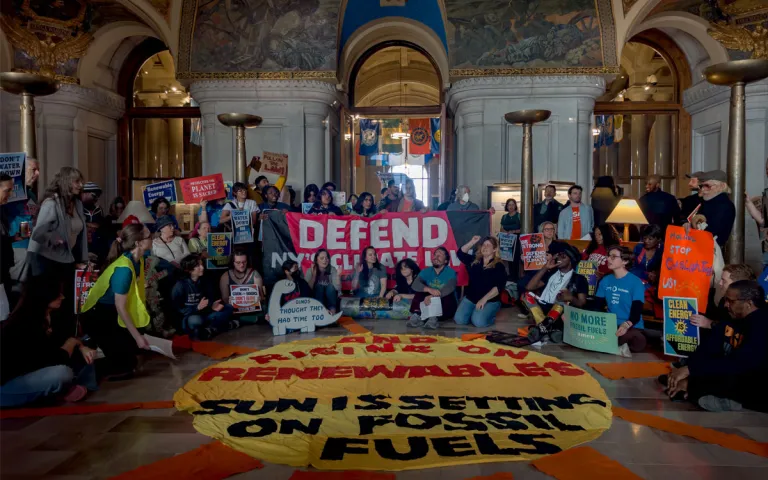
Activists convene inside the state capitol building's War Room. | Renewable Heat Now/Lorenzo Mohammed
Backtracking on targets
In her time as governor, Hochul has a history of wavering. Last June, she paused New York City’s congestion pricing program at the last minute. And after that, she nixed a building electrification law that required all new buildings to run on electricity. But perhaps the biggest reversal was on the only regulatory policy related to the state’s capstone climate law.
This initially came in the form of a cap-and-invest program. The governor, however, abruptly canned it days before it was expected to go into effect. The initiative would have required polluters to purchase allowances for their emissions, with a limit on total allowances. By most estimates, an economy-wide cap-and-invest program in New York is expected to raise billions of dollars annually. At least a third of that would go back to customers in the form of rebates to help offset any potential rate hikes. The remaining revenue would pay for at-home energy efficiency upgrades and support the buildout of industrial wind and solar. Both are expected to drive energy costs down.
The Climate Leadership and Community Protection Act required such a program to go into effect two years ago. Since New York passed its law, California and Washington have extended or started their own cap-and-invest programs, with Washington state netting over $3 billion in 2024 alone from its program.
Climate justice groups sued the Hochul administration last year over the delay and won. A judge ordered the governor to implement the law, noting that if she did not like it, she could ask the legislature to change it. The governor appealed the decision and, since the start of the year, has been lobbying lawmakers to push back deadlines.
That opposition came to a head in February when the New York State Energy Research and Development Authority (NYSERDA), which is responsible for crafting a climate program for the state, put out a memo that quantified the cost of an extreme version of a cap-and-invest program. They claim it could cost ratepayers an extra $4,000 per year, especially those who live upstate, where gas prices and heating costs are high. Their thinking goes that if the state imposes a price on pollution, companies will pass those costs on to ratepayers.
“Absent changes to the law, the New York State Energy Research and Development Authority found the impact of meeting the Climate Act’s 2030 targets would be staggering,” Hochul wrote in her op-ed. “And while the Climate Act is not the driver of the high energy prices we are experiencing, the undeniable fact is we cannot meet the Climate Act’s 2030 targets without imposing new and additional crushing costs on New York businesses and residents.”
Climate groups, researchers, and scientists say that the memo takes a worst-case scenario and leaves out cost-cutting measures. More than two dozen researchers responded to the state’s memo, asserting that it is not based on fact. Lisa Marshall, the advocacy and organizing director at New Yorkers for Clean Power, said the result of the letter was a widely covered document that amounted to one big scare tactic.
It seems to be working. Since the memo was released, much of the television media coverage has focused on the memo's numbers, while overlooking the amount of money a cap-and-invest program would generate. Meanwhile, economists have long argued that the best way to bring prices down in any sector is to make options available. In this case, these options would be utility-scale solar and wind, which can be a fraction of the price of oil and gas.
Stephan Edel, the executive director of NY Renews, a coalition of more than 300 environmental groups, said that the NYSERDA memo relied on a cost per allowance that no one ever put forward. The authors assume the lowest price of emitting carbon would be $120 per ton. However, this is wildly above the price in other states. Under California’s cap-and-invest program, for example, an allowance is $30 per ton.
“The level of misinformation is really extreme,” Edel said. “It strikes many of us as disingenuous to be fighting this fight during an election year when the deadline is years out and [the governor is] trying to hold the legislature hostage on key pieces of the budget to get her way.”
Budget deadline
Among her targets, Hochul is reviving her attempt to alter how New York state assesses the threat of methane. The gas is 80 times more powerful than carbon dioxide at heating the planet during its first 20 years in the atmosphere. The governor wants the state to look at methane’s impact over 100 years, making the impact of methane seem less dire and also screwing the numbers to seem as if the state has done more than it really has.
The legislature has a deadline of April 1 to iron out a budget that would incorporate the governor’s proposals into the law. But New York’s budget process is notorious for going beyond its due date. Some have suggested that the governor, who controls the budget, will try to assert her will on legislators, who may be eager to get back to their districts as election season gets underway. And some of them, even those who support the law, have indicated a willingness to make modest adjustments to the deadlines but not the overall goals and ambitions.
“When you have a plan, you have to do what you can to follow it as best you can, and the CLCPA gives us the outline of where we need to go and how quickly we need to get there,” assembly member Deborah Glick, who represents Manhattan, said. “Sometimes, one faces unexpected changes in reality, and you make modifications, but you don't make wholesale changes.… New York has to find a path to expand renewables as quickly as possible because that is what will make energy more affordable.”