How Wildland Firefighting Culture Poses Its Own Risks
Traditional ideas about gender and masculinity take a toll on the firefighting community
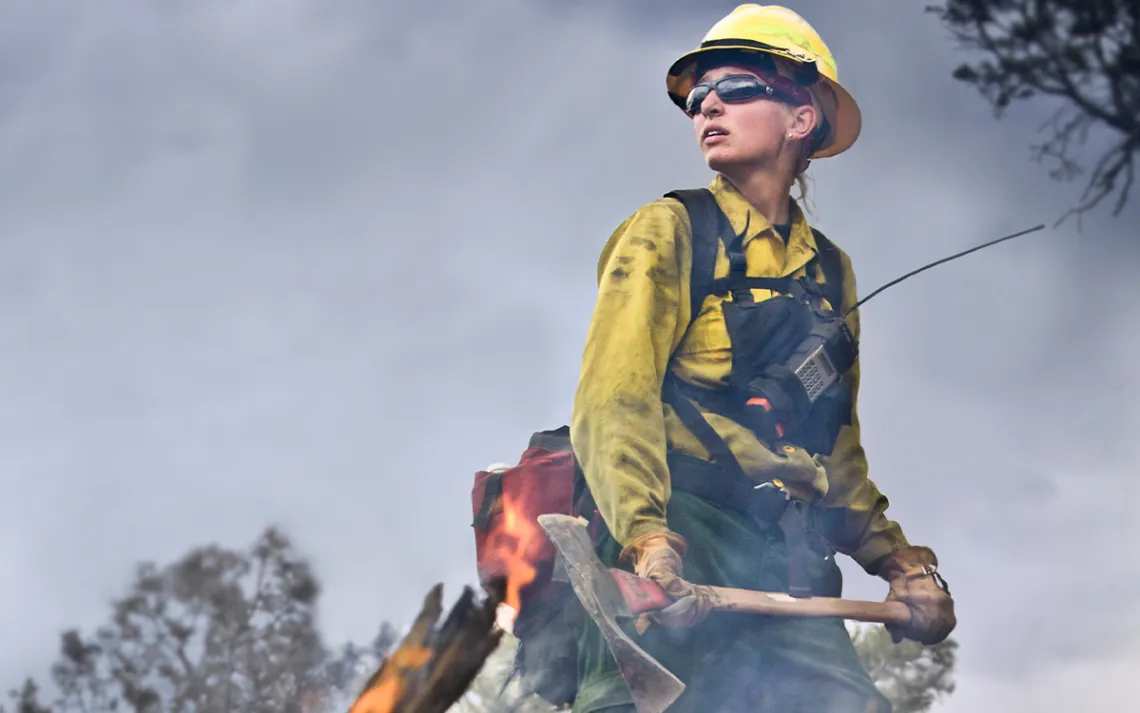
Photo by Tyler Stableford
There are 10 Standard Firefighting Orders and 18 Watch Out Situations in the Incident Response Pocket Guide, reminding wildland firefighters how to identify and avoid dangerous scenarios. The final standard order instructs them to “Fight fire aggressively, having provided for safety first.” These lists are meant to keep them safe.
But the IRPG doesn’t address the dangers of toxic fire crew culture, or the ways that entrenched beliefs and behaviors can fail wildland firefighters. For more than a century, long-standing gender norms have shaped wildland-firefighting culture and policies, fostering an environment that can exclude some firefighters and put their safety at risk.
As a squad boss, Courtney Kaltenbach aims to foster a zero-tolerance culture for their crew. But when they first started wildland firefighting, they remembered their supervisors telling the crew not to make eye contact with anyone as they walked through a fire camp, lest they be seen as weak.
“That concept of being tough and having to really change yourself to fit into that workplace is a big part of what masculinity means to me within wildland fire,” Kaltenbach said. “It also means … people that I've worked with have been harassed, and in these very blatant actions that can be traced to sexism.”
Kelly Ramsey, a former hotshot—part of an elite team of wildland firefighters—described a similar pressure to prove herself when she was the only woman on her first crew.
“I felt like I had to come here and represent all women and prove that a woman could do this,” Ramsey said.
Ramsey forced herself to adapt and assimilate to the hyper-masculine environment in which she was surrounded, and described the crew as hostile and exclusionary, often without even trying.
“Being ignored is powerfully shame-inducing and frightening,” she said. “They didn't know how to engage with me, but kind of everything about the way they acted at first made me feel like an outsider and an alien.”
Traditional notions of masculinity can also put male firefighters at risk. Some crews look down on anyone who shows signs of caring about their health, associating weakness with basic safety measures like wearing an N95 mask to prevent inhaling carcinogenic particulate matter, or showing concern for chemical exposure.
These harmful gender norms on the firefighting line have a long history that dates back to the creation of the US Forest Service.
“Men Wanted!”
Under a header “Men Wanted!,” one advertisement for a USFS ranger position in 1905 read that it was “not a job for those seeking health.”
That year, President Theodore Roosevelt created the US Forest Service to protect natural resources and make more land public—primarily considering the interests of white Americans. The agency’s foundation was a radical move at the time; legislators with ties to the timber industry did not approve of the idea that forests should be protected and made public rather than abused for the financial gain of a select few. It wasn’t until a wildfire blazed through more than 3 million acres across three states in 1910 that the United States government moved to halt wildfires, unlike any other act of nature. Congress saw the value in funding an organization that managed American forests—and men who would fight their wildfires.
But even as the agency gained status, the work of a USFS employee was viewed as only a man’s job—specifically, a white man’s job. A 1950 USFS employment leaflet stated, “The field work of the Forest Service is strictly a man’s job because of the physical requirements, the arduous nature of the work, and the work environment.” During the 1910 fire, Buffalo Soldiers put their lives on the fire line and saved a small Idaho town from turning to ash, all while residents made racist remarks about their town’s soon-to-be heroes.
Then, in 1978, Congress passed the Civil Service Reform Act to create a “federal work force reflective of the Nation’s diversity.” This introduced affirmative action into the USFS. More women and people of color were hired as a result, but often not into roles where advancement into leadership roles was possible. A 2023 study found that BIPOC women hired into the USFS were the least likely to be promoted. To remedy the same kind of discrimination within the National Park Service, the agency created a pilot program in 2021 to create two all-women fire crews. The initiative drew in and empowered scores of women until the Department of Government Efficiency eliminated its funding in 2025 for advancing diversity, equity, and inclusion.
Tim Ingalsbee saw the result of the diversification mandate after being recruited as a wildland firefighter in 1980. He explained that seeing women hired onto crews and into leadership positions caused some men “distress.” They felt that the women hadn’t earned their way into the positions, leading them to disrespect the women or second-guess their decisions, regardless of rank. But Ingalsbee thought his diverse crew stood out from the all-men crews.
“I was on crews where half of them were women,” Ingalsbee said. “We had female leaders, and we really stood out in that time with our decision-making processes, [which were] much more democratic and collective.”
While Ingalsbee’s crews embraced the diversification efforts across agencies, others did not. River Selby joined a hotshot crew in the early 2000s, the first woman to do so in a long time. Selby said their crew treated affirmative action “as a joke.”
“It was my perception that I had been hired as an affirmative-action hiring,” Selby said. “It was just very clear that I was a minority. Some of the guys I worked with were scared to engage with me because they didn't want to say or do the wrong thing. Some of them seemed to resent me, and my superintendent really made it a point to point out my gender all the time.”
Prior to their experience as a hotshot, Selby was a wildland firefighter on different contract crews, which work for private companies as opposed to federal and state agencies. They said these crews were often more diverse and felt more welcoming, making the job enjoyable. They were excited to advance, become an elite firefighter, and make an entire career out of wildland firefighting. But Selby’s first hotshot crew was so toxic and disrespectful toward them that, despite being on a less alienating crew the following year, they were mentally unable to continue in the sector.
When gender stereotypes threaten lives
Firefighters operating on the ground face different risks. A reluctance to reconsider established approaches can perpetuate outdated and potentially dangerous practices. The “10 a.m. policy,” for example, was codified in 1935 and required crews to extinguish any wildfires by 10 a.m. the following morning. It was ultimately abandoned in 1978 after agencies recognized that such aggressive fire-suppression tactics were not only bad for the environment but also dangerous for firefighters.
The Trump administration is trying to bring back the full-suppression mindset of the failed 10 a.m. policy. Some wildland firefighters worry that the continuation of this aggression could be lethal. Similarly, others worry that after the administration fired hundreds of tenured firefighters, the lack of experienced leaders could put crews in danger. The administration is also trying to move wildfire-fighting responsibilities to the Department of the Interior while simultaneously restructuring the Forest Service.
Wildland firefighters’ mental health has also suffered from a culture that staunchly opposes talking about feelings. A 2021 study found that wildland firefighters had higher rates of depression, anxiety, and PTSD than the general public. Another study found that 36.7 percent of surveyed wildland firefighters experienced current suicidal ideation.
“You [were told] to suck it up and stuff it in,” Ingalsbee said. “That's caused lasting damage, even to men of my generation.”
Wildfire seasons will get worse and deadlier as climate change exacerbates the size and intensity of fires. A hyper-masculine, war-on-wildfire culture will not help. A recent survey from advocacy group Grassroots Wildland Firefighters reports high rates of burnout and low morale among crews, with one respondent saying, “Distrust is at an all-time high, leading everyone to an every-person-for-themselves mentality."
A cultural shift
According to some wildland firefighters, one necessary change is the culture within the sector so that anyone can see themselves enjoying wildland firefighting. Ramsey explained that she’s noticed a slow change within crew composition. More college-educated folks seem to be joining crews to steward the land, instead of seeing it as just a summer job.
Kyle Trefny and Megan Bolten have both been wildland firefighters on diverse contract crews in the Pacific Northwest for over five summers. They feel like their crews have fostered a healthy culture by having a strict zero-tolerance policy, made more meaningful by coming from their leadership.
“I've experienced a culture where generally there's a sense of safety and support,” Bolten said. “And that really allows you to work well and continue showing up for work and continue showing up year after year and [have] a physical and mental ability to do that.”
That isn’t to say they’ve completely escaped the “fire bro” elements that persist in wildland firefighting culture. But with a more supportive culture, they haven’t been driven away from the sector, even practicing prescribed burns when they’re not actively fighting a wildfire. Ingalsbee believes this shift in culture and mindset is central to improving the wildland firefighting workforce, ultimately protecting both the environment and the lives of those who want to see it thrive.
“Working with fire should be a labor of love,” Ingalsbee said.