The Devastating Wildfires in Spokane Point to the Risks for a Hotter Planet
The city and its first responders are still struggling to recover after three wildfires combined, wiping out thousands of acres
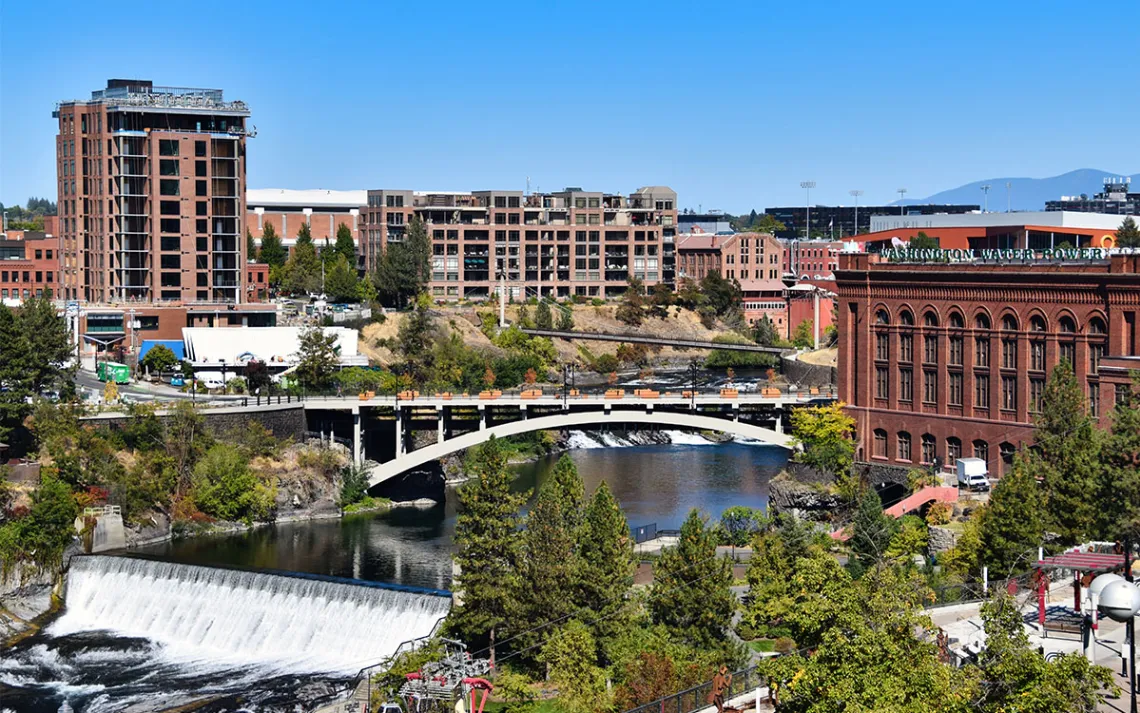
City of Spokane at Spokane Falls. | Photo by Brandon Withrow
In Spokane, the outdoors is never far from city life. That’s why I visit every year—my home away from home. Hikers can find lush trails here that stretch between Ponderosa pines and Douglas firs. The landscapes are breathtaking.
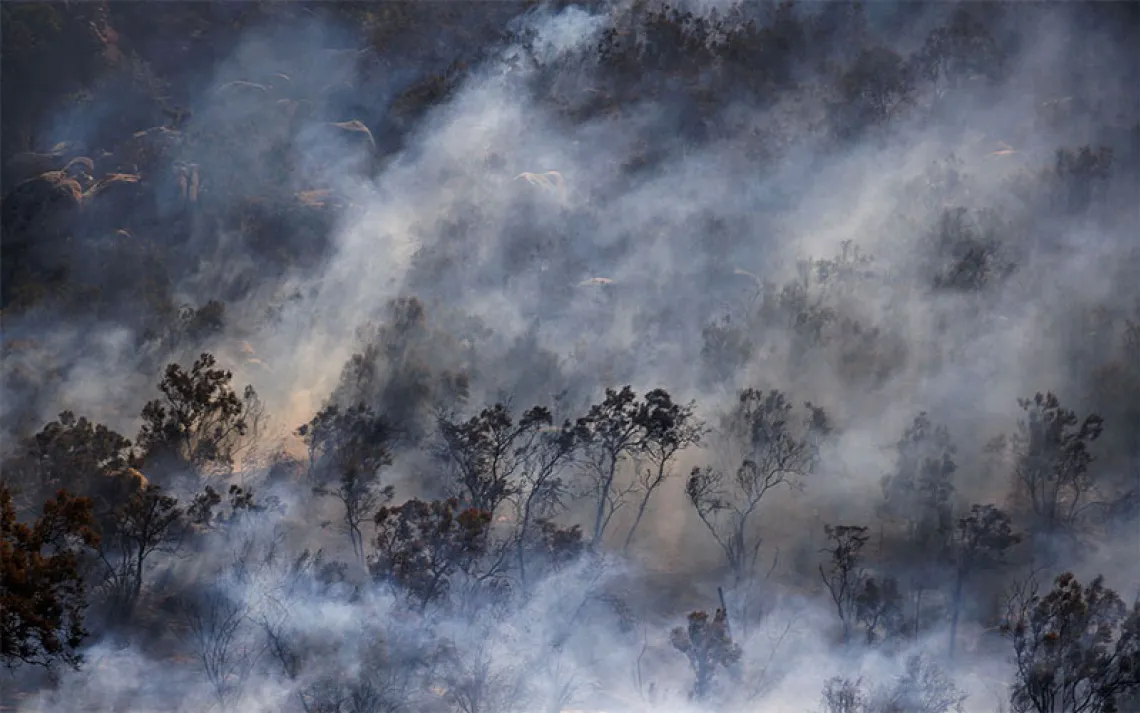
That proximity to wildlands, however, is why the city was so vulnerable to a massive wildfire last August. Three fires combined to ravage Spokane, forcing 65,000 people to evacuate, wiping out nearly 10,000 acres, and destroying 649 primary residences.
Climate change is amplifying fire danger throughout North America. Not all fires can be treated equally—some, like the fire that impacted Spokane, do not involve federal forest land, whereas others do and require a different response. For communities like Spokane, what happened is not simply a warning of what the future could be; it’s a promise that our climate inaction will have catastrophic consequences.
Spokane’s Old Trails, Autumn Lane, and the Fairview fires, together known as the Spokane Complex Fire, were unprecedented. Two of those are thought to be accidental, while the largest of them, the Old Trails Fire, was traced to arson. The suspect, Aaron Farinacci, who confessed to setting the fire and several others, is facing a competency hearing. Old Trails burned roughly 3,200 acres, destroyed 400 structures, and upended the lives of thousands.
It was “an extremely above average fire season for the state of Washington,” said Ryan Rodruck, the communications manager for the Department of Natural Resources Eastern Washington. He noted that the National Weather Service issued for the first time in the state of Washington a warning called a “Particularly Dangerous Situation,” where both the fuel and weather made for severely dangerous conditions.
Fires across Washington have caused $188 billion in damage, pushing Governor Bob Ferguson to request $117 million in funding from the federal government.
“It was certainly one of the more intensive and destructive fire seasons that I have experienced in my career,” Rodruck added, “and certainly one of the most intense and destructive fire seasons that the state of Washington has seen in recent memory.” Fires across Washington have caused $188 billion in damage, pushing Governor Bob Ferguson to request $117 million in funding from the federal government.
Matthew Kincanon grew up in Spokane and graduated from Gonzaga University with a journalism and political science degree. He’s a writer for the local publication FāVS News. On Saturday, August 1, Kincanon made plans to meet up with college friends at a park.
“That’s when I got the notifications about the fire,” he told me. He was used to seeing fire notifications in the region. “Because we have great firefighters, they usually address everything pretty quickly,” he said.
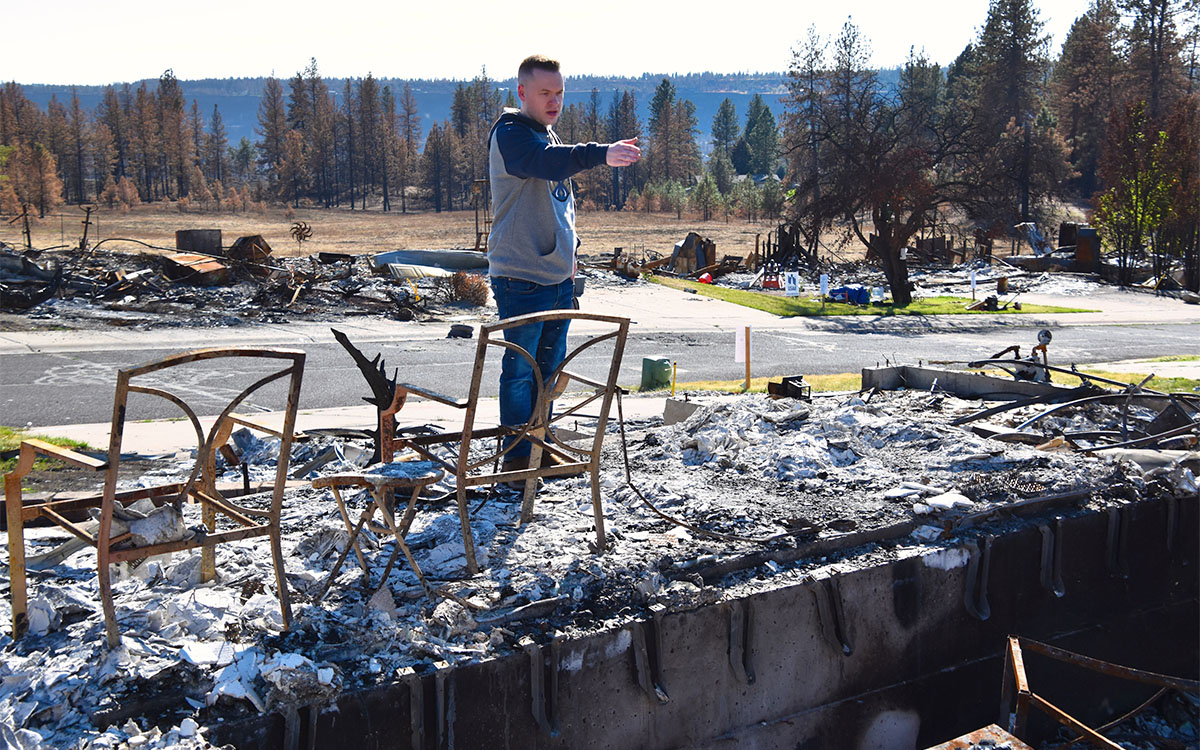
Matthew Kincanon at his former home in Spokane. Photo by Brandon Withrow
Before he left his house, which he rented from his parents, he was notified again. This time the fire had jumped the nearby Spokane River and his neighborhood was now listed in the evacuation zone. “And that's when I started coordinating with my brother and my fiancé,” Kincanon said. “I was also just rushing around packing things, putting what I could in my car.”
Within 30 minutes to an hour, his house was engulfed.
“I lost everything in that fire,” he told me. “It took so many things that represented 30 years of my life.”
The lost items include artifacts from his childhood and school days, including art projects, and his cherished collection of 1,100 films, including every Best Picture winner. His fiancé lost belongings as well. He found himself temporarily living in his old childhood bedroom at his parents’ house. Kincanon’s editor started a GoFundMe for support and others in the Spokane community reached out to offer clothes, a guitar, and even bins of DVDs. A friend from the Spokane Tribe of Indians gave him a blanket as a prayer for his future, and he’s slept with that blanket ever since.
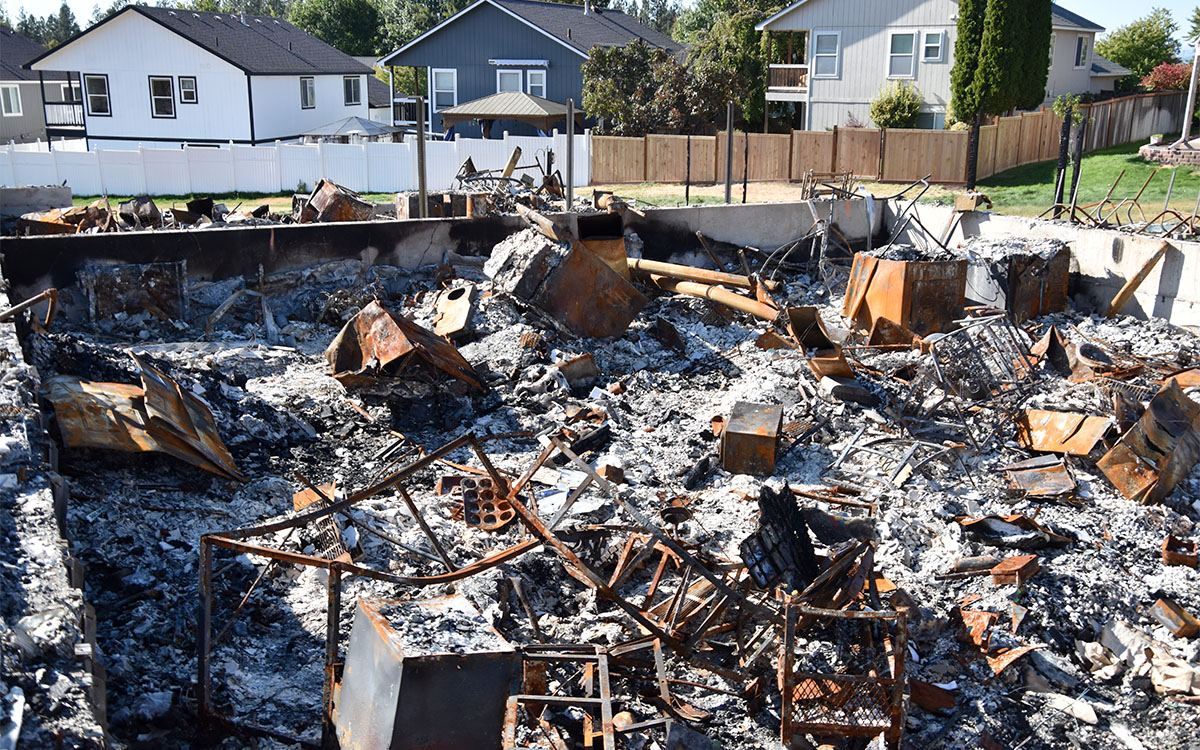
The ashes of Matthew Kincanon’s former home in Spokane, Washington. | Photo by Brandon Withrow
What happened in Spokane reflects a global trend: extreme fires. In some areas of the European Union, like France and Spain, the fire season has been rough and extreme, leading to broken records on a country-by-country basis. There are more intense or extreme fires due to rising global temperatures, less moisture in the air and ground, and a history of forestry practices - especially clearcutting and strict fire suppression - that contributed to increased fuel loads. A recent study from UCLA using satellite data, for example, found that high severity forest fires in California are outpacing historical, “ecologically restorative” fires.
Mitchell Hung, one of the authors of the UCLA paper and now a Ph.D. student at Stanford University, told Sierra, “From 1985 to 2024, we are seeing much more high severity fires today, that is, more forest-killing fires today than we did at the beginning of the study period in the 1980s.”
One of the drivers, he said, “is this growth in atmospheric dryness.” During the study period there was “a steady increase in the atmospheric dryness during the fire season, and that has strongly correlated to the amount of high severity fire you get in any given year.” Forestry practices that focus on fire suppression, allowing for denser forests, he noted, provide the fuel for extreme fires.
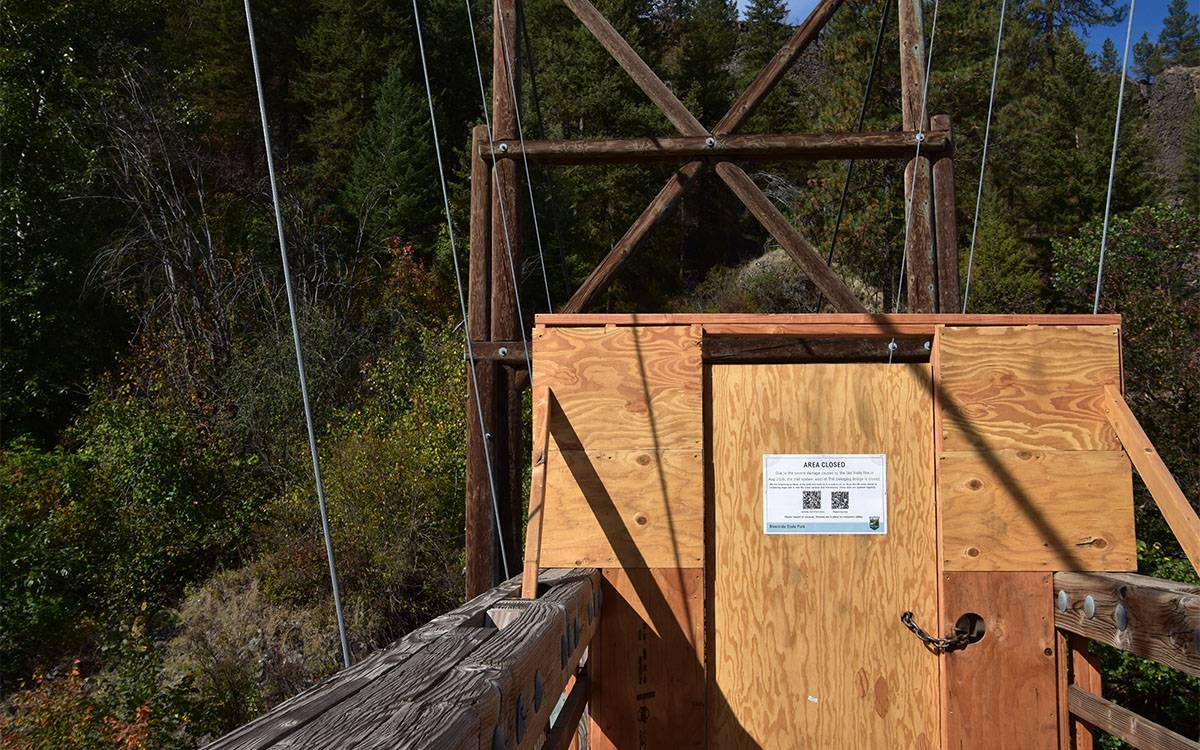
Doorway blocking the end of the suspension bridge at Riverside State Park’s Bowl and Pitcher due to unsafe conditions on the trails resulting from fire damage. | Photo by Brandon Withrow
More studies are showing that severe fires will prevent forest recovery and force landscape changes. According to Hung, “the higher the severity of a fire…the more tree mortality there was.” Forests are not recovering like they would in less severe conditions.
Hotter and drier conditions, amplified by global warming, will make these conditions worse. According to a new UN Environment Programme report, global action failed to cut emissions in time to avoid the Paris Agreement’s 1.5°C mark. Even an “optimistic scenario” still results in an “expected peak temperature” at 1.8°C. “With unprecedented action it is possible to minimize and adapt to the impacts of exceedance and return to 1.5°C,” the study says, but “this is by no means an acceptable or preferred pathway; it is simply the best remaining option.”
Authorities have determined that the Old Trails Fire was a case of arson and charged Aaron Forrest Farinacci, who confessed after his arrest. He exploited these climate weaknesses. According to the indictment, Farinacci admitted to planning the Old Trails Fire for two weeks and that he knew the consequences. He studied the weather and planned accordingly. Spokane had a lower snowpack and a dry summer. He said he waited for what he knew would be a day of “high winds, low humidity” and “high heat.” High winds pushed the fires to what fire scientists call the wildland-urban interface, the place where the city meets the forest, providing fuel and a recipe for disaster.
“That was definitely the most extreme fire day I’ve had in my career...apocalyptic,” said Kyle Breeding, a firefighter for the Spokane Fire Department, recalling the day he arrived at the chaotic scene during his 72-hour shift. The thick smoke and incredible speed of the fire made it hard for them to know where resources should go to “make a difference,” he noted.
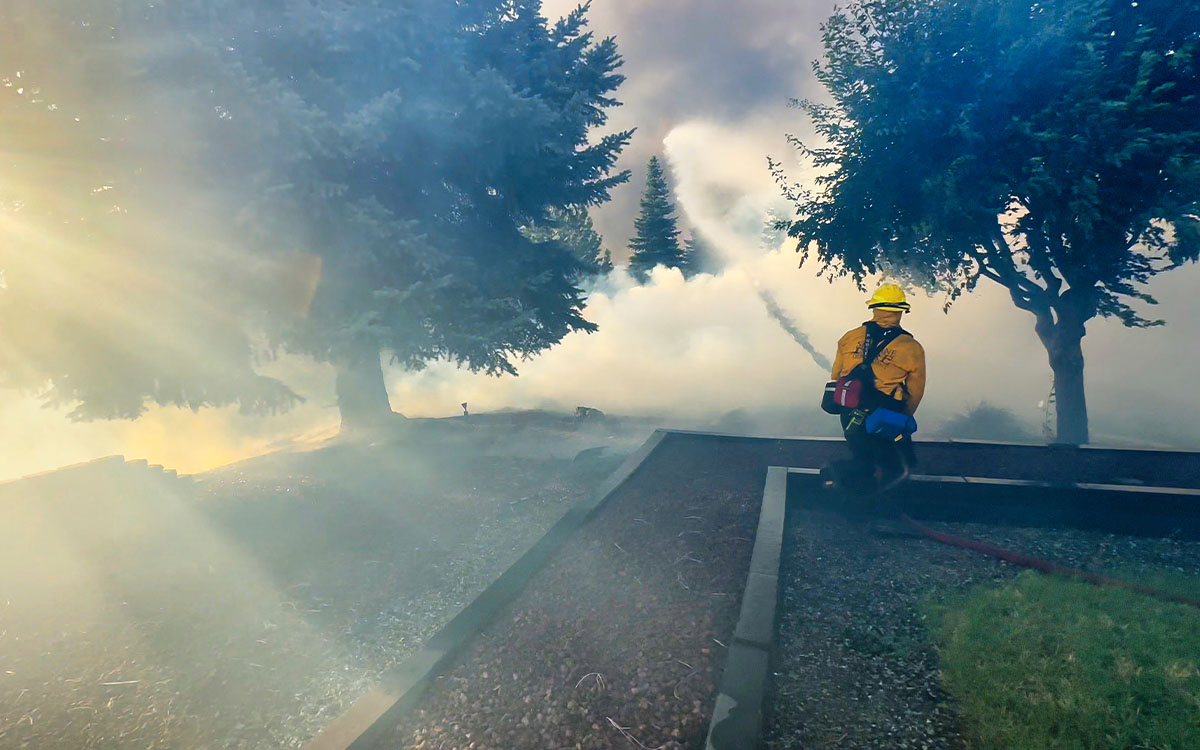
Firefighter Kyle Breeding of the Spokane Fire Department fighting the Old Trails Fire. | Photo courtesy of Spokane Fire Department
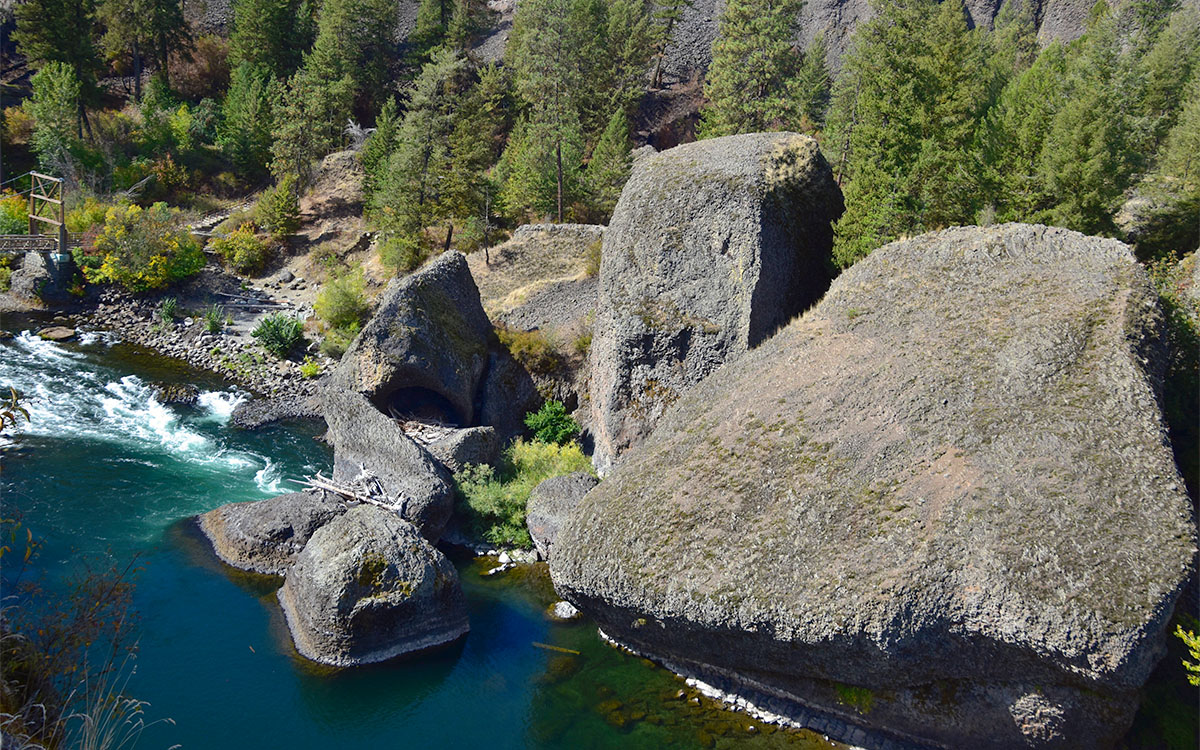
Riverside State Park Bowl and Pitcher Area with Bridge. | Photo by Brandon Withrow
Fires moved so quickly that the roughly two-minute process of hooking up to a hydrant to protect homes became a safety risk for the crew and the firetruck. With hundreds of homes ablaze firefighters tried to find a way to stay ahead of it to “protect what they could.”
The next morning, they went into homes that were smoldering or still “halfway involved in a fire,” Breeding said, grabbing baseball trophies and family photo albums and putting them out on the curb to save what they could.
Normally, these first responders are fighting a fire at a house or two. This event was beyond their resources.
“It was very demoralizing,” Breeding said.
A month after I spoke to Kincanon, I arrived in Spokane and met him at his former home. The house and his neighborhood were located on one side of a river. We walked his ash-painted street, where only the foundations of homes, burned-out cars, and remnants of his former life remained. Across the water, Riverside State Park was still standing thanks to local firefighters who were able to fight back the flames there, saving an historic bridge in its popular Bowl and Pitcher Area. But they could only do so much.
“I miss my house; I miss the life I built in there,” Kincanon told me, pointing to the ashes. He said that sometimes he thinks about resting on his couch and then realizes, “No, I don't have any of that.”
He's looking forward to starting a new life together with his fiancé, and to leaving “all the pain” in those ashes.