 The Magazine of The Sierra Club
Sound Full of Rainbows
Grateful Dead songs evoke the splendor of the natural world
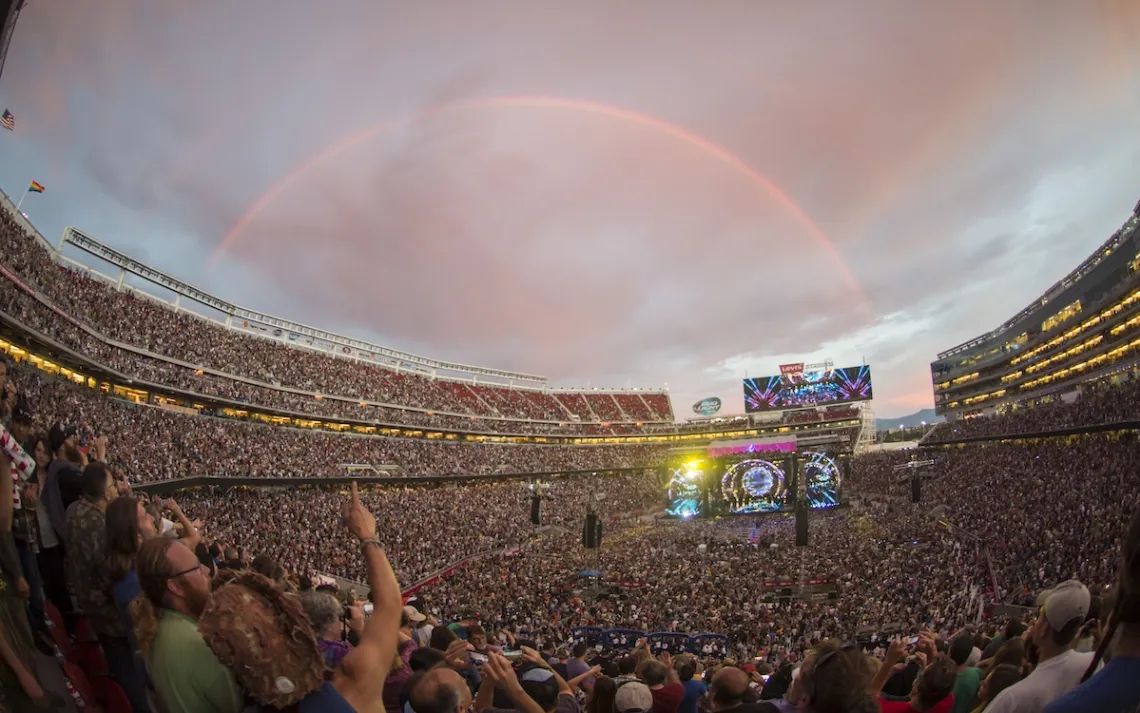
A 2015 Grateful Dead performance in Santa Clara, California. | Photo by Invision for the Grateful Dead/AP Images
We can discover the wonders of nature
Rolling in the rushes down by the riverside…
Sugar Magnolia
Ringing that bluebell
Caught up in sunlight
Come on out singing, and I'll walk you in the sunshine…
— “Sugar Magnolia” by Bob Weir and Robert Hunter
In the days since Grateful Dead rhythm guitarist and singer Bob Weir died on January 10, the band has been lauded for its daring musicianship, remarkable endurance, and dedicated fans. One aspect that’s been largely overlooked: The Dead celebrated the planet and its seductive beauty with vision and inspiration.
Through lyrics and music, the band encouraged followers to get outside and enjoy nature, to cultivate a love for mountains and rivers and oceans and forests, and to protect the only home we have.
The 1980s anti-nuclear anthem “Throwing Stones,” written by Weir and longtime songwriting partner John Perry Barlow, starts: “Picture a bright-blue ball just spinning, spinning free / Dizzy with eternity.” The song speaks to “a fear we can’t forget” that the human race could “lay our home to waste.”
Songs such as “Weather Report Suite” evoke America’s agricultural heritage during a time when staying in tune with the seasons could mean the difference between hunger and abundance. Part II of the suite, “Let It Grow,” has this verse: “Round and round, the cut of the plow in the furrowed field / Seasons round, the bushels of corn and the barley meal / Broken ground, open and beckoning / to the spring, black dirt live again.”
“Weather Report” goes beyond appreciating Earth’s offerings, said David Dodd, author of The Complete Annotated Grateful Dead Lyrics. “That’s the big song for me,” he said, because it speaks to “the divinity of the planet itself.”
Co-writer Barlow was a biblical scholar, and the line, “Listen to the thunder shouting, ‘I am, I Am, I AM!’” is an invocation of Yahweh, the Hebrew name of God in the Old Testament. “He’s saying that the planet is divine,” Dodd said, and “we don’t have anything except this planet.”
The Dead sang about people who lived close to the land: the cowboys of “Me and My Uncle” and “Mexicali Blues,” the mariners in “Lost Sailor” and “Saint of Circumstance.” The numerous plant and animal names in their songs, from “Scarlet Begonias” to “Dire Wolf” call out the natural world, Dodd said.
At his home in Northern California, Dodd has a garden of plants named in Grateful Dead songs: lilacs for the “lilac rain” in “Unbroken Chain,” lilies for “escaping through the lily fields” in “The Other One,” and manzanita for “the manzanita stark and shiny in the breeze” from “St. Stephen.” Naturally there are begonias for “Scarlet Begonias” and magnolias too.
Scientist Eric Beattie, a longtime Grateful Dead listener, cites the song “Eyes of the World” with these lines: “Wake up to find out that you are the eyes of the world / But the heart has its beaches, its homeland and thoughts of its own.”
Written by Robert Hunter with music by the Dead’s lead guitarist, Jerry Garcia, the song was “way ahead of its time,” Beattie said, citing a theory that humans manifest the planet’s consciousness.
“The new physics, which I don’t completely understand, suggests that our consciousness may not be a happenstance of the universe’s evolution, but an indication of its basic structure,” he said. “On a more emotional level, (the song) is just an invitation to celebrate the world around you and be grateful for your awareness as you start that great hike in the beautiful Sierra!”
The Dead reveled in playing at gorgeous outdoor venues such as Colorado’s Red Rocks, a natural amphitheater set among dramatic ochre cliffs. A Bay Area band, some of the Dead’s best shows were at Berkeley’s Greek Theatre, backed by San Francisco Bay, where you could see the sun set behind the Golden Gate Bridge. Another favorite: Stanford’s open-air Frost Amphitheater, a stone’s throw from where Garcia and Weir met at a music shop in Palo Alto on New Year’s Eve in 1963.
Grateful Dead bassist Phil Lesh wanted the band to play at what he called “places of power.” In 1978, the Dead performed at the ultimate “mojo” site, the Pyramids of Giza in Egypt. During the last of three shows there, as they performed “Fire on the Mountain” and “Sunrise,” a lunar eclipse traversed the pitch-black sky.
Early in their career, the band often played free shows in San Francisco’s Golden Gate Park, near the house they shared in the city’s Haight-Ashbury district. Fittingly, their final three shows, celebrating 60 years of the Grateful Dead last August, were in the same park.
The Dead sometimes appeared to have a connection to natural forces. On June 27, 2015, during one of the 50th anniversary concerts, a luminous rainbow appeared over Levi’s Stadium. The colors were so intense that some thought it was a special effect. The rainbow may have seemed supernatural, but like the Dead’s music, it was real as could be.
On January 14, 2024, just before Weir sang the opening lines to “Looks Like Rain,” at a beach venue in Mexico, a warm rain began to shower the audience, abating at the end of the song. Some fans thought Weir was playing to the weather, but a photo of the setlist revealed the song had been planned ahead of the show.
At the celebration of life at San Francisco’s Civic Center Plaza on January 17, former Speaker of the House Nancy Pelosi said that Weir “believed in the stewardship of the Earth … long before it was fashionable. … He invited us to wander and wonder, and to keep on listening.”
Bob Weir’s daughter, Monet Weir, noted that her father walked his talk, playing at benefits to raise funds for environmental and social justice groups. And he brought his eco-ethic home: “He insisted on our family using reusable bamboo paper towels, which by the 17th wash became little more than a moldy ball of lint. He was very upset when we eventually threw them away,” Monet said with a laugh.
While Bob Weir’s wife and daughters spoke at the memorial, a resplendent red-tailed hawk appeared overhead. A coincidence perhaps, but just about everyone there felt Bobby’s spirit, circling his loved ones and admirers for a final time before soaring to his next adventure.
The Dead’s final act was a decade-long collaboration with guitar wizard John Mayer in an ensemble called Dead & Company. Though it took Mayer a few years to fully understand the emotional depth of the Dead’s repertoire, he injected new life into the band and paired well with Weir. The outfit had an exultant farewell tour in 2023, only to reemerge at a new venue in 2024: Sphere in Las Vegas.
At Sphere, a half century after the Dead had created its monumental Wall of Sound, Deadheads were surrounded by 167,000 speakers, a pristine sonic experience like no other. Lavish videos gave viewers the sensation they were rising above Earth into space.
While the video sequence changed nightly, each Dead concert at Sphere opened with images of the band’s 1960s home on Ashbury Street. The “camera” would rise up to show San Francisco, the verdant hills and surrounding bay, all of California, then the planet: a bright-blue ball spinning free, dizzy with possibilities.
“It’s a big journey,” Dodd said. For three hours, viewers flew through fantastical visions of the cosmos, serenaded by songs such as “Dark Star.”
In the Dead’s view, “the natural world extends beyond the planet into space,” Dodd said. In “Standing on the Moon,” Weir (and Garcia before him) sang: “A lovely view of heaven, but I'd rather be with you.” Dodd noted, “See what they’re paying attention to: It’s the planet (Earth) down below.”
Every Sphere show ended with a return from space, back to Earth. The message was as clear as a crisp mountain morning: There’s no place like home. The 1939 film, The Wizard of Oz, now playing at Sphere, conveys the same message.
Dead songs are often metaphorical, encouraging listeners to stay present and go with the flow. Consider “Birdsong,” which advises: “Laugh in the sunshine,” and “Sleep in the stars / Don’t you cry / Dry your eyes on the wind,” a nod to the warm embrace of the natural world.
The Dead’s penultimate show ended with Weir, clad in an Earth-tone serape (wool poncho) and Stetson hat, singing “Brokedown Palace,” one of the band’s many river songs: “River gonna take me, sing me sweet and sleepy / Sing me sweet and sleepy, all the way back home / It's a far gone lullaby, sung many years ago / Mama, Mama, many worlds I've come since I first left home. / Going home, going home / By the waterside I will rest my bones / Listen to the river sing sweet songs / To rock my soul.”
So much expressed in so few words: the distance the protagonist has traveled physically and spiritually, the soothing sounds of the river’s lullaby, the ultimate surrender every living being must endure. Most of all, the song speaks to the healing power of nature.
Michael Shapiro attended his first Grateful Dead show as a teenager in December 1980, his second show two nights later, and his third three nights after that, on New Year’s Eve. The band’s evocation of the natural world played a part in Shapiro becoming a whitewater river guide. He’s the author of two interview collections, The Creative Spark and A Sense of Place. Shapiro has written features for National Geographic, The Washington Post, and The San Francisco Chronicle. His most recent story for Sierra is a tribute to Jane Goodall. Learn more: http://michaelshapiro.net/