How to Talk (and Listen) to Nature
Rosey Chan pairs natural sound with classical piano to help heal both people and the planet
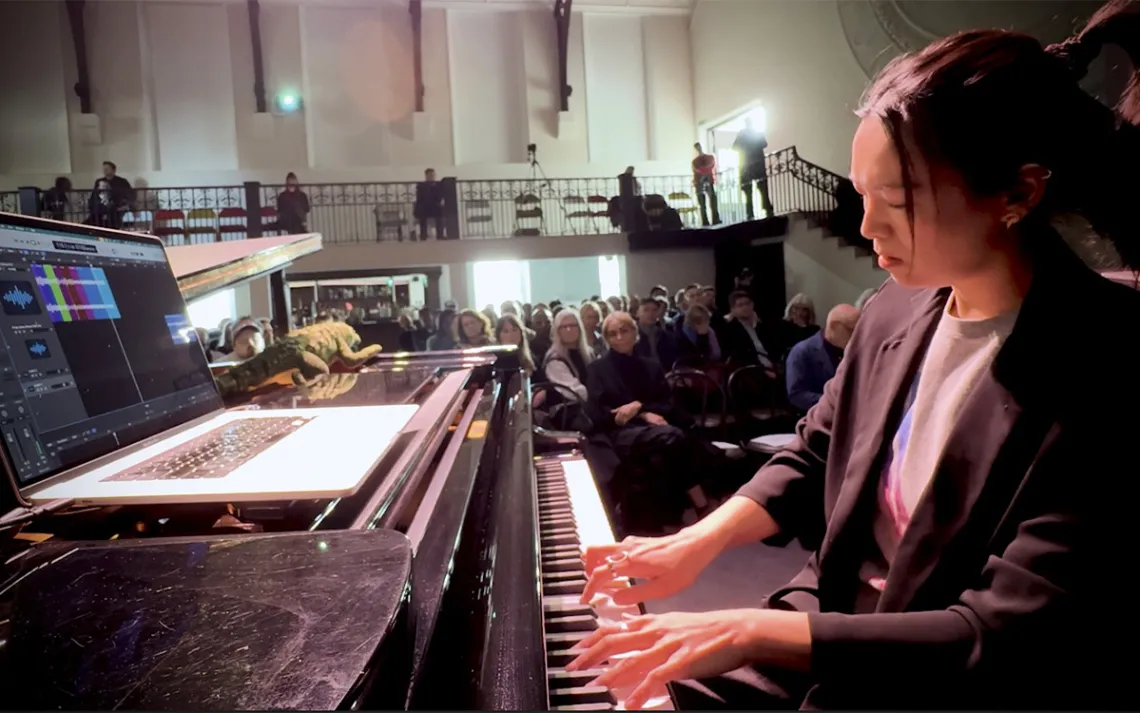
Photo courtesy of Rosey Chan
First comes the slow rise of hoots, trills, and crashing waves. Then, with almost clinical precision, you hear a single note from a piano. This pattern of nature’s cacophony, supported by a classical melody, repeats itself throughout Rosey Chan’s latest album, Sonic Earth. The album is a result of her spontaneous reactions to sounds of nature recorded from all over the world. It is the latest in Chan’s ongoing attempts to “bottle up” her music as therapeutic prescription.
When I met Chan in her apartment on a rainy London afternoon, she had just returned from a two-week trip to her home in a small Italian town free from the distractions that come with cellphone coverage.
Trained in classical piano at the Royal Academy of Music and the Royal College of Music, Chan also studied improvisation with jazz musician Yonty Solomon, an influence that continues to shape her work. After graduating, she toured as a concert musician and had the opportunity to perform in some of the “greatest concert halls and venues.” But she soon began craving something more. “If I wasn't able to play classical music, I can't imagine writing the music that I do today,” she said. Giving up a regular paycheck seemed frightening, but Chan wanted to use “this gift that I've been given and worked really hard to sustain,” in a more meaningful way.
Chan has been incorporating natural themes into her multimedia performances for years. At a concert for the environmental law charity Client Earth in 2017, Chan displayed visuals of the earth to electronic music. Since 2007, Client Earth has taken legal action against industry and governments that have been involved in unsustainable extraction of natural resources. Chan connected with the founder, James Thornton, who is also a poet, because of their shared interest in using art and culture to highlight environmental issues.
Then around 2020, she met Martyn Stewart from Listening Planet. Since the age of 11, Stewart has been capturing sounds of flora and fauna from around the world. Recorded from over 60 countries, the Listening Planet library contains archives of a disappearing world, from the grunts of white rhinos to snorts of polar bears. For Chan, who is “always reaching for a sound,” to be able to hear and respond to almost any sound nature had to offer proved transformational.
The resulting tracks display her strong foundation in classical music and her knack for improvised riffs. On Sonic Earth, we hear a conversation between Chan and the birds, brooks, and wolf howls. Gentle human notes playing off wild cacophonies can make listeners feel closer to nature even while listening to it while deep underground on the London tube.
But there are also reminders of ecological fragility. At around five minutes and 45 seconds in "Response," we hear a chainsaw’s whir as it digs into the bark of a tree. Sounds can be very evocative, so for an audience that’s not used to something like this, she remembers thinking, “We need to gently” introduce them to it.
The tracks in Sonic Earth give plenty of breathing room for human and nonhuman sounds alike. This duet with nature is part of her parallel efforts to turn her music into a sort of science, which can help people feel more connected to nature and to themselves.
When Chan was young, her mother would improvise melodies on a piano to put her to sleep. That’s when she recalls first being inspired to play music. Ever since, she has felt that music can heal her.
It has long been known that music can heal. Music was one of Plato’s prescriptions for depression. The ninth-century Arabic philosopher Al-Kindi claimed to have cured a person with paralysis with music. China, where Chan’s parents come from, also has a long tradition of using music in healing practices. There are some clinical trials that combine psychedelic therapies and music into their protocols. Chan sees herself as part of the long tradition of using music to heal. But she wants to align that effort with modern science to understand what exactly it is about music that affects people emotionally.
She first started exploring the connection during the Covid lockdown when she was isolated in her apartment. Entering the flow state in which she composes music helped her make it through the experience. The music she created at the time would eventually be part of her 2021 album Sonic Apothecary. She sent early versions to her friends, and the live feedback was even better than she’d anticipated. One friend, she says, played a track to soothe their toddlers, and another still uses Chan’s music in palliative care while working with patients who have terminal illnesses.
She also collaborates with experts in industry and academia. In 2021, she partnered with Lucid Therapeutics, a company that uses AI to create personalized music to help people heal. Chan says they measured how patients responded to her music so she could optimize it for specific moods. Based on some of that research, the Sonic Apothecary site also helps users match their mood to specific tracks in the playlist.
Speaking to sleep physician Lourdes del Rosso at a World Sleep Society event, she said that she created the track "Water Is Life" specifically to help “induce states of sleep.” Chan is now gearing up to launch the Sonic Apothecary Institute, which will run pilot experiments connecting music to emotions.
It is already radically changing how she plays. About a year ago, she detuned her piano to 432 hertz, because she’d heard it helps people heal better than the traditional 440 hz. The science behind this is debatable. Some studies show that listening to music at this slightly lower frequency reduces stress and improves sleep, while other studies show only mild effects on cardiac health. But it instinctively made sense to Chan. To lower the frequency, she explains, you need looser strings. Surely it means less tension. “And then what does it mean to the receiver?... Can it really mean more heart opening?”
Finding someone to do the job proved surprisingly hard, but it was worth it. The instant she pressed the keys on her newly detuned piano, she was transfixed. “I was there for about two days. I wrote three albums just in that time, because there's something, and I've never done that before. I love my piano.”
The second volume of Sonic Apothecary, which will be out later this year, is partially recorded on the detuned piano.
Raw recordings from a tropical forest are not always easy to process and may not be accessible to everyone. Chan’s piano offers an entry point, carrying listeners toward the calming effects of natural sound while inviting a quieter reckoning with our inextricable ties to ecosystems near and far.