 The Magazine of The Sierra Club
Every Watershed Deserves a Rock Opera
How an Oregon sewer inspired a live multimedia performance
Photos courtesy of The Watershed Rock Opera. | Illustration by Mel Haasch
The municipal sewer system in Hood River, Oregon, is in most ways like any other: essential to daily life, vulnerable to clogs, and rarely discussed in polite company. But it is surely the only sewer system in the world to play a starring role in a rock opera.
The Watershed Rock Opera, which was performed live in Hood River last spring and is now available to watch online, was the brainchild of Sarah Fox, a local multimedia producer. As the director of a popular annual lecture series called Sense of Place, Fox invites community experts to address topics ranging from salmon migration to Japanese American history to the evolution of mountain biking. “I’m always looking for things that, whether we recognize it or not, whether we acknowledge it or not, connect us all,” she says.
During a chance conversation with a local official, Fox realized that one of the most basic of those connections lay under the city streets. Every resident depends on the system of pipes that collect waste from homes, businesses, and schools and carry it to the wastewater treatment plant—and every resident plays a part in their maintenance by keeping grease and debris out of household drains. Without a functioning sewer system, the city’s watershed would be poisoned with pollution and its 8,300 residents plagued with disease. Wastewater treatment should matter to everyone, Fox thought, but there was one big problem: No one was likely to show up for a lecture about sewage.
To start a conversation about such a complicated and hidden and, frankly, gross subject, Fox knew she had to get creative. She began brainstorming with friends. What about a game show about wastewater treatment? Or a talk show? Perhaps music would help: Sense of Place audiences had been charmed by a lamprey biologist who performed a rap about his favorite fish and a volcanologist who used his violin to accompany sonified data from an eruption at nearby Mount St. Helens.
Finally, Fox hit on the idea of a rock opera. Like the musical Jesus Christ Superstar and the Who album Tommy, the Hood River rock opera would tell a story, but its story would begin in the peaks of the Cascade Range and follow the watershed all the way to the Columbia River. And yes, the Hood River sewer system would play a central part.
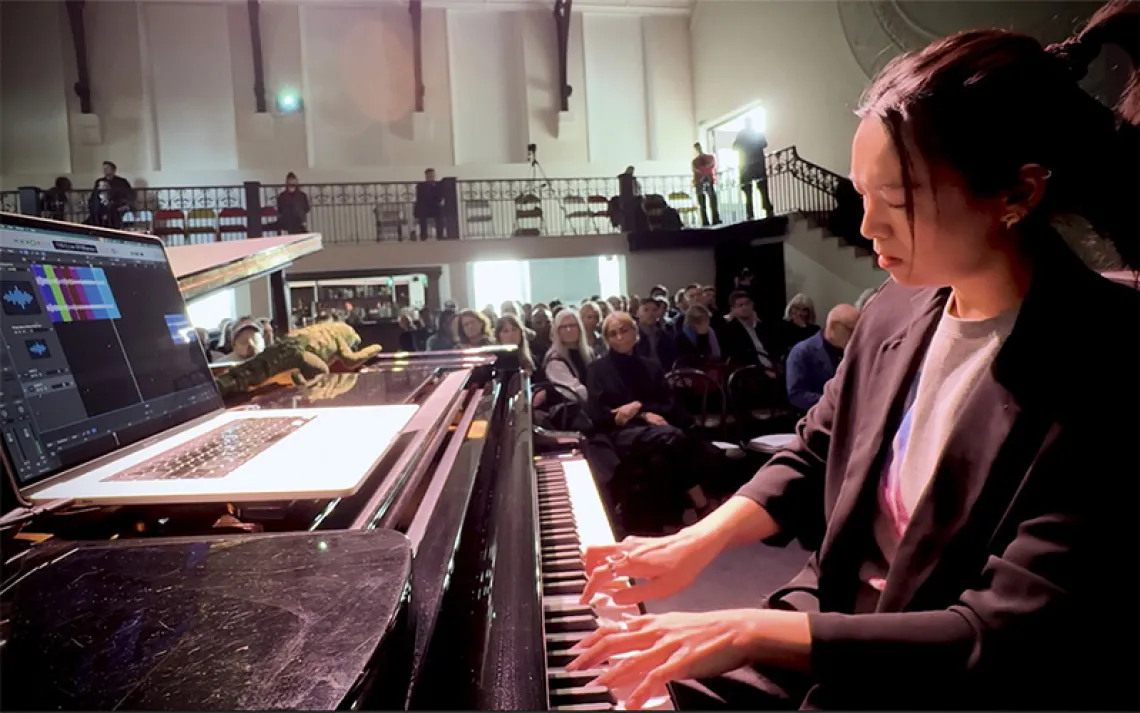
With the help of a storytelling grant from Oregon Humanities, Fox set about turning her idea into a community project. She recruited percussionist and Hood River resident Leila Kaneda to serve as music director and Leila’s composer husband, Erik Kaneda, to write the music. Eventually, the production assembled an eight-piece orchestra and an eight-member choir. For each of the opera’s five acts, Fox recorded interviews with local experts, and Erik wrote music to either accompany their voices or reflect their experiences. After more than a year of work, The Watershed Rock Opera opened at the Columbia Center for the Arts on April 11, 2025.
Umatilla storyteller Thomas Morning Owl began the evening by evoking, in both English and Umatilla, the journey of water from sky to land to sea. Carnivore biologist Jocelyn Akins talked about her work high in the Cascades, where she has spent more than a decade tracking the movements of wolverines, Canada lynx, and the elusive Cascade red fox. Lesley Tamura, a fourth-generation orchardist, then described the annual cycle of pruning, irrigating, and picking at her orchard in the mountain foothills. The orchestra accompanied Tamura’s words with a percussion performance on harvest bins and smudge pots. The opera ended with a tribute to the Columbia River by Terrie Brigham, a ship captain, salmon fisher, and member of the Confederated Tribes of the Umatilla Indian Reservation. “Everybody has a different place that they call home,” she said, and no matter how bad her day or how rough or cold the water, the river always felt like home.
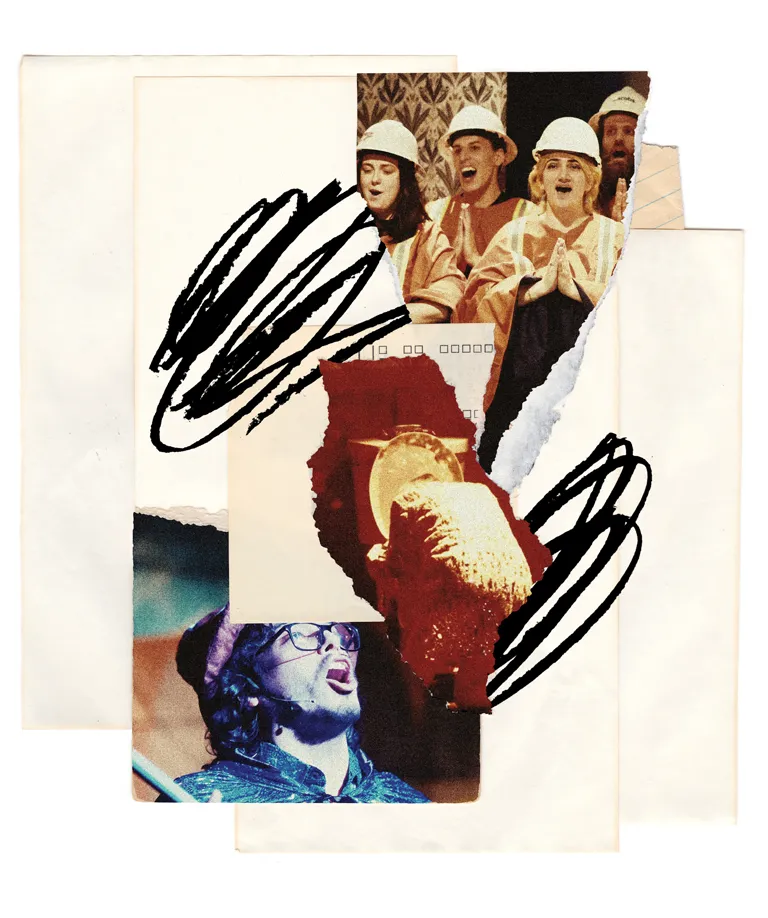
The climax of the show came in the fourth act, with a duet by local performers Molly Schwarz and Marcos Galvez. Schwarz played a hapless Hood River resident who, after overindulging at a party, receives a late-night bathroom visit from Galvez, the “wastewater wizard.” Waving a glitter-encrusted plunger, Galvez burst into song, informing his astonished host that the 1,500 pounds of waste that city residents produce daily must go somewhere. “You think the flush means you’re done—but baby, we’ve only begun,” he crooned, wrapping up his municipal plumbing lesson with a public service announcement:
Public enemy number one, grease is the worst of all.
It takes a pipe that’s made just right and turns
it upsettingly small.
It clogs and plugs as chaos reigns.
Workers struggle and strain
To remove what just doesn’t belong.
And that’s why I sing this song.
Don’t put grease down the drain!
The sold-out crowd roared.
Though the cast and crew gave only three performances of The Watershed Rock Opera, thanks to its online presence, its effects have been lasting. City manager Abigail Elder, who helped Fox with her wastewater treatment research, says she’s never had so many people ask her why so-called flushable wipes aren’t flushable. (While they can be physically flushed down toilets, most contain materials that don’t break down easily and contribute to clogs.) She says the opera also delivered a more profound message: “One big part of it is this is what it takes for us to live this close together, right? We have to share resources, and we have to have some shared understanding and shared agreements.”
Community storytelling is, of course, a tradition at least as old as campfires. As digital isolation and political polarization have grown, a grassroots countermovement has been encouraging people to keep gathering, in person, to listen to their neighbors. Organizations such as the Hearth, TMI Project, and the Moth host story-telling events and offer workshops for people interested in telling their own stories onstage. The Sense of Place series is a variation of science cafés, casual gatherings held at bars, coffee shops, and restaurants where researchers discuss their work with members of the public.
These live performances and exchanges aren’t simply entertaining and informative. They can help bridge political and cultural divisions by emphasizing what communities do have in common; The Watershed Rock Opera, for instance, made clear that everyone in its audience has an interest in a healthy watershed. They establish and foster the kind of social ties that strengthen communities and remind us that none of us is alone.
“That’s such a simple, fundamental thing that we as humans need, and we’re losing the opportunity for it,” says Fox. “When you’re in a room together and you’re feeling it, there’s a catharsis that comes from that.”
Though community storytelling often happens one voice at a time, The Watershed Rock Opera demonstrated that it doesn’t have to be that way. Every community’s stories intersect and overlap, and the relationships among stories are as important to understand as the stories themselves. The people who depend on and care for the Hood River sewer system are connected to the wolverines and orchardists who live upstream and the salmon and fisherpeople who live downstream. Through songs, stories, and a little potty humor, The Watershed Rock Opera made all those connections impossible to ignore.