This Brooklyn Artist Records Thawing Permafrost
Scientists are listening to discover new ways of understanding climate change
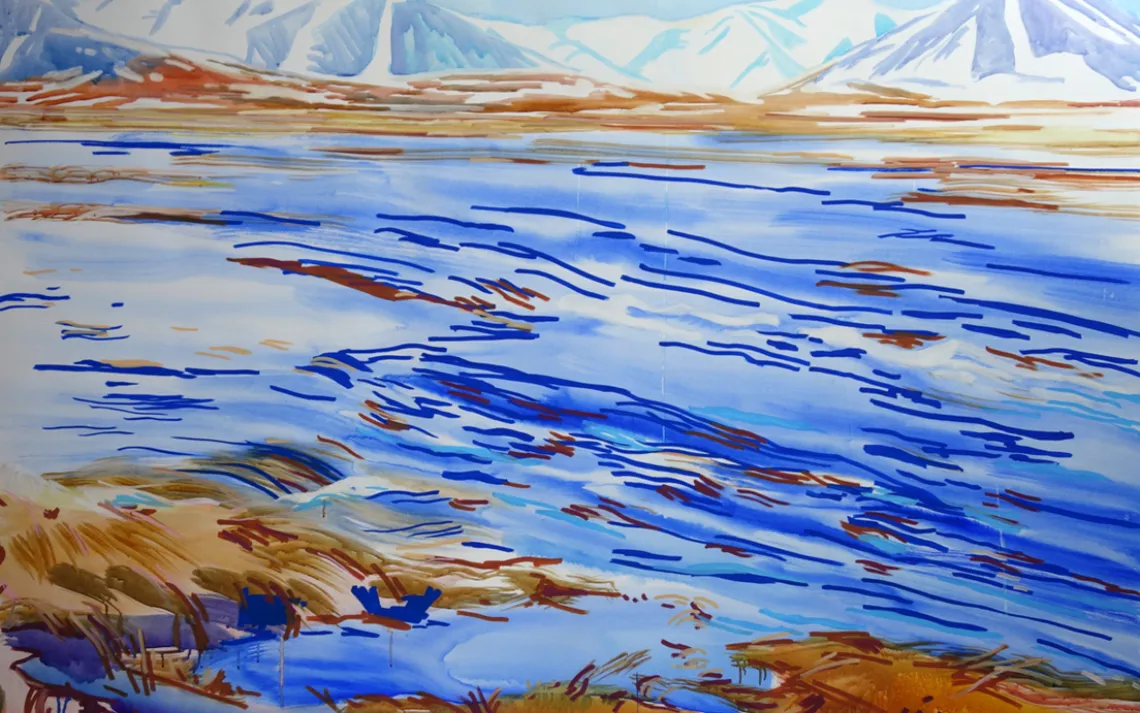
Rapids (Spring Thaw), watercolor on paper. | Painting by Nikki Lindt
Seven years ago, Nikki Lindt, a visual and acoustic artist, left Brooklyn to paint the melting Alaskan Arctic. "I wasn't expecting what I saw," she said, recounting strange visions of thawing permafrost—trees frozen in place "leaning every which way and football-field-size holes in the soil."
But what she heard when she stepped into this underground world—the relentless drops of ice crystals thawing and the beat of water dripping—made her pick up a microphone. Lindt was in Fairbanks, where the lopsided birches she found in a drunken forest took her breath away. Then she stepped into a permafrost sinkhole on the edge of town.
"When you go down there," she said, recounting her experience descending under the frozen soil, "there's this feeling of danger because a big chunk can fall at any moment." But what was falling was the meditative drip-drip-drops of thawing permafrost, she said, which eventually made her realize "this is the sound of our changing climate." An aha moment emerged when she instantly knew "this is what I have to share with the world."
Lindt has been coming back to the Arctic ever since, placing probe-like geophones in the soil, hydrophones in the water, and a piezoelectric pickup to convert vibrations to voltage. Unlike images, "sound captures time," she said when asked about audio's power. "The thawing in the permafrost is going on and on, and whether you witness it or not, it keeps going."
That was the story she wanted to tell, a new way to communicate our changing world. To do that, she's not just sticking mics into the ice. She's working with researchers who influence her art, which is now influencing their research too. Throughout the tundra, there are places scientists think are thawing but can't tell just by using conventional tools. Now, Lindt's approach is helping them find out.
"Sometimes researchers don't think about putting a microphone in a specific location," she said, "and I can hand them the headphones, and they see how water moves," a synergy she's repeated with scientists in Arctic Alaska, plus Yellowknife, Canada, and Sweden.
Listening can pinpoint areas scientists can't reach or see, which could help track how water is melting and how nutrients move. That can help scientists better model carbon release and melt patterns. And it's fast. "Underground sounds have a very deep rumbling sound," added Lindt, which helps her pick up that drip-drip beat. "It's like a heartbeat."
Lindt previously worked in Toolik Field Station, one of America's longest-running Arctic research site, in 2023, traveling by helicopter and hiking across tundra to see thermokarst slumps, which are often dubbed Arctic sinkholes. The Arctic isn't what you think. Yes, it's brutally cold during winter, but its short summers are increasingly warm—and green. Color pops as grass blooms after rivers break free from ice, melting under the relentless 24-hour sun.
That cycle is normal. What isn't is its timing. Longer summers mean more hot days, more thawing permafrost, more open water, which thaws more permafrost and raises temperatures. It’s a positive feedback loop of warming. No one knows how to stop it—beyond shutting off every car, ship, and plane. That's why researchers are open to thinking outside the box.
Permafrost itself isn't ice or frozen soil. It's a mix, plus whatever organic material was trapped in the ground with it; think plant or animal matter like bones, wood, even ancient microbes. When that frozen water melts, it thaws everything frozen in it. An old stick is no biggie, but 10,000-year-old bacteria are another story—even worse are mercury and methane, a gas that can trap up to 100 times more heat than carbon.
That's why finding thawing permafrost and understanding these patterns is crucial. But it's not always easy to spot. At Toolik, studying permafrost typically means coring samples, which is time-consuming. Enter Lindt.
She's working on a pilot audio program here to track water, recording in places hydrologists have a hunch may be melting but can't prove. "Researchers are interested in water movement below the tundra, since it's extremely unpredictable," she details. "Water does surprising things because you're not sure which parts of the landscape are frozen and which aren't. Some years a lake appears; some years it's not there; and then it comes back."
Figuring out why is crucial for Jason Dobkowski, an ecosystem ecologist at the University of Michigan who has spent 18 years working at Toolik, studying thaw and freeze patterns to better understand this landscape. "When most people hear 'Arctic,' they think snow and polar bears, or it's a far-off place. But this place can be green, and it plays a role in everyone's lives," he noted.
Dobkowski studies trends, like why water movements change so much year to year and over time. That's important because more water flowing out of the tundra—and what it's carrying, like carbon or methane—increases temperatures for all of us when those gases get released.
With twice as much carbon in Arctic soil compared with the atmosphere, linking what we hear with what's happening could help "look at this whole realm of tundra we've always ignored," Dobkowski said. "We don't look at how sound comes into play in research," he added, but spotting and tracking flows could help researchers understand temperature shifts. Water is the great connector, he said. As plants pull carbon out of the atmosphere and permafrost thaws, carbon and methane end up in the water too. That then flows out to the ocean, leading temperatures to rise.
"If we can figure out this weird noise is actually caused by this process, which affects this thing, filling in that science element to connect it back is what we're trying to do," he explained.
“When you hear the heartbeat, the rapid heartbeat of the permafrost thaw, those are experiences you want to bring back and share.”
Lindt, who was born and raised in the low-lying Netherlands, said she's always been attuned to water, calling nature "key" to her work. "It's not all the same in different parts of the world," she added. "In Yellowknife, there are lots of boulders, and scientists there say rocks absorb heat and speed up the thaw. In each part of the world, the ecosystem is based on a different set of variables, and it behaves differently." So does sound. In Sweden, "a lot of the permafrost isn't there anymore," so when Lindt came to a bog in Abisko, Sweden's top Arctic station, she didn't hear a thing. Then she pulled out a hydrophone, put on headphones, and "I heard a seltzer-like bubbling," she said.
At first, Friederike Gehrmann, a plant ecologist who joined Lindt, found her approach "unscientific." But the more she listened, the more Gehrmann felt Lindt was experiencing nature in ways "not measured in traditional scientific research."
"Sound is also an indication of nature's value," added Gehrmann, who's now co-writing a research paper with Lindt and others on perspective shifts caused by art and science.
In the meantime, Lindt is refining her recordings closer to home in upstate New York and New York City. And her audio is part of a soil show at the United Nations in Rome, a film at COP29, and upcoming installations at Alaska's Museum of the North and an EU-UNESCO supported group show, Soil Tales, traveling across Europe through 2027.
But she's still facing north. Last spring, while recording the Chena River breakup in Fairbanks, Lindt twisted wrong and heard a pop in her knee. Despite the pain, she kept recording for a week before driving to a hospital back in New York, where an MRI revealed a torn meniscus. Five months of rehab later, she's planning her return. There's an irony to being an artist—which is already risky—and working in a place where she's run into moose and bear and hopped into sinkholes.
"But the Arctic is like nothing else," she said on a hot summer day in her studio. "You make a decision," she said, regarding risk. "You're either really scared or you just drop it. I made the latter, and when you hear the heartbeat, the rapid heartbeat of the permafrost thaw, those are experiences you want to bring back and share. That's why it's so meaningful to work there."