Senate Official Throws Wrench in Mike Lee’s Plan to Sell Public Lands
Here's what's next as the senator tries to privatize public lands
AP Photo/The Christian Science Monitor, Ann Hermes
The Republican effort to sell America’s public lands was dealt a significant blow this week. On Monday, a nonpartisan official, called the Senate parliamentarian, ruled that such a sale falls outside the scope of budget reconciliation. The ruling follows a proposal submitted by Utah Republican Senator Mike Lee that would mandate the sale of millions of acres of federal land to help raise money to offset President Trump’s proposed tax cuts.
Aaron Weiss, deputy director at the Center for Western Priorities, a nonprofit conservation organization, said that the amount of money generated from public lands sales would have been nowhere near enough to offset the increase to the national debt should Trump cut taxes on the rich. Kristen Brengel, the senior vice president of government affairs at the National Parks Conservation Association, added that Lee’s land sale provision was a major policy change and doesn’t belong in budget reconciliation.
Monday’s announcement means that a potential land sale in the budget bill would require at least 60 votes, a much higher bar than what most provisions in the spending bill require, which only need a simple majority. That could potentially stop the sales completely. Green groups and advocates saw the news as both a validation of their conservation values and as a rallying cry to continue advocating for their protection.
“The parliamentarian ruled that Senator Lee's language violated the Byrd Rule, which basically means it was so unrelated to the actual budget bill that it wasn't eligible to be in the bill for the final vote,” Laiken Jordahl, the Southwest Conservation Advocate at the Center for Biological Diversity, said. “So, certainly, good news and a big win. However, the threat still remains, and Lee has vowed to double down, and literally said that he's just getting started. So, the threat is very real, very present, and we will, we'll keep fighting.”
Senator Lee’s proposal
Lee’s original plan, released June 14, mandated that the federal government sell roughly 0.5 to 0.75 percent of US Forest Service and Bureau of Land Management (BLM) land, annually for five years. This included land in Alaska, Arizona, California, Colorado, Idaho, Nevada, New Mexico, Oregon, Utah, Washington, and Wyoming. The total acreage of sellable land would have ranged between 2 to 3 million acres.
In response to the parliamentarian’s ruling, Lee issued a post on X outlining how he intended to move forward. Instead of mandating the sale of Forest Service lands, he plans to restrict sales to BLM lands within five miles of population centers. On Wednesday, he released an updated version of his proposal. His slimmed-down version includes the sale of between 0.25 and 0.5 percent of BLM lands, totaling the sale of up to 1.2 million acres, a far cry from the “isolated parcels” Lee initially said would be included in a public lands’ sale.
With over 240 million acres under its purview, nearly three times the size of the National Park Service, the Bureau of Land Management is the largest land manager in the county. It’s charged with managing resource extraction, grazing, recreation, and conservation throughout the West. It manages over 8 million acres of wilderness areas, undeveloped lands that provide habitat with wildlife and sensitive species. It’s also responsible for managing areas that require special protections for their historical, cultural, and conservation value, collectively called Areas of Critical Environmental Concern. And it oversees over two dozen national monuments, including Chuckwalla, Berryessa, Bears Ear, Grand Staircase–Escalante, and Rio Grande del Norte. Lee’s proposal excludes conservation areas and national monuments, but some conservationists question the validity of such exclusions after the Trump’s Justice Department recently ruled that a president can rescind and revoke monument designations.
“Mike Lee said national monuments are protected. Well, what does that matter if the Trump administration is going to go in and argue they can erase national monuments whenever they want,” Weiss said. “Mike Lee also promised to protect land that was being used for recreation and hunting and fishing, but if you're doing that, then what land is there left? Because every single acre of BLM land in the West that is not already being used for, say, mining and drilling, is used for recreation.”
Powerful resource
Since the parliamentarian's ruling, the senator has waged a communications campaign, primarily using X, to appeal to the public, saying that only “underutilized land” would be sold, but as one commenter noted, no such provisions exist. The number of people who use BLM lands is staggering in sheer number and impact. Last year, over 80 million people visited a tract of public land managed by the BLM. The prior year, these activities generated over $250 billion. And according to the Trust for Public Land, over two-thirds of participants in an April survey oppose the sale of public lands.
Conservation groups have used this broad appeal to encourage members and supporters to call lawmakers, write letters, and sign petitions, opposing a public lands sale. Some groups have formed coalitions around protecting these lands, such as the Outdoor Alliance, and others have encouraged everyday citizens to advocate on their behalf. In the two weeks since he released the Senate Energy and Natural Resource Committee’s portion of the spending bill, conservation groups, hunters, anglers, advocacy groups, and outdoor recreation lovers have all issued calls to urge lawmakers to abandon what some organizations, such at the Public Employees for Environmental Responsibility, have called a “land heist.”
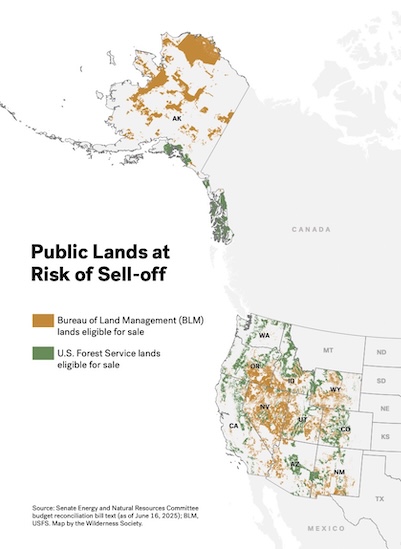
Senate Energy and Natural Resources Committee budget reconciliation bill text (as of June 16, 2025); BLM, USFS. | Map by the Wilderness Society
In addition to a love of the outdoors, opponents to Lee’s proposal cite a common denominator: maps that turned the 67-page budget proposal into an interactive captivating image. At least three groups—the Wilderness Society, the Outdoor Alliance, and the Center for Biological Diversity—have crunched the criteria and numbers to visualize Lee’s plan. Tracey Stone Manning, the president of the Wilderness Society and former BLM director, posted on her LinkedIn that over a million people had clicked on TWS’s version of the map since the organization released it two weeks ago.
Across social media, conservation groups have pushed out these images to advocate for their cause or to spur action around general public lands protections. Some groups, including New Mexico Wild, used the maps to show what lands in its state would be threatened by a public lands sale. Others, such as Wilderness Watch and the League of Conservation Voters, used it on social media to inspire others to reach out to their elected leaders.
Earlier this week, New Mexico Wild held a rally in front of the state capitol as the Western Governors Association was having its annual meeting. Thousands showed up to protest public lands sales and to tell Western governors and Trump administration officials that under no circumstances should public lands sales be permitted. Mark Allison, the executive director of New Mexico Wild, which helped organize the rally, said it was one of the largest in the state's history and attributes the turnout, in part, to the power of these maps.
“Maps have always been an important tool and an important way to tell a story, but I think in this instance, they're kind of more interactive," Allison said. “The public can have access to them and really drill down into those special places where they recreate, that they love, where they camp with their families, and they can see how this would personally affect them. That's just very powerful.”