Why Mike Lee Is Waging War Against America’s Public Lands
A man, a monument, and the battle for the future of conservation
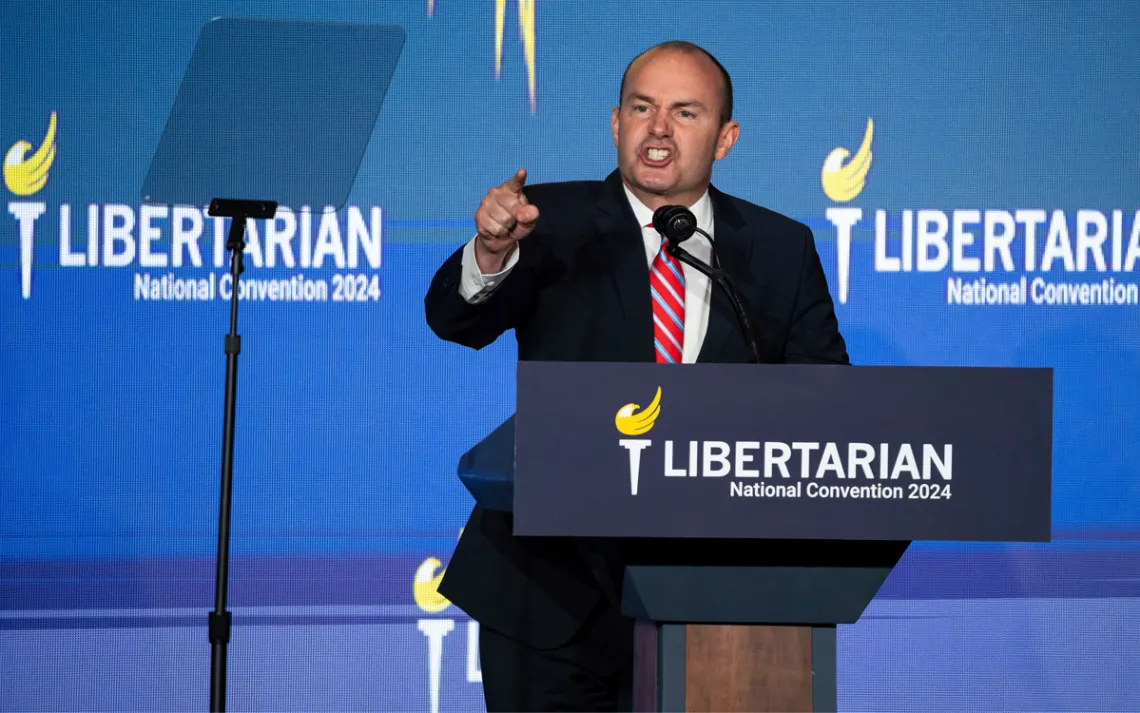
Senator Mike Lee (R-Utah) delivers remarks during the Libertarian National Convention in 2024. | Photo courtesy of Francis Chung/POLITICO via AP Images
In 2018, Utah Senator Mike Lee stood in front of supporters at an event hosted by the conservative Sutherland Institute and laid out his ambitions for America’s public lands with characteristic bluntness. “The campaign for land transfer will take years,” Lee said. “And the fight will be brutal.”
Lee was referring to a long-standing effort by his fellow Republicans to hand over all of Utah's 35 million acres of federally managed public lands to the state. Nearly a decade later, that fight is still unfolding. And Lee has positioned himself as one of the most anti–public lands lawmakers in recent memory.
On March 4, he introduced a resolution in Congress that could dismantle fundamental protections for one of the most iconic landscapes in the American West. His target is the Grand Staircase–Escalante National Monument, a 1.9-million-acre expanse of sandstone canyons, dinosaur fossil beds, and sacred Indigenous sites in southern Utah. If successful, Lee's resolution would eliminate the monument’s current management framework and prevent federal land managers from implementing a plan that is substantially the same in the future.
Lee's plan is a danger to public lands, warn conservation groups, but his tactics are an even bigger threat to the democratic process. Together with Utah Representative Celeste Maloy in the House, Lee is using the Congressional Review Act—an obscure procedural tool that allows Congress to overturn federal regulations with a bare majority vote—to undo years of public process and planning around who and what the monument is for.
“This is a novel use of the Congressional Review Act,” said David Feinman, vice president of government affairs at the Conservation Lands Foundation. “They’ve essentially taken the ambiguity of how the law was written and blown a hole through it.”
Management plans such as the one governing Grand Staircase–Escalante normally take years to develop. Federal agencies gathered public comments, consulted tribal nations, and obtained feedback from local stakeholders to determine how land should be used. Overturning the plan through Congress bypasses that process entirely. “It effectively undermines all of the work ... on what a management plan should look like and how it serves all the interests of the community,” said Feinman.
This is the first time public land opponents have used the CRA to target a national monument. But it is an escalation of tactics that Republicans have been testing since at least last year, when several lawmakers successfully rolled back management plans on Bureau of Land Management lands in Alaska, Wyoming, Montana, and North Dakota. If Lee and Maloy prevail with their resolution, the consequences could mean that even the most cherished landscapes may be in danger of having their plans revoked.
“Senator Mike Lee is an avowed opponent of federal public lands at every level,” said Steve Bloch, legal director at the Southern Utah Wilderness Alliance. “He fundamentally believes it’s unlawful for the federal government to own and manage these lands on behalf of all Americans.”
For observers who have watched the fight over public lands for decades, Lee’s latest proposal fits into a familiar pattern. Conflicts over federal land ownership have deep roots in Utah, from early settlers' hostility toward the federal government to the so-called Sagebrush Rebellion of the 1970s and '80s, which argued for the transfer of federal lands into state or private hands.
But these lands have never belonged to the state. Indigenous communities called this area home for millennia. When the US government granted Utah statehood through the 1894 Enabling Act, the state specifically disclaimed interest in 37 million acres of federal land, as a precondition of statehood. Yet the fight over public lands never disappeared from Utah politics. Instead, it evolved into a steady campaign of lawsuits, legislation, and political messaging aimed at expanding state authority in any way it could.
The modern phase of that conflict around monuments began in 1996, when President Bill Clinton established the Grand Staircase–Escalante National Monument under the Antiquities Act, which authorizes presidents to create monuments out of existing federal land. To many Utah politicians, the move symbolized federal overreach.
Mike Lee’s ascent
Lee didn't invent the Republican assault on public lands, but he did emerge as one of the movement’s most vocal champions. In 2010, he was elected to the Senate by primarying then–Senator Bob Bennett, whom Lee accused of being too soft on public lands. Since then, Lee has consistently worked to gut public lands protections and put them in the hands of political donors and developers. In recent years, he's proposed to sell millions of acres of BLM land; weaken the Antiquities Act; and remove federal safeguards from national parks. His efforts encourage state or private ownership of federal land, and he often uses the budget reconciliation and other process loopholes to avoid debate.
According to Feinman, the senator’s stance is rooted in a deep ideological belief about the role of government. “I think there’s a core federalism issue here,” said Feinman. “He believes that the land within the boundaries of the state of Utah is the state of Utah’s and not for the federal government to manage.” Other conservation advocates take a more cynical view.
Josh Osher, the public policy director at the Western Watersheds Project, first met with Lee's team after his election in 2010. He knew Lee was a libertarian who claimed to believe in efficiency and small government, and hoped he could make some headway by pointing out that the government's heavily subsidized grazing program was an example of wasteful bloat. But when he presented these points to Lee's team, he got a decidedly pro-government response. Lee's team admitted that the program violated their principles and ideology, recalled Osher. But they told him point blank that it didn't matter because they were going to cater to the ranchers.
The experience revealed a core truth behind Lee's motivations. His principles, Osher said, were all for show. "Lee's fight is not about public lands. It's about keeping certain constituents happy. And in Utah, that means ranchers and industry."
Nate Blouin, a state legislator whose position on the state legislature’s Natural Resources Committee gives him an inside view of public lands battles, put it more bluntly. "It's about money," he said. "Money and power." Blouin said that Lee is influenced by the same developers and extractive industries that show up at the state level to pressure legislators—from mining and real estate companies to oil, gas, and ranching lobbies.
Blouin takes particular issue with Lee’s latest attempt to use the housing crisis to sell off public land. Blouin said he's manipulating a real crisis. “There’s real anger from people who feel like they don’t have control over land where they live," he said. “Mike Lee has weaponized that anger in a way that’s very dangerous.”
If he had his way, Blouin said, Lee would privatize all the land he could to enrich himself and his industry friends. “Some people will get rich, while the rest of us deal with the pollution and the privatization of the land.”
Lee at odds with the public
Lee's choice to prioritize privatization and industry is increasingly at odds with public opinion. A recent Colorado College poll found broad bipartisan support for keeping public lands under federal management: 84 percent of Americans said rollbacks in environmental protections pose a serious problem, and 91 percent agreed that existing national monument protections should be kept in place.
“Lee’s vision is of a very different nation than what most Americans want to see,” said Bloch from the Southern Utah Wilderness Alliance. “I don’t think he uses these lands. And the consequences of the decisions he makes about them aren’t things he’ll ever personally experience.”
Ultimately, Lee's fight to dismantle Grand Staircase-Escalante National Monument is part of a bigger disagreement about what public lands are meant to be. For Lee and his allies, the land represents economic potential—resources that states should be free to develop. For conservation groups, the value lies in preserving cultural heritage and ensuring public access.
When Theodore Roosevelt first set aside lands for conservation, he was betting on the idea that wise use and access to nature were as important as any other American value. But if Lee and Maloy succeed in passing their resolution, that vision may be damaged for generations.
It's a battle that's been fought before. And it's a battle that Bloch thinks conservation groups can win. “Lee comes from a long crop of politicians who have tried to undo federal land management in Utah," he said. "We expect him, like many before him, to end up in the trash bin of history.”