How to Build a Forest For the Future From a Coal Mine of the Past
The duo behind Ohio's Sugar Creek Community Forest is restoring land and hope on acres ravaged by the coal industry
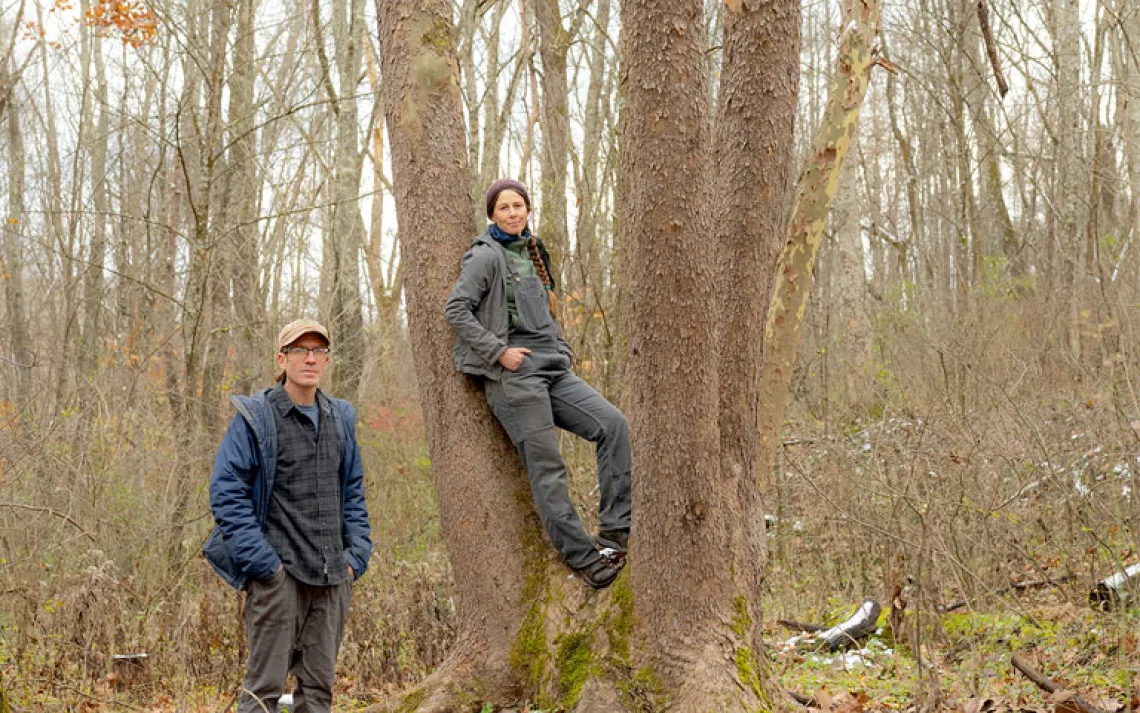
Photo by Rich-Joseph Facun
When hikers amble through the Appalachian forest in southeastern Ohio, they encounter mile after mile of white oak, shagbark hickory, and American hazelnut. It may feel like a walk in a typical forest—until they kick the dirt. Underfoot, visitors to this part of the state often find vestiges of coal, ranging from dust to chunks as big as golf balls.
A century ago, miners smashed up the area to unearth the combustible carbon under the Hocking Valley Coalfield. Despite the sounds of industry fading long ago, the impacts still linger. Communities across southeastern Ohio have been plagued by mining pollution, and while forests once covered nearly 95 percent of the state, development has reduced that share to less than a third today. But change is afoot. Conservationists are working across the region to both clean up old coal sites and rebuild forests.
Among this cohort of people are Weston Lombard and Molly Jo Stanley. Through their nonprofit, Rising Appalachia, the duo launched a project called the Sugar Creek Community Forest, with the goal of turning 900 acres of former coal-mining land into woodland, with walking trails, educational facilities, a store, a farm, and a nut-processing facility. The endeavor has already begun to create jobs and restore ecosystems—providing benefits for the local community, wildlife, and the climate. So far, the Rising Appalachia team has reclaimed 45 acres of the former mine site.
Stanley, who studied foraging, ethnobotany, and dendrology at a local college, says that the benefits of a community forest in this part of the country are clear. Protecting intact forest ecosystems and soils will help sequester carbon and keep pollution out of watersheds, including those serving millions of people in downstream cities like Cincinnati and Louisville. Lombard and Stanley hope that the Sugar Creek Community Forest will help bridge neighboring Wayne National Forest with Strouds Run State Park and provide green space for both people and wildlife.
These woodlands are home to keystone species such as the black bear, a mammal that was extirpated in Ohio in the 19th century and has been on the state’s endangered species list since 1995. The fruit and nut trees in the region provide food for the bears, and increasing the forest cover would help further recovery efforts.
Lombard and Stanley are growing food for people here too. In 2023, they won two grants from the Forest Service to launch an apprenticeship program focused on sustainable food practices. They brought together 20 young adults from the region to work on projects including planting hazelnut and chestnut trees and propagating mushrooms. While that program has ended, they secured an additional $350,000 from the Minneapolis Foundation to continue a similar one on a smaller scale.
“[Sugar Creek] is meant to be symbolic of transitioning from an extractive industry that left the land desolate and polluted to building a regenerative economy atop an old mine,” said Lombard, who runs Solid Ground Farm on land slated to become part of the Sugar Creek forest.
Badger Johnson, an Ohio-based farmer and forester, has known Lombard for more than 15 years. Today he runs the Southern Ohio Chestnut Company, a business that embodies what Lombard and Stanley hope to create in the Sugar Creek Community Forest. Johnson said that good hauls on his land can earn people more than $25 an hour. “[Lombard and Stanley] have helped pioneer this work,” he said. “I think people will be motivated to support better care and stewardship of our woodlands if they can eat and pay bills with the nuts that go through the processing facility.”
But bringing the Sugar Creek project to fruition is far from straightforward. In March 2025, President Donald Trump issued an executive order calling for a 25 percent increase in domestic timber production across the United States, including within Wayne National Forest. While the community project likely won’t be directly affected, environmentalists are concerned that expanded logging could clog rural roads and disturb Sugar Creek’s tranquil trail walks with the sound of chainsaws and heavy machinery. Lombard and Stanley also still need millions of dollars to purchase the rest of the acres from the Sugar Creek Mining Company to meet their goal. While they received $600,000 from the US Forest Service to buy more land in August, prices have gone up since then, and as of December 2025, their funding would cover only 140 acres.
“We haven’t been able to purchase the land yet,” Lombard said. “[The mining company] wants to sell it all together. We raised $700,000 toward the total purchase price, which is going to be about $4.5 million.”
Despite these challenges, Lombard and Stanley said the project’s benefits far outweigh the barriers. “We are really excited about introducing the idea of a commons, an area of collective use to support rural populations,” Lombard said. “This is the future of public lands.”