
Cities and counties in California serve as guiding lights as the state navigates a transition from gas to clean-energy buildings. Motivated by the climate crisis, worsening air pollution, escalating gas rates, and safety risks from gas, a new cohort of local government leaders is emerging in California. Over 60 cities and counties across the state are considering policies to support all-electric new construction.
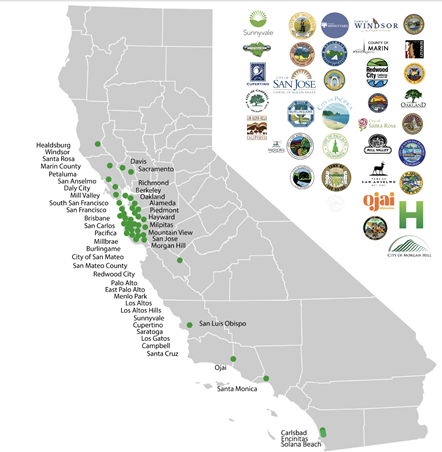
This blog summarizes the cities and counties that have already adopted gas-free buildings commitments or electrification building codes (i.e., “reach codes” that go beyond the statewide building code) and is regularly updated to reflect the latest wins in California. Ordinance language is also linked below.
To urge your city council members to be climate leaders and to create a gas-free future for our homes and buildings, please sign this petition. To get more involved in the campaign, please sign up here for updates on what is happening in your city. For more information, or any tips/edits to the cities and counties on this list, please contact Sierra Club's California Press Secretary Sander Kushen at sander.kushen@sierraclub.org.
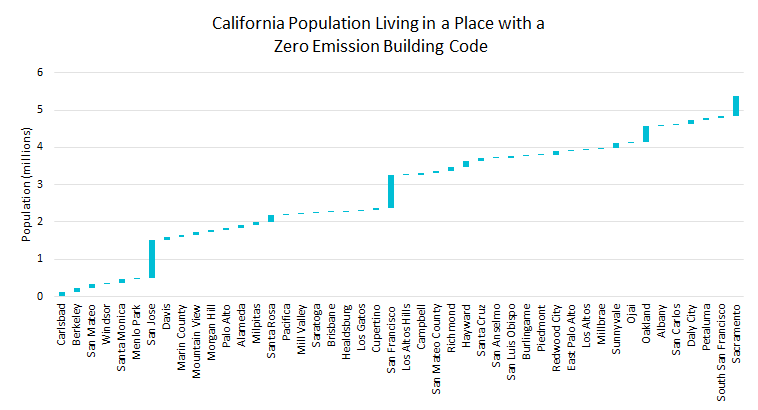
So far, 76 cities/counties (listed with the most recent area first) have adopted building codes to reduce their reliance on gas. More to come with your help! Stay tuned….
76. Carpinteria - prohibits fossil gas in new buildings as well as significant remodels beginning October 1, 2023. Exemptions for commercial cooking and laboratories remain. Approved 4/10/2023
75. Agoura Hills - requires new residential and commercial buildings to be built all-electric starting one month after the ordinance's approval, with exceptions for commercial cooking and spas. Approved 1/25/2023.
74. San Pablo - requires all new buildings be built all-electric with exceptions including laboratories and public agency-owned emergency centers. If natural gas appliances are used in any of the exceptions, natural gas appliance locations must be electrically pre-wired for future electric appliance installation. Approved 1/17/23
73. Los Angeles- requires new residential and commercial buildings to be built all-electric starting on or before January 1st, 2023, with exceptions for commercial cooking. Approved 12/07/2022.
72. San Rafael- requires new buildings be built all-electric with exceptions for commercial kitchens, commercial laundry, emergency back-up power, commercial laundry, and industrial processes. Adds additional requirements for EV charging. Prohibits adding gas capacity to single family homes and accessory dwelling units (ADUs) and requires new gas appliance installations to reduce British Thermal Units (BTU’s) through some other measure (e.g., replace an existing gas appliance with an electric one or remove it). Approved 12/05/2022.
71. Riverside- requires newly constructed buildings three stories or less with a building permit filed on or after January 6th, 2023, to be all-electric buildings, and newly constructed buildings four stories or more with a building permit filed on or after January 1st, 2026, to be all-electric buildings. There are exceptions for commercial cooking. Approved 12/06/2022.
70. Atherton- requires new buildings to be all-electric with exceptions for residential and commercial cooking and additional requirements for EV charging. Approved 11/16/2022.
69. Corte Madera- requires all new buildings be to built all-electric with exceptions for commercial cooking, industrial process heat, and attached accessory dwelling units (ADUs) with additional requirements for EV charging. Approved 11/15/2022.
68. Dublin- requires new buildings be built all-electric with exceptions for commercial cooking. Adopts mandatory CALGreen Tier 2 level EV charging requirements. Approved 11/15/2022.
67. Glendale- requires new buildings to be built all-electric with no exceptions, adds additional requirements for EV charging, and adds additional non-residential and multifamily solar photovoltaic requirements. There is an economic infeasibility provision applicable to commercial kitchens. Approved 11/15/2022.
66. San Leandro- requires new buildings to be all-electric with exceptions for commercial kitchens and commercial clothes drying for hotels with 80+ rooms. Also includes requirements for additional EV charging. Approved 11/07/2022.
65. Pleasanton- requires new buildings to be built all-electric with exceptions for commercial cooking and industrial process and adds additional requirements for EV charging. Approved 11/1/2022.
64. Ventura County- requires new buildings to be built all-electric, starting in January 2023, with exceptions for indoor/outdoor fireplaces, outdoor grills, swimming pool and spa heaters, commercial cooking, and commercial and industrial equipment approved by building officials. Adopted 11/1/2022
63. Portola Valley- requires new buildings to be all-electric, however, building officials may grant exceptions for commercial cooking. This building code requires that upon replacement/upgrade to an electrical panel and/or AC unit, that panels are upgraded to accommodate new electric loads, and that a heat pump be installed instead of A/C. Approved 10/26/2022.
62. Livermore- requires new buildings to be all-electric with exceptions for commercial kitchens, laboratories and commercial clothes drying for hotels with 80+ rooms. Also includes requirements for additional EV charging. Approved 10/24/2022
61. San Bruno- requires newly constructed buildings be all-electric with exceptions for hospitals, commercial kitchens, and 100% affordable housing developments. Also requires additional electric vehicle spaces and EV chargers. Approved 10/11/2022.
60. Martinez- requires all newly constructed residential buildings, hotels, offices, and retail buildings to be all-electric, with exceptions for restaurants and the industrial sector. Approved 10/5/2022.
59. Pasadena- requires newly constructed mixed-use buildings, commercial buildings (except food service establishments and commercial kitchens), and multi-family buildings with more than three units to utilize electric energy only. Single-family dwellings, accessory dwelling units (ADUs) and junior accessory dwelling units (JADUs) are exempt from the ordinance, but staff will return to the City Council within a year with a recommendation as to whether these buildings should also be included. Approved 8/8/2022.
58. Hercules- requires all newly constructed residential, office, and hotel buildings be all electric, with minimal exemptions for specific situations occuring in labratories and emergency facilities.
57. Hillsborough- has adopted an all-electric preferred, with mixed fuel option, reach code ordinance. This requires all new single-family residential construction to implement electric space heating and electric water heating.
56. Belmont- adopted a reach code that requires new buildings to be all-electric with exemptions for space conditioning in labs, clothes drying in large hotels, and an application-based exemption for gas stoves in commercial kitchens.
55. Half Moon Bay- adopted a reach code policy requires all electric new construction, with no gas or propane in new construction, and requires fuel gas lines to be capped/decommissioned in existing buildings by 2045.
54. Contra Costa County- requires all newly constructed residential buildings, hotels, offices, and retail buildings to be all-electric starting June 1, 2022.
53. Santa Clara County- adopted an all-electric reach code for new residential and commercial buildings, with minor exceptions for certain factories, hazardous materials facilities, hospitals, and laboratories.
52. Solana Beach- requires new construction in residential and commercial buildings to use electric appliances for space heating, water heating, dryers, pools and spas. It sets standards for major renovations to ensure that significant remodels beyond a certain point require these electric upgrades as well. The ordinance also requires all-electric readiness, and has provisions for electric car charging, commercial solar, and prewiring for home battery storage.
51. Santa Clara- this all-electric reach code applies to both new residential and commercial buildings, and contains minimal exemptions.
50. Encinitas- in accordance with their most recent Climate Action Plan update-- will now require all new residential and commercial buildings to be all-electric, making it the 50th municipality and the first city in San Diego County to require all-electric buildings, with situational exemptions for restaurants, essential service buildings, and special projects.
49. Fairfax- requires all newly constructed residential and commercial buildings to be all-electric, starting March 1, 2022, with an exemption for commercial kitchens.
48. Emeryville- requires all newly constructed residential buildings to be all-electric, with exemptions for newly constructed nonresidential buildings. However, these buildings must be furnished with conduit or pre-wiring for future electric appliance installation.
47. Santa Barbara- requires all new buildings to be all-electric starting January 1, 2022, though it does offer an exemption for restaurants.
46. Sacramento- requires all new buildings under 3 stories to be all-electric by 2023 and extends the mandate to all new construction by 2026. Approved 6/1/2021.
45. South San Francisco- requires all new residential buildings to be all-electric. Approved 5/26/2021.
44. Petaluma- Requires all buildings to be all-electric and bans all new gas stations. Approved 5/3/2021.
43. Daly City- Required all-electric new residential and non-residential buildings with blanket exemptions for 100% affordable housing buildings, commercial kitchens, and laboratories. Approved 4/27/2021.
42. San Carlos- Requires newly constructed buildings and remodel projects that update more than 50% of the building to be all-electric with some exceptions. Approved 1/25/2021.
41. Albany- Encourages newly constructed residential and commercial buildings to be electric preferred and requires mixed fuel buildings to exceed the California Energy Code. Approved 12/9/2020.
40. Oakland- Requires all newly constructed buildings to be all-electric. Approved 12/1/2020.
39. Ojai- Requires all-electric new construction for buildings with some exceptions. Approved 10/27/2020.
38. Sunnyvale- Requires newly constructed residential and commercial buildings to be all-electric with an exemption for gas fuel cells. Restaurants may apply for an exemption. Approved 10/27/2020.
37. Millbrae- Requires all-electric residential and commercial buildings with exemptions for laboratories, restaurants and gas cooking/fireplaces. Approved 10/27/2020.
36. Los Altos- Requires all newly constructed buildings to be all-electric with exemptions for gas cooking/fireplaces in residential buildings with 9 units or less, laboratories and restaurants. Approved 10/27/2020.
35. East Palo Alto- Requires that new residential and commercial buildings be all-electric, with exceptions for affordable housing, and commercial kitchens. Approved 10/6/2020.
34. Redwood City- Adopted a reach code requiring all-electric new construction for commercial and residential buildings, with exceptions for multiple specific building types such as laboratories. Approved 8/24/2020.
33. Piedmont- Promotes all-electric new construction for low-rise residential buildings and incentives electrification for renovations of low-rise residences. Approved 7/20/2020.
32. San Anselmo- Promotes all electric housing by requiring higher energy efficiency requirements for mixed fuel projects and prewiring for al electric kitchens. Approved 4/14/2020.
31. Burlingame- Requires all electric new construction for projects with exemptions for single-family and commercial projects for gas cooking and fireplaces. Approved 7/6/2020.
30. Santa Cruz- Requires all electric new construction with exemptions for projects that are deemed to be in the public interest and for restaurant cooking. Approved 3/24/2020.
29. Hayward- All new residential buildings are required to be all-electric and nonresidential and high-rise residential buildings are electric preferred. Mixed-fuel buildings must install solar panels, and the energy budget must be 10 percent better than code. Approved 3/3/2020.
28. Richmond- requires all new buildings to be all-electric starting January 1, 2022.
27. San Mateo County- Requires that no gas or propane plumbing is installed in new buildings, and that electricity be used as the energy source for water and space heating and cooking and clothes drying appliances. Approved 2/11/2020.
26. Campbell- Requires all-electric space and water heating in new residential buildings, accessory dwelling units, and major remodels. Approved 2/4/2020.
25. Los Altos Hills- Requires electric space and water heating in new low-rise residential buildings. Approved 1/16/2020.
24. San Francisco recently expanded on their building electrification ordinance, now requiring that all new construction be all electric starting June 1st 2021. Approved 12/17/2019.
23. Cupertino- Requires all buildings, including accessory dwelling units, to be all-electric. Also requires outdoor pools, spas, and barbeques to be included within the definition of an all-electric building. Approved 12/17/2019.
22. Los Gatos- Requires all newly constructed single-family and low-rise multifamily buildings to be all-electric. Approved 12/3/2019.
21. Healdsburg- Requires electrification for most appliances but grants an exemption for gas cooking and fireplaces. Approved 12/2/2019.
20. Brisbane- Requires all newly constructed single-family homes and low-rise multifamily buildings to be all-electric. Allows exemptions for cooking appliances but requires pre-wiring for electric readiness. Approved 11/21.2019.
19. Saratoga- Requires all newly constructed buildings to be all-electric. Approved 11/20/2019.
18. Mill Valley- Requires all newly constructed residential buildings to be all electric. Approved 11/18/2019.
17. Pacifica- Requires electrification for most appliances but grants an exemption for gas cooking and fireplaces in new residential buildings. Requires water and space heaters, cooking appliances, fireplaces, and clothes dryers to be all-electric for new nonresidential buildings. Public agencies providing emergency services and nonresidential kitchens are exempted. Approved 11/12/2019.
16. Santa Rosa- Requires all newly constructed low-rise residential buildings to be all-electric. Approved 11/12/2019.
15. Milpitas- Limits gas infrastructure for newly constructed buildings on city-owned property. Approved 11/5/2019.
14. Alameda- Limits gas infrastructure for new residential construction on city-owned property and as of May 18, they've expanded the code to require newly constructed buildings to be all electric with some exceptions. Approved 11/5/2019.
13. Palo Alto- Requires all newly constructed low-rise residential buildings to be all-electric, plus higher energy-efficiency standards and electrification readiness in mixed-fuel non-residential buildings. Will revisit all-electric requirement for non-residential new construction in 2021. Approved 11/4/2019.
12. Morgan Hill- Phases out gas hookups in all newly constructed residential buildings and most nonresidential buildings. Approved 10/23/2019.
11. Mountain View- Requires electrification for new residential and nonresidential buildings. Does not exempt gas stoves, fireplaces, or firepits in residential buildings. Approved 10/22/2019.
10. Marin County- Offered three compliance pathways for newly constructed buildings in unincorporated buildings: one for all-electric construction, one for limited mixed-fuel construction that has fewer efficiency requirements because it uses less gas but allows gas stoves, and one for mixed-fuel construction that requires the most strict compliance with Cal Green Tier 1 and electrification-readiness requirements. Approved 9/24/2019.
9. Davis- Requires higher energy-efficiency standards and electrification readiness in mixed-fuel buildings. Approved 9/24/2019.
8. San Jose- San Jose passed a natural gas prohibition for all new building types, with limited temporary exemptions, becoming the largest city in the nation to do so. Approved 9/17/2019.
7. Menlo Park- Requires all-electric new construction for residential buildings as well as new nonresidential buildings but allows an exemption for cooking appliances in low-rise residential buildings. Approved 9/10/2019.
6. Santa Monica- Requires additional energy-efficiency measures for new residential and nonresidential buildings that use gas. Approved 9/10/2019. Updated on 9/27/2022. now requiring all-electric construction via the city’s municipal code and an EV charger reach code.
5. San Mateo- Requires new residential buildings and buildings with office-use to be all-electric. Adds additional requirements for rooftop solar and electric vehicle charging. Approved 8/27/2019. Updated 11/7/2022, now requiring the installation of all-electric heat pump air conditioning when new air conditioning is installed or replaced, and heat pump water heater installation during addition and alteration projects that include water heater replacement.
4. San Luis Obispo- Requires additional energy efficiency and electrification readiness for all newly constructed buildings and adds a small fee for new mixed-fuel buildings based on expected gas consumption. Approval of updated code 6/16/2020. Updated 7/5/2022, so that on January 1st, 2023 an updated Clean Energy Program for New Buildings goes into effect, requiring all new buildings to be built all-electric. There are only a few exemptions, like for gas-powered equipment in commercial kitchens.
3. Windsor- (Updated July 13, 2022: Windsor has since had its reach code revoked. It will remain on this list as a place-holder until officially reinstated.) Mandates all-electric new construction for low-rise residential buildings, including single-family homes, multifamily homes with fewer than four stories, and detached accessory dwelling units ( but attached ones are exempt). Approved 8/27/2019.
2. Berkeley- Phases out gas hookups in all newly constructed residential buildings and most nonresidential buildings. Approved 7/15/2019.
1.Carlsbad- Requires heat pump water heaters or solar thermal water heating in new residential buildings that have fewer than four stories. Approved 2/26/2019.
City and county leadership is essential not just for local climate action but also to convince the California Energy Commission to require or at least support all-electric new construction in the statewide building code (Title 24).
The CEC updates Title 24 every three years. The 2022 version of Title 24 was adopted on December 14, 2021 and will go into effect on January 1st, 2023. The next iteration of Title 24 will come out in 2025, giving Californians plenty of time to push for an even stronger rule! All of this community and city support for more-ambitious building codes sends a strong signal to the CEC to align the statewide building code with climate science and require all-electric new construction. Californians deserve nothing less.