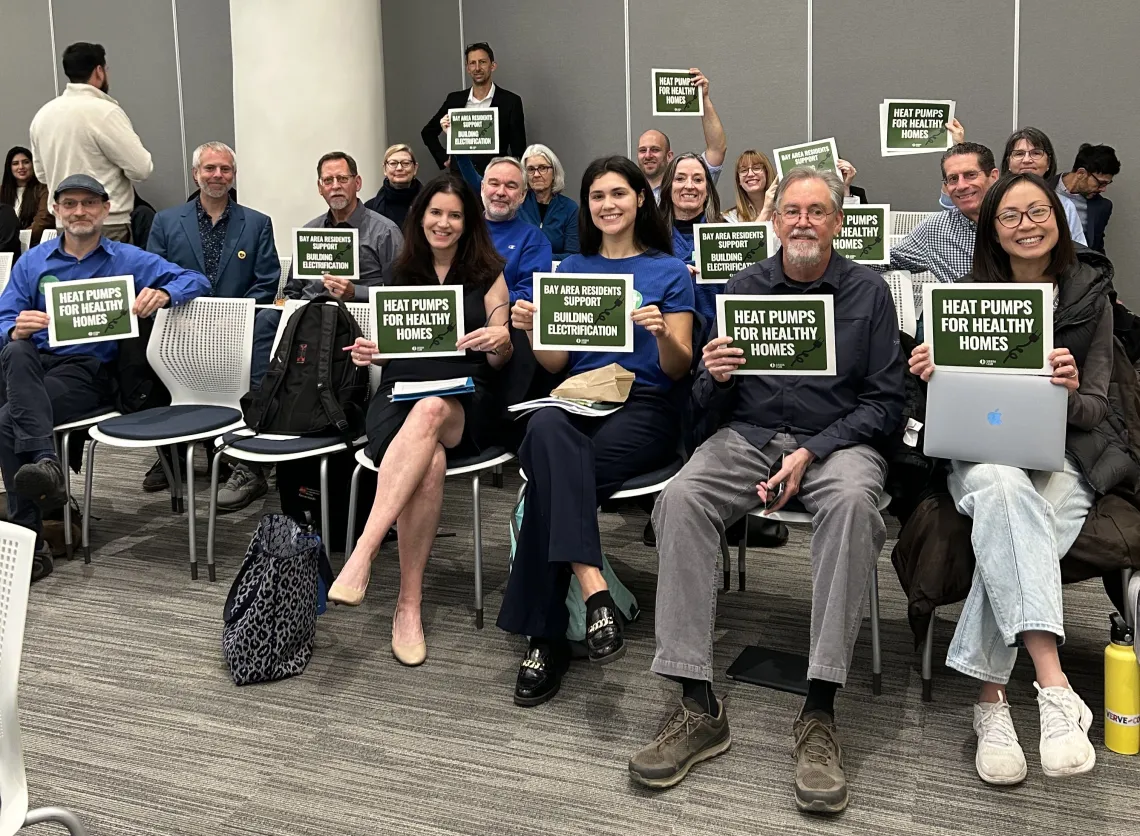
The Bay Area Air District adopted groundbreaking standards in 2023 that will help accelerate adoption of efficient electric heat pumps, cutting deadly air pollution and making energy bills more affordable. The standards will only apply when existing fossil fuel equipment needs replacement and will phase in gradually starting in 2027 for water heaters and 2029 for furnaces.
Ahead of the 2027 implementation date, the Air District is working to amend these rules to incorporate flexibility measures. Unsurprisingly, the fossil fuel industry and its allies are hoping to use this process to roll back these clean air standards entirely.
But some of the loudest voices pushing to roll back clean air standards in the Bay Area might not be who you'd expect. They’re coming from the Realtor associations.
At first glance, it makes no sense. These rules were designed to gradually upgrade homes with energy efficient, money-saving heat pumps to reduce air pollution in a region with some of the dirtiest air in the country. And homebuyers' interest in energy-efficient technologies is growing, according to the National Association for Realtors (NAR).
So why would these Realtor associations—organizations that claim to champion housing affordability and environmental sustainability—be fighting tooth and nail against these standards?
The answer, as usual, is money.
The Fossil Fuel Connection
Realtor associations say they oppose the Bay Area Air District's emissions limits because they worry about costs to homeowners. But a closer look at their funding sources raises questions about their real motives.
In the 2024 election cycle, California Alliance for Progress and Education—a group working to influence state assembly and senate races that is funded primarily by the California Association of Realtors (CAR)—took in $250,000 from a PAC funded by business interests including Chevron. That same year, Keep California Golden, another shadowy group primarily funded by California Realtors, received $75,000 from a PAC backed by oil and gas companies and Sempra, the parent company of Southern California's gas utility.
The timing is hard to ignore. While CAR claims on its website that it "is doing its part to become a more environmentally friendly organization and will lead the way toward a greener world," the organization simultaneously backs front groups that accept substantial funding for their political work from fossil fuel interests while opposing clean air standards that would encourage heat pump adoption. Whether this funding directly finances Realtor associations’ current campaign in the Bay Area is unclear. But political organizations funded primarily by Realtor associations are accepting money from the very industries that have the most to lose from California's clean energy standards, while realtor associations are leading voices fighting those standards.
Many individual Realtors have no idea this is happening. They pay dues to their associations without realizing those dollars are funding this work, or that their organizations are working with fossil fuel companies. The alignment alone is striking enough to warrant serious scrutiny.
The Bigger Pattern: Claiming to Care About Housing Affordability While Opposing Key Policy Reform to Lower Costs
The fossil fuel funding ties aren’t the only place where Realtor associations' actions contradict their stated values. The same organizations that say they care about housing affordability have systematically opposed policies that would actually make homes more affordable.
Realtor associations regularly claim housing affordability as a top priority. CAR, which represents about 190,000 Realtors and brings in roughly $58 million a year, presents itself as a champion of homeownership and housing access through Californians for Homeownership, the group's legal arm that files lawsuits it says are intended to pave the way for housing development.
But as Los Angeles housing advocate Thomas Irwin pointed out in the San Francisco Chronicle, the CAR are some of the most stringent opponents of affordable housing reform. This year alone, CAR opposed at least two bills aimed at increasing California's housing stock by allowing more multifamily homes in residential neighborhoods. When AB 647 made it onto the agenda—a bill that would have expanded multifamily housing and designated affordable housing—CAR brought 2,200 members to Sacramento to lobby against it. The organization took credit when the bill was pulled from consideration. CAR also opposed SB 677, which would have expanded laws allowing multifamily homes in residential neighborhoods.
Instead of backing policies that increase housing supply, CAR has repeatedly spent enormous sums supporting measures that primarily benefit wealthy homeowners.
In 2018, they sponsored Proposition 5, which would have given substantial property tax breaks to older homeowners moving to more expensive homes—putting younger and less wealthy buyers at a disadvantage while reducing funds for schools and other local services by $1 billion a year. CAR and NAR spent $13.2 million supporting it, but voters rejected the measure.
Then, in 2020, Realtor associations spent $62.2 million supporting Proposition 19, a similar measure that provided property tax breaks for wealthy homeowners by removing tax benefits for inherited properties. That measure narrowly passed. The pattern is clear: Realtor associations will spend whatever it takes to secure tax breaks for wealthy homeowners, even when doing so drains resources from public schools and makes homeownership less accessible to lower-income families.
Blocking Tenant Protections
CAR's contradictions don't stop with housing development. The organization has also teamed up with landlord associations to block even modest tenant protections.
Last year, CAR and NAR spent $27 million supporting an effort to oppose Proposition 33, a ballot measure that would have expanded local governments' abilities to impose rent controls. After the wildfires displaced thousands of families in the Los Angeles area earlier this year, CAR worked with landlord groups to oppose a proposal to freeze rents for a year after the disaster—a proposal that would have helped displaced residents stabilize and recover.
CAR even opposed a bill requiring landlords to maintain working refrigerators and stoves in rental units.
All together, these positions reveal a clear priority: protecting landlords' profits matters more than protecting renters' basic living conditions.
Who's Really Pulling the Strings?
To understand why Realtor associations are willing to contradict their stated values, it helps to understand the scope of their political power—and who benefits from it.
The National Association of Realtors spent $86.3 million on federal lobbying last year, more than any other organization in the country. CAR brings in about $58 million annually and directs at least a third of its membership dues toward lobbying and political activity. That's money that individual Realtors often contribute without realizing where it goes.
And it doesn’t stop at housing policy. Realtor PACs have spent millions supporting election deniers, anti-abortion rights, and organizations fighting environmental protections. NAR has funneled millions through a dark money group called American Property Owners Alliance to fund causes having nothing to do with real estate—causes that many of its own members may oppose.
Individual Realtors Are Caught in the Middle
None of this is the fault of individual real estate agents. Most Realtors care about their communities and want to sell homes in healthy neighborhoods with clean air. But they're forced to be dues-paying members of realtor associations that use dues to fund political causes—causes that often contradict the Realtors' own stated values.
This creates an uncomfortable situation for Realtors who genuinely care about clean energy, housing affordability, and democracy. They're part of an organization claiming to champion these values while it is simultaneously spending their dues to undermine them.
What's Really at Stake
When Bay Area Realtor associations oppose clean air standards that would upgrade homes with heat pumps, they're claiming to protect homeowners' interests. But their ties to political funding from fossil fuel companies—combined with their alignment with the industry’s agenda—raise legitimate concerns about whose interests they're actually serving.
When CAR opposes housing expansion bills and tenant protections while claiming to care about affordability, the disconnect between the organization's stated values and its actual priorities is hard to ignore.
The Bay Area's heat pump standards would lower energy bills and improve home efficiency while reducing air pollution. They're good policy by any measure. The fact that Realtor associations are fighting them—while political associations funded primarily by realtors are simultaneously accepting money from oil and gas companies—deserves scrutiny from policymakers and the public alike.
As California debates the next generation of climate and housing policy, one question should be front and center: when Realtor associations warn that a policy will hurt their members, are they truly speaking for those members—or for landlords, wealthy homeowners, fossil fuel interests, and conservative political allies?
The money trail suggests this warrants investigation.