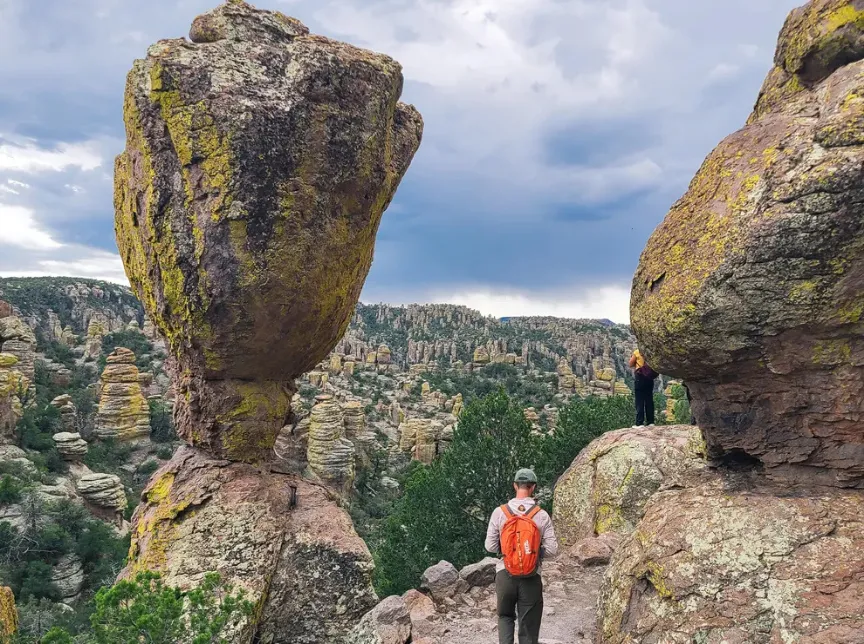
In southeastern Arizona, tall rock spires rise above wooded canyons, and enormous boulders balance on narrow columns of stone. For more than a century, visitors have known this place as Chiricahua National Monument. For much longer, it has also been a place of significance for Indigenous people – there is evidence of people inhabiting this area for thousands of years.
On October 20, the Chiricahua National Park Act was signed into law, making Chiricahua the country's newest national park. The landscape joins a long line of national parks that began as other types of conservation areas, with protections that helped preserve them long before their names changed.
For Chiricahua, that history reaches back to April 18, 1924, when President Calvin Coolidge established the national monument to protect its distinctive rock formations. Its new designation continues more than 100 years of that protection.
Rock formations millions of years in the making
The story of Chiricahua’s rock formations begins about 27 million years ago, when eruptions from the nearby Turkey Creek volcano covered the region in hot ash and debris. That material then compacted and fused into a thick layer of rock.
As the rock cooled, it cracked, and over millions of years weathering and erosion carved columns that rise above the canyons today. Some tower hundreds of feet into the air, with large masses of rock balanced on bases far too narrow to hold them.
The park’s 8-mile scenic drive winds among these formations on the way to Massai Point, where visitors can look out across the standing rocks. 17 miles of trails offer a closer view of the formations and the forests growing around them.
Life on a sky island
The Chiricahua mountains form one of southeastern Arizona’s famous “sky islands,” isolated pieces of land rising above the surrounding desert. Higher elevations bring cooler temperatures and more moisture. Within the park, the landscape shifts from desert scrub to pine and oak forest. Along the bottoms of the canyons sycamores and willows follow the path of seasonal streams, providing food and shelter for wildlife.
Among the trees are Apache pines, which are rare in the United States and have needles that can reach 10 inches long. Alligator junipers are easier to recognize by their thick, scaly bark. Their berries feed wildlife, and their branches provide places for birds to nest.
That variety of habitat makes Chiricahua a rewarding place to watch birds. Mexican jays are year-round residents, often gathering in noisy groups, while acorn woodpeckers are commonly seen along the creeks. Listen, too, for the descending song of a canyon wren among the rocks.
The wider Chiricahua Mountains also support Mexican chickadees, birds whose range extends south through Mexico as far as Oaxaca. In the United States, they live in just two mountain ranges, the Chiricahuas and New Mexico's Animas Mountains. These birds nest in tree cavities and search the branches for caterpillars and other insects.
What changes — and what does not — at Chiricahua
Each redesignation depends on what Congress puts in the law. At Chiricahua, the new law keeps the existing boundaries and continues National Park Service management. It makes the monument's existing funding available to the national park. The change adds no land.
The law also directs the Interior Department to protect traditional religious sites and consult with Tribes. It requires access for Tribal members' traditional uses and allows temporary closures of specific areas to protect those uses. These provisions recognize the continuing relationship between Tribes and the land. Additional details on this will need to be developed to ensure that an increase in visitors does not put at risk important cultural sites or ceremonies.
The new name could bring more visitors. A 2019 Headwaters Economics study examined eight monuments redesignated as national parks and found that average annual visitation was 21% higher in the five years after redesignation than in the five years before.
If more people do visit Chiricahua, the Park Service will need the resources – the people and the funding – to care for the land and help visitors explore it safely. The designation law includes no new appropriation for additional staff or visitor facilities. The Trump administration has already made substantial cuts to the National Park Service, reducing visitation hours and forcing popular trailheads to close. A portion of park entrance fees, traditionally used for maintaining the parks, have also been siphoned into vanity projects in Washington, D.C. The agency is now operating with roughly a quarter fewer staff than it had in January 2025 while facing a large backlog of maintenance projects. Congress will need to address those staffing and maintenance needs in its funding decisions.
That responsibility extends to national monuments, too. Whether a family is visiting a newly designated national park or a monument protected decades ago, their experience depends on people who maintain the trails and help them find their way. Likewise, ensuring protection of cultural resources is a high priority, particularly for the affected Tribes, and that requires people and funding too. As Chiricahua's new name draws attention, the work of caring for the place continues.