Health and Safety Impacts of the Pipeline Expansion
The Algonquin gas transmission pipeline was first installed in the 1950s in NJ, Rockland, Westchester, Putnam, CT, RI, MA.
A new massive three-part expansion (by Spectra/Enbridge) replaces the original 26” with 42” diameter pipeline and adds new segments, dangerously increasing pressure, volume and toxic emissions.
- AIM (Algonquin Incremental Market) Project. Completed and operational as of January 2017 with 42“ pipe from NJ, Rockland, under Hudson River to Indian Point nuclear power plant, Buchanan, Peekskill, ending at Yorktown; then from Southeast for 4.5 miles into CT. The Stony Point compressor station was expanded to 59,000 hp, a 55% increase, Southeast compressor station expanded to 50,000 hp, a 25% increase, & other expansions in CT, RI, MA.
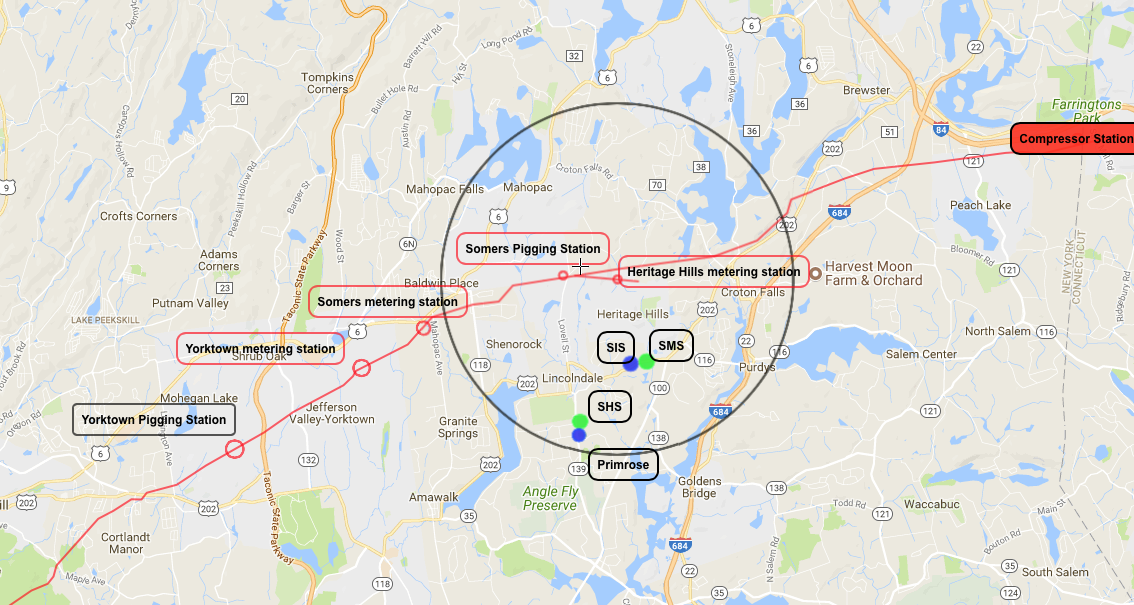
- Atlantic Bridge Project. 4 miles of pipeline from Stoney Street, Yorktown to Birdsall Road, Somers, modifying a Yorktown metering station, and relocating a pigging station from Yorktown to 36 Birdsall Road, Somers; other expansions in CT, RI, MA & ME. Work to begin October 2017. See NY map:
- Access Northeast Project. Further expansions of pipelines in Somers and Southeast and the Stony Point and Southeast compressor stations (each by approximately 20%). Other expansions in CT, RI, MA, ME and Canada. This project is temporarily delayed. (See definitions p. 2)
1. Location of gas transmission pipelines at Indian Point Nuclear Plant is a major threat. The 42” diameter AIM pipeline, was constructed within 105 ft. of critical structures at Indian Point (IP), despite overwhelming opposition from local citizens and elected officials. This gas pipeline infrastructure poses unacceptable risks for catastrophic radiation releases to 20 million people within the 50-mile impact radius in NY metro area. Nuclear, pipeline and medical disaster preparedness experts warn that a gas pipeline explosion at that location would be more devastating than Fukushima. Closing IP would not solve that risk. Even as it is decommissioned, its massive amount of highly radioactive nuclear waste remains indefinitely. Gov. Cuomo commissioned a risk assessment of siting AIM at IP but has failed to release it, despite great public demand. IP is the only nuclear power plant in the US with gas transmission pipelines on site. https://sape2016.org/resources/indian-point/ ; https://sape2016.org/resources/risk-assessment/
2. Impacts on our Health and Climate. Gov. Cuomo banned fracking in New York State because of its adverse health impacts but he continues to allow the increase of gas infrastructure which transports fracked gas from Pennsylvania into NY. Serious health and climate impacts are also associated with natural gas infrastructure due to highly toxic emissions from pipelines, compressor, metering and pigging stations, etc. This infrastructure is also subject to leaks, blowdowns, accidents, malfunctions, fires and explosions. Over a thousand peer-reviewed scientific studies have linked gas infrastructure with negative health impacts. The AMA and Medical Society of NYS have passed resolutions. The Medical Society of the State of New York notes in its 2015 resolution, Protecting Public Health from Natural Gas Infrastructure: "…The chemical and radioactive emissions associated with HVHF (High Volume Hydraulic Fracturing) exposes humans and animals to the same chemical and radioactive emissions as those released at drilling sites, which include dangerous mixtures of contaminants and carcinogens…which are especially damaging to the development of embryos, fetuses, and children, as well as reproduction and survival of livestock, poultry and wild animals." http://stopnypipeline.org/resolution-of-the-medical-society-of-the-state-of-new-york/ ; http://concernedhealthny.org/wp-content/uploads/2016/12/COMPENDIUM-4.0_FINAL_11_16_16Corrected.pdf
On Climate. Methane (97% of natural gas - a fossil fuel) is a heat trapping greenhouse gas, 86 times more potent than carbon dioxide over a 20-year period, according to the Intergovernmental Panel on Climate Change. IPCC's Fifth Assessment: www.ipcc.ch/report/ar5/wg1/; http://www.eeb.cornell.edu/howarth/summaries_CH4.php
3. Safety Impacts. Spectra (now Enbridge which acquired Spectra in 2017) has a poor safety record. They have been responsible for numerous pipeline explosions, leaks and violations which have increased especially in new pipeline construction. https://sape2016.org/resources/pipeline-safety/ Also, there are no evacuation plans in case of an accident at IP, and no “pipeline impact training” which dramatically increases the danger to the public and our first responders. According to Pipeline Hazardous Material Safety Administration (PHMSA) statistics, there have been 832 serious incidents in the 20 year span from 1997 to 2016. https://hip.phmsa.dot.gov/analyticsSOAP/saw.dll?Portalpages
4. Undemocratic, deeply flawed federal and state process. The Federal Energy Regulatory Commission (FERC) is run by pro-gas insiders paid by industry fees, who rubberstamp approval of gas projects. To avoid the full assessment of wide-reaching cumulative impacts on air, water, wetlands and land, FERC allowed Spectra to break the massive expansion from NJ to Canada into 3 impermissibly segmented projects that were improperly evaluated separately, instead of as one, violating federal law. Yet when challenged by the public to complete a cumulative review of all three in one, industry and FERC used multiple “delay and denial” tactics to continue construction - so that by the time the appeal is heard in Federal court, the project is already finished and operational. Dividing the expansion into different projects also divides public reaction in individual communities diminishing the power of residents to investigate, talk to each other, fight back and expose what is really going on. https://sape2016.org/ferc-process/
Unresponsive, unprotective NYS process. FERC only addresses the siting (location) of the project. NYS refuses to conduct State Environmental Quality Reviews (SEQR) on air, water, and land or support an official Health Impact Assessment (HIA) in spite of massive outcry from the public and elected officials. Resolutions: https://sape2016.org/resolutions/; https://sape2016.files.wordpress.com/2014/01/111815-amy-r-to-dec-re-permit-modification-with-blowdown-notification-w-signatures1.pdf ; https://sape2016.files.wordpress.com/2014/05/skmbt_28314081912150.pdf
5. Main purpose of transmission pipeline expansion is for export. The plan is to ship the gas overseas to far more lucrative international markets. www.sape2016.org/resources/export/ Once this expansion is complete, our communities will be held hostage to this dangerous and unhealthy infrastructure for decades - just for the sake of corporate profits. www.mass.gov/ago/news-and-updates/press-releases/2015/2015-11-18-electric-reliability-study.html).
6. Potential financial impacts. The Access Northeast expansion in Somers, Southeast and CT, RI, MA, ME and Canada is temporarily delayed while industry and some Massachusetts officials try passing legislation to shift construction costs onto citizen’s utility bills. http://bit.ly/2vTAsMk
7. Readily available and cost-effective alternatives to natural gas/fossil fuels are already here - conservation, energy efficiency, solar, wind, wave, passive homes, heat pumps & geothermal. www.thesolutionsproject.org/resource-library/
Definitions
• Compressor stations pressurize and propel gas through the pipeline. The Southeast compressor station annually emits over two hundred thousand tons of greenhouse gases and over 100 tons of hazardous air pollutants. People who live within 3 miles of a compressor or metering station are most at risk - particularly young children, the elderly and those with respiratory, cardiac and pulmonary conditions. Emissions are not adequately assessed for risk to human health for nearby residents. Dingle Ridge/Finch/Vail area and heavily populated Peach Lake are within the 3-mile radius of the Southeast compressor station.
• Metering & Regulating stations measure and regulate flow of gas through transmission pipelines and may "down pressure" it into smaller distribution lines to local users. Although they are generally smaller than compressors, they emit the same toxic gases. Little is known about their emission levels as there are no reporting requirements. Somers metering station is at 36 Birdsall Road near Route 6 in Somers, and the Heritage Hill metering station is off Warren Street on Fred’s Way, across from the Heritage Hills Maintenance facility - sign says Gate 3 - note the road is labeled West Hill Drive south on Google maps.
• Pigging stations clean out the accumulation of radon’s deadly radioactive decay products - Lead 210 and Polonium 210 and other contaminants - from inside the pipe. Pigging equipment becomes contaminated during these activities and can contaminate surrounding property. Storm water runoff containing radioactive materials can migrate to nearby property and surface waters and seep into soil contaminating groundwater. Inhalation of this material is associated with lung cancer. A pigging station will be relocated from Yorktown to 36 Birdsall Road, Somers.
• Blowdowns occur frequently at all three stations, whether planned or accidental, releasing much higher levels of hazardous air pollutants that put the public at even greater risk. Advance notification of planned blowdowns and notification immediately following accidental blowdowns are imperative, but are not provided to the public to enable emergency measures - e.g. staying indoors or evacuating the area. If wind direction blows the emissions towards your home and there are low clouds and/or a temperature inversion (which acts like a lid), the toxins will be concentrated in the air you breathe. The Southeast compressor station blowdowns exceeded 4 thousand cubic feet of toxic gas and other contaminants into the air annually, as self-reported by Spectra. https://sape2016.org/resources/compressor-station-impacts/