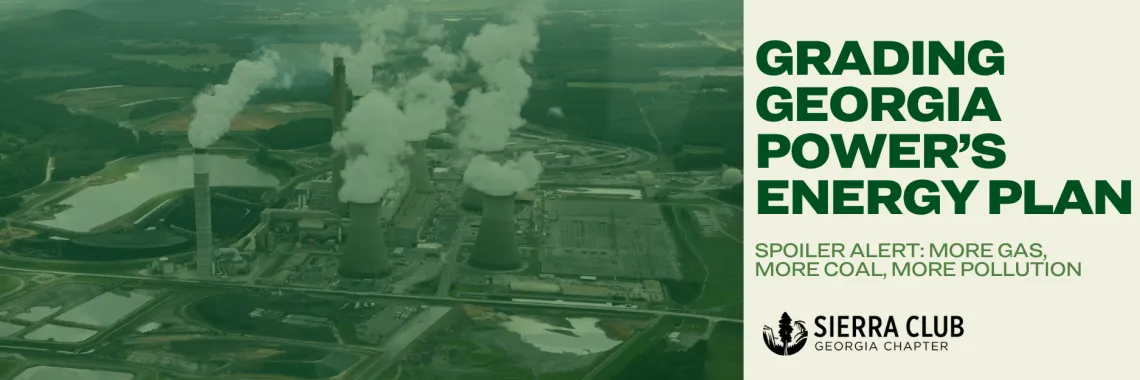
Every three years, Georgia Power has to prepare an Integrated Resource Plan, also known as an IRP. The IRP outlines how Georgia Power will generate the electricity it will sell to its customers for the next 20 years, including whether that electricity comes from clean, renewable sources or from dirty fossil fuels like coal and fracked gas.
The Georgia Public Service Commission (PSC) will be reviewing Georgia Power’s proposal for the next several months. The PSC is a five-member elected governmental body responsible for regulating utilities in Georgia, including electric, gas, and telecommunications services.
Broadly, the IRP calls for delaying planned retirements of coal burning power plants, increasing the use of so-called “natural gas” or methane gas as a fuel, and does not make any meaningful attempt to add more renewable energy to our grid. For context, Georgia Power’s energy mix in 2023 was made up of 46% gas/oil, 25% nuclear, 16% coal, 7% renewables.
Sierra Club wants to help customers throughout the state understand what is included in Georgia Power’s approved energy plan, and what happens next.
After reading more about the IRP and the impacts it will have, click here to send a message to the Public Service Commission.
Commitment to Climate Action
Grade: F
What’s in the plan:
- Honestly? Not much. If the PSC approves the plan Georgia Power submitted, the utility would be one of the top greenhouse gas emitters in the U.S.
Why it matters:
- Climate change is here. Look no further than the extreme weather Georgia has experienced in recent years. Increased drought is causing wildfires in the North Georgia mountains. Hurricane Helene caused significant damage across our state, will cost Georgia farmers $5.5 billion, and will likely result in increased electricity rates to pay for the damage to our electric grid.
A better way forward:
- Georgia Power should stick to its plan to retire its coal plants. Instead of building new infrastructure to burn methane gas, Georgia Power should meet the increased electricity demand with renewable energy. Georgia has a massive and growing solar industry — adding more solar power to our grid not only makes it more resilient and curbs climate change, it also supports jobs right here in our state.
Ditch Coal
Grade: F
What’s in the plan:
- Despite previously planning to retire coal plants, Georgia Power has decided to breathe new life into them by continuing to operate Plant Bowen, near Cartersville, and Plant Scherer, just outside Macon, well into the 2030s. To comply with new federal regulations, Georgia Power will have to add new pollution control technology to these coal plants, making it even more expensive to keep these plants running.
Why it matters:
- Burning coal harms the health of our communities and pollutes our environment. The air pollution alone can cause asthma, strokes, and heart attacks, and the toxic coal ash generated as a byproduct is resulting in dangerous substances seeping into our water. Georgia Power also admits that keeping coal plants online is expensive and not in the best interests of Georgians. Keeping these plants burning for another decade (or more!) will harm Georgians’ health.
A better way forward:
- Georgia Power must keep their promise and shut down Plant Scherer and create firm retirement dates for Plant Bowen.
No Methane Gas
Grade: F
What’s in the plan:
- Georgia Power is looking to invest in new methane gas infrastructure at Plants McIntosh, Bowen, and Scherer. The utility also seeks to extend the life of Plant Gaston in Alabama, which primarily burns methane gas, and transmitting the electricity to Georgia.
Why it matters:
- Methane gas has much more of an impact on the warming of our planet than carbon dioxide. It requires expensive and dangerous pipeline systems [that will disrupt our communities/backyards]. The price of methane gas is extremely volatile, and since Georgia Power passes 100% of fuel costs on to its customers, it is a significant factor in rising power bills.
A better way forward:
- We should not replace our aging coal fleet with methane gas burning turbines. Replacing one fossil fuel for another does nothing to advance our climate goals, will cause power bills to rise further, and pollute our communities. Renewable, carbon-free energy is the best path forward economically and environmentally. Switching from importing methane gas, which Georgia does not produce, to clean energy infrastructure will create jobs for thousands of Georgians.
Clean, Renewable Energy
Grade: D-
What’s in the plan:
- Very little. The IRP does not include plans for Georgia Power to build any new solar power infrastructure in Georgia, though it calls for modest increases in battery storage. One of the ways Georgia Power brings more electricity to its portfolio is by putting out a “request for proposals” from third parties to sell electricity to the utility. This process sometimes drags on (there are still unfilled RFPs from the last IRP), but Georgia Power still considers this as adding clean energy in an IRP.
- The 2025 IRP is no different: Georgia Power plans to ask for 1,000 MWs of clean energy through an RFP process. However, this represents less than 13% of the 8,000 MWs of new energy Georgia Power claims it will need over the next six years. The rest will be obtained from reversing retirements at coal plants, expanding generation at existing gas, nuclear, and hydro units, and a broad RFP that is likely to be filled by more fossil fuels.
Why it matters:
- Again, climate change is already impacting every facet of our lives. Continuing to burn fossil fuels when renewable energy alternatives are available and cheaper is foolish.
A better way forward:
- Go big on solar! Georgia Power could make significant investments in building new utility-scale solar projects, improve incentives for residential solar panel installations, and allow for “community solar” projects to provide additional options for its customers.
Energy Burden and Equity
Grade: F
What’s in the plan:
- Energy burden is the percentage of a household’s income that is spent on electricity, methane gas, and other household fuels. Georgia Power does not acknowledge the fact that Georgia residents face some of the highest bills in the nation and has no plan to help residents other than keeping coal plants online for longer.
Why it matters:
- Black households in Georgia face disproportionately high energy burdens, including historic discrimination and disinvestment in infrastructure. Additionally, residential power bills in Georgia have gone up dramatically: six times in the last two years, hitting communities during a time of unprecedented economic burden. The average customer’s bill has increased more than $500 a year since 2023. Meanwhile, Southern Company brought in $4.4 billion in profit last year.
A better way forward:
- Georgia Power may only be motivated by the pursuit of higher profits, but it is the responsibility of the PSC to protect Georgians and ensure they pay a reasonable rate for electricity. Our communities are struggling to pay their bills, and the areas around coal and gas power plants are seeing significant air and water pollution. Again, Georgia Power must shift away from fossil fuels, transition to clean energy, and stop making investments based on profit margins.
Pollution
Grade: F
What’s in the plan:
- Georgia Power’s commitment to coal – as well as the rush of data centers to the state and their use of diesel generators– are set to quickly degrade Georgia’s air quality. It will make our coal ash problem worse.
Why it matters:
- There is nearly 100 million tons of toxic coal ash stored across Georgia, including in communities like Juliette, where residents recently settled multiple lawsuits with Georgia Power over whether this pollution was harming their health. The chemicals found in coal ash have been found to raise the risk for cancer, heart disease, and stroke, and can inflict permanent brain damage on children. Burning coal and gas will also lead to increased air pollution in frontline communities near power plants.
A better way forward:
- There is no such thing as clean coal or clean gas. Alternatively, solar panels don’t cause pollution! There is no toxic byproduct from wind turbines. Georgia Power’s proposals to install new technology to limit pollution from their fossil fuel power plants will add insult to injury by passing those costs on to customers. Additionally, Georgia Power should commit to excavating every coal ash pond that has this toxic material sitting in groundwater so that our communities are protected from the utility’s legacy pollution.
More Information
Q: How can you help improve this plan?
Georgia Power’s IRP has several serious failings. The IRP will go through a lengthy process involving testimony from Georgia Power, intervenors like the Sierra Club, and the public. We have a significant opportunity to improve and strengthen the IRP proposal to create a clean energy future for ALL Georgians. If we pull together, we can protect our air and water, provide affordable energy for all, and live on a healthy planet where everyone can thrive.
Remember, the Public Service Commission works for YOU! You can send them a message using the instructions at this link. Tell them you want more clean energy, a transition away from fossil fuels, and fair rates for ALL Georgians!
Q: How does this compare to previous IRPs?
It's worse. The Sierra Club identified many areas of concern in Georgia Power’s 2022 IRP and graded it accordingly. There were some bright spots in the 2022 IRP, including plans to retire multiple coal plants. Unfortunately, this year’s IRP breaks those retirement commitments, proposes building more fossil fuel infrastructure, and contains shockingly little clean energy, which is why this year’s grades are so much lower compared to 2022.
Q: Why is the IRP so important?
Georgia Power’s IRP is the blueprint and roadmap for our state’s energy future and how we’ll get there. The IRP process is one of the few ways the public can interact with and impact that roadmap.
Q: What do data centers have to do with the IRP?
Data centers are causing a boom for energy providers across the nation because of the massive amounts of energy they require. Atlanta is one of the top data center markets in the U.S., and Georgia Power is making several bad choices in the name of powering these data centers, including keeping coal plants online past their planned retirement.
Q: What is “energy burden?”
Energy burden is the percentage of a household’s income that is spent on electricity, methane gas, and other household fuels.