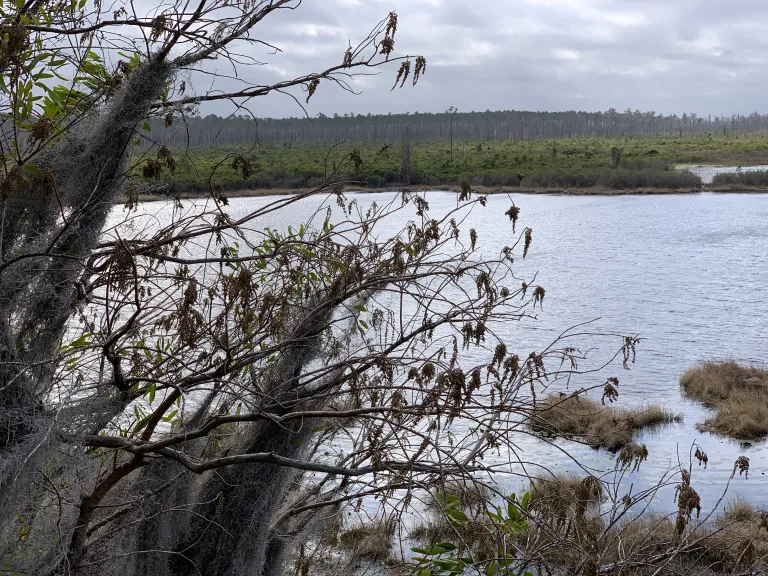
The Sierra Club Georgia Chapter has been working to stop Twin Pines’ proposed mine near the Okefenokee Swamp for the last six years. We've fought in the halls of the Georgia Capitol and Congress, in boardrooms across the country, and in lowlands of the Swamp itself. Since the campaign began, there have been multiple changes in decision-making jurisdictions, multiple presidential administrations, and the upheaval of the COVID-19 pandemic. Despite all the upheaval, the campaign persisted and was consistently one of our most engaged-with efforts.
Twin Pines’ mining proposal
Twin Pines Minerals, based in Birmingham, Alabama, announced its plan to mine near the Okefenokee National Wildlife Refuge for titanium dioxide, commonly used as a white pigment in paint, toothpaste, and other consumer products. Twin Pines wanted to mine along Trail Ridge, an ancient sand dune formed when sea levels on Georgia’s coast were much higher. The ridge is a natural dam that keeps water in the Okefenokee, making it critically important to the health of the swamp. Twin Pines planned to dig 50-foot pits on Trail Ridge, run the excavated soil through a machine to separate its component parts, extract the titanium dioxide, refill the pit, then move on to the next site to repeat the process.
Shifting jurisdictions
When the project was first announced, Twin Pines had to seek permits from the U.S. Army Corps of Engineers (USACE), which asked for public comments and even held a virtual public meeting about the proposal. But in 2020, the Trump Administration weakened protections in the Clean Water Act and removed Trail Ridge’s wetlands from federal jurisdiction. Permitting for the mining proposal fell to the Georgia Environmental Protection Division (EPD). The EPD held multiple public comment periods and public hearings over the five years it was considering the permit applications.
Multiple strategies
The Georgia Chapter left no stone unturned in our efforts to stop this mine. We drove public comments to federal and state agencies that were considering the mining permits. We lobbied our state lawmakers to pass legislation that would protect the Okefenokee. We mobilized supporters to amplify the Felician Sisters of North America's shareholder resolutions with multiple corporations, including Chemours, Home Depot, and Sherwin Williams, urging them to publicly disavow this mining proposal in an attempt to dry up the financial incentives for Twin Pines. (The Felician Sisters got a commitment from Chemours in 2022). We sent letters to decision makers at all levels urging them to take action, including then-Interior Secretary Deb Haaland and Georgia Gov. Brian Kemp. We hosted webinars to educate the public about the threat posed by the mine and coached them on how to craft a strong public comment.
Forming coalitions & mobilizing our supporters
We knew we couldn’t do this alone, so we worked hard to organize coalitions and partnerships to help. The Georgia Chapter was a founding member of the Okefenokee Protection Alliance, which was named Refuge Advocate of the Year in 2024 by the National Wildlife Refuge Association. We worked closely with the Sierra Club Florida Chapter on multiple initiatives and got communications and legal support from the National Sierra Club.
The Sierra Club Georgia Chapter also built multiple action alerts to drive public comments to federal, state, and local agencies, as well as multiple corporations. All told, we helped our supporters send more than 14,000 messages to decision makers, drawing action takers from all 50 states.
Contributing to the victory
In the end, the mining proposal was defeated when The Conservation Fund bought Twin Pines’ land on Trail Ridge. Although the Sierra Club did not play a direct role in this purchase, we strongly believe that our work helped push Twin Pines to the negotiating table. It’s very rare for the Georgia EPD to take five years to approve permits for a project like this, and we suspect that the outsized attention this project received led to EPD slowing the approval process down.
The longer Twin Pines had to wait to begin mining, the worse its finances got. Twin Pines was sued for nonpayment by multiple companies it had subcontracted to help with shipping and storing mined titanium. The company also owed back taxes to Charlton County and failed to put up a $2.1 million bond the state required before permits could be issued. By slowing down the mine’s approval and therefore straining Twin Pines’ finances, the Sierra Club helped make it more likely that Twin Pines would be open to a buyout.
What’s next?
The fight to protect the Okefenokee will continue. The Conservation Fund purchased about 7,800 acres of Trail Ridge near the Okefenokee, but more than twice that amount remains unprotected. Two attempts to mine Trail Ridge have now been defeated (DuPont tried to mine there in the 1990s), but we don’t want to have to keep fighting the same fight every 10-20 years. The solution is permanent conservation for Trail Ridge.
While the Conservation Fund may continue to pursue additional purchases in the area, we cannot sit by and hope that philanthropy will save the day once again. Instead, the Sierra Club Georgia Chapter plans to continue our work in the Georgia Legislature to protect the Okefenokee. These efforts include passing legislation to ban mining on Trail Ridge, reforming Georgia’s “Bad Actor” provisions to give the EPD more authority to decline permit applications for companies who have a poor track record, or a moratorium on mining near the Swamp. Stay tuned for more information as our coalition regroups and plans our next steps.
In closing, the Sierra Club Georgia Chapter would like to thank everyone who took action to help protect the Okefenokee over these last six years, all of our coalition partners, the lawmakers who stepped up to fight for the swamp, and The Conservation Fund and its donors for dealing the final blow to this mining threat. This victory would not have been possible without you.
About the Sierra Club Georgia Chapter
The Sierra Club Georgia Chapter is the largest grassroots environmental organization in the state, with more than 75,000 members and supporters. The Chapter supports a robust outings program and has active committees working on forest and coastal protection, transit expansion, and clean energy. For more information, visit sierraclub.org/georgia.
About the Sierra Club
The Sierra Club is America’s largest and most influential grassroots environmental organization, with more than 3.5 million members and supporters. In addition to protecting every person's right to get outdoors and access the healing power of nature, the Sierra Club works to promote clean energy, safeguard the health of our communities, protect wildlife, and preserve our remaining wild places through grassroots activism, public education, lobbying, and legal action. For more information, visit sierraclub.org.