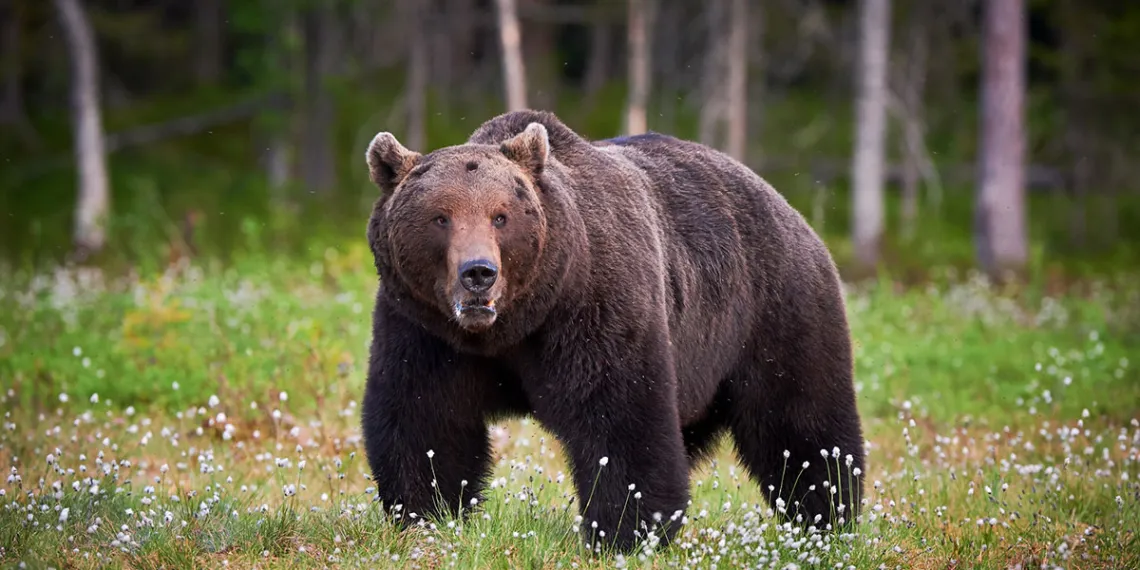
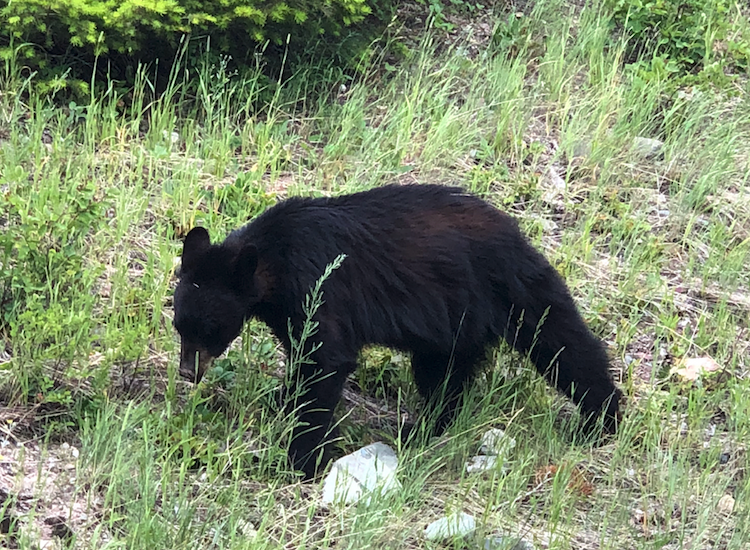
When you visit Yellowstone and Glacier National Parks, as my family and I did a couple weeks ago, you see something spectacular everywhere you look, whether it's towering peaks wreathed in cloud or carpets of wildflowers. One thing you probably won't see is a grizzly bear, even though both parks and the surrounding wilderness are prime bear habitat. Like us, you might find yourself in what's known as a "bear jam." As you can see, though, the animal backing up traffic was the grizzly's smaller cousin, a black bear:
Grizzly bears do their best to avoid the most dangerous animal of all: humans. At the same time, park rangers do their best to keep people away from grizzlies, even if it means temporarily closing a popular trail. Even so, when you hike in the park, it's at the back (or for my wife, the front) of your mind: Will there be a bear around that corner? Part of you would be excited to see one (from a distance), and part of you (the sensible part) hopes you're making enough noise on the trail to avoid surprises. Even so, and despite their size, without their grizzlies, Yellowstone and Glacier National Parks would be diminished.
That came close to happening about fifty years ago, when the total grizzly population in the lower 48 was down to about 800 bears. In the Greater Yellowstone Area, fewer than 150 were left. Technically, what saved grizzlies was passage of the Endangered Species Act. In reality, though, it was a shift in attitude -- from "us or them" to "conservation and coexistence" -- that made it possible. Federal protection led to enlightened policies (like closing park garbage dumps that attracted bears and educating local landowners on how to avoid human-bear conflicts) that made coexistence feasible.
Even so, it's been a long, slow road toward recovery. Grizzlies reproduce very slowly (only one North American mammal takes longer, and if you don't already know, you'll never guess which one). Although grizzly populations in Yellowstone and Glacier are certainly in better shape now than before they were protected, their future remains precarious. That's why it's so disastrous that U.S. Fish and Wildlife Services took the Greater Yellowstone grizzly off of the endangered species list, which eliminated many protections and put the fate of the bears in the hands of the Wyoming, Idaho, and Montana state governments.
Grizzlies today occupy only about two to four percent of their historic range in the Lower 48