by Diane Myer
Reprinted with the permission of Minnesota Women's Press
"We're Up Against Billionaires" - Farmington residents in lawsuit against city for approving giant data center without community input
This year’s bill HF16 — a budget deal finalized by Minnesota legislators on June 9 — is primarily focused on incentivizing the development of new hyperscale data centers in Minnesota. The bill includes uncapped sales tax breaks for technology companies and data center developers. Development is set to cost the state $137 million in potential tax revenue for the 2027 budget and $219 million in 2029, according to the Minnesota Department of Revenue.
Data centers are not new, but their exorbitant energy consumption is. Hyperscale data centers, 11 of which are currently proposed in Minnesota by companies including Meta, Amazon and Tract, “are in every way unprecedented in their potential impacts,” according to Peter Wagenius, Legislative and Political Director for the North Star Chapter of the Sierra Club.
In 2011, when the state of Minnesota introduced sales tax breaks intended for Target, IBM, and other Minnesota companies seeking to build data centers at home, the first data center built by CenturyLink in 2014 supported 1.2 megawatts. In 2015, sales tax breaks for computers and other necessary equipment cost the state only $6 million in revenue.
The average hyperscale data center now requires 800 megawatts of electricity, because of the emerging dependency on cloud computing and artificial intelligence. The new “hyperscale size [of data centers] is not just reflected in their physical size, but the size of their subsidies, the size of their impacts on the electric grid, and the size of how much water they may need to heat and cool,” Wagenius explains. He believes that HF16 failed to advance the law in stride with the drastic development of the data center industry and its demands.
Referring to Minnesota’s willingness to accommodate data center growth rather than constrain its anticipated impacts on the environment and local communities, Wagenius admitted that he has little faith in the government when it comes to the issue of energy and the environment. Environmental regulations that the Sierra Club and other organizations lobbied for were shut down by legislators mainly concerned with attracting business from developers. The developers tend to promise to bring thousands of jobs, despite concerns that construction jobs will be temporary and the bulk of administration jobs will be remote — as is the case in other states — according to several advocates we talked to.
“It comes down to an issue of trust,” Wagenius says. “Minnesotans are on our own now. If the legislature doesn’t step up and insist Minnesotans are protected, then Minnesotans won’t be protected.”
The Sierra Club and other environmental advocacy groups have pointed out the disparity between the minimal environmental standards required of data centers by law and what they believe is actually needed from industry to succeed as stewards of the earth. Minnesota is still looking ahead to 2040, the year heralded as the 100 percent carbon-free energy deadline, but Wagenius is now worried that the state will not be able to meet this goal.
Missing from the bill, he says:
- water conservation measures, which would require closed loop water cooling systems (an industrial and commercial standard in Minnesota);
- regulations addressing noise and light pollution;
- assurances that massive backup generators will not use too much diesel fuel;
- restrictions on nondisclosure agreements signed between data center developers and local governments;
- requirements that data centers provide environmental impact statements
As for the impact on the state budget, Wagenius believes that “cuts to healthcare, transit and services that Minnesotans rely on were bigger than they needed to be because of space [needed] in the budget to give tax credits to data centers.” Minnesota law will allow data centers to claim uncapped sales tax exemptions until 2042, a “sunset” date which would in actuality allow continued benefits until 2072.
“We had hoped to achieve big changes in terms of being able to confidently tell the public that they were protected from data center threats, and I don’t think we can do that,” Wagenius concedes. He believes that state agencies have already failed to prove a commitment to environmental protections, and that there is no reason to have faith in developers when it comes to upholding the state’s goals for carbon-free electricity goals and clean air and water.
He observes that “the Walz administration has not given us reason to be confident,” citing People Not Polluters, a collaborative project launched in 2024 by the Sierra Club and 18 other Minnesota environmental advocacy organizations, aimed at exposing statewide failures related to the overarching issue of inappropriate corporate influence when it comes to environmental regulations.
“We’re on the clock,” Wagenius stresses. “How long [will] it take us to get to 100%
carbon free energy? If it takes 10 years longer, because we’ve spent an incredible amount of electricity on artificial intelligence, is that worth it?”
"Data centers are not good neighbors"
In the city of Farmington, residents have been fighting back against data centers since 2024, when community members received vague notices about the rezoning of a residential area in their city. They discovered that NDAs had been signed by the city in partnership with Tract, a private out-of-state development company. Now community members are waging a legal battle against the city.
Cathy Johnson, a former home sciences teacher who lives in Farmington, says she and her neighbors realized that only a small percentage of their community had been notified about the proposed “technology park” 250 feet from some of their property lines. They later learned that the rezoned land would become a data center campus. It would include 12 buildings and span 2.5 million square feet, requiring 708 megawatts of energy and 236 backup generators.
Copies of the rezoning notice started circulating as anxiety about the development increased. So, neighbors talked to neighbors and they began to organize. “We met in the park, and we exchanged emails. We started meeting in my backyard as the coalition. Now we’re a corporation and we’re registered lobbyists,” Johnson says of her coalition’s unlikely journey as activists in their community.
Residents of Farmington raised concerns, attended public hearings, and pleaded with city council members to think about the anticipated environmental impacts. The lawsuit filed against the city raises those concerns about excessive noise and light pollution, nitrous oxide emissions from generators, and encroachment on the federally protected Vermillion River. Yet Johnson and the coalition feel ignored by the local government.
Gathered around their dining table on June 30, and across the street from the proposed data center campus, Johnson and her husband Gary spoke candidly with Minnesota Women’s Press — alongside retired telecommunications engineer Mo Feshimi — about the challenges facing their new Coalition for Responsible Data Center Development.
They recounted how residents showed up at the first public hearing — held by the Farmington Planning Commission on May 14, 2024 — to discuss the rezoning of residential areas to a MUCI (mixed-use commercial/industrial) site. But it was as though the decision had already been made. Tract developers seemed to them to be invoking light responses to small data centers of the past — rather than the hyperscale nature of their project. Johnson says the project should be considered heavy industrial instead of the light industrial classification that the MUCI zoning implies.
At one point, Johnson says, the coalition asked Tract for a delay in the process, during which they could negotiate, but she says that request was ignored. She bemoans Tract’s lack of transparency — which rippled into the NDAs they required city planners that greatly limited open community conversation — and says that the coalition feels steamrolled:
“This is about as un-Minnesotan as anything I’ve ever seen. This is throwing our environment under the bus. This is lying to the public.”
Tract promises to work with communities on its website, Feshimi says, but “I don’t think they’ve ever taken us seriously.”
Economic development?
Tract’s promise to spur economic development in Farmington has been alluring to city council members, who rallied around the 275 jobs that the developers claimed they would bring to the area, alongside the attractive land sale near Castle Rock township. During the 2025 legislative session, Minnesota legislators argued about the claim of “thousands of jobs” created by data centers — with ambiguity about what type of work would be readily accessible for Minnesotans.
Feshimi is skeptical that this job growth will happen in Farmington, or benefit residents. Feshimi — citing his 20 years working as an IT specialist and telecommunication and data center network architect — says that while there will be temporary construction jobs, he expects that most administration jobs will not be available for residents in Farmington.
“A majority of those jobs, especially the high-paying ones, are done remotely. These data centers are almost lights out,” Gary Johnson adds.
The coalition hopes it can garner statewide recognition and support as they seek to educate fellow Minnesotans. “This is a precedent-setting situation. We’re not just fighting for Farmington. This [will have] a big impact and we can’t be isolationist. This is much bigger than any one city.”
In nearby Rosemount, a hyperscale data center owned by Meta is already under construction; Tract is seeking to build a second data center in Rosemount. A development application has been filed in Cannon Falls. Other projects have been proposed in Becker and Chaska.
The Coalition for Responsible Data Centers is trying to fund its ongoing legal battle against the city of Farmington. Johnson welcomes support. “We’re just folks and we’re up against billionaires.”
She cites the water story developing in Georgia, where state policies that prioritize hospitals and nursing homes — when water reservoirs are at risk — have not yet factored in the increased stress placed on water supplies by data centers.
The New York Times recently did a story indicating the issues that have arisen with water supplies to homes. Beverly Morris, a resident of Mansfield, Georgia, has experienced severe disruptions since the data center project nearby was developed. Her well water went dry, and appliances stopped functioning due to sediment buildup, costing thousands of dollars in repairs so far.
“Data centers are not good neighbors,” Feshimi adds. He worries about the potential effects on Farmington’s water. He notes that because Tract reached an agreement with the city of Farmington to use the municipality’s domestic water supply, “it [will be] impossible to say what’s used domestically and what’s used industrially.” That makes it impossible for the DNR to enforce their water prioritization statute, which is intended to support residents over corporations.
The coalition is co-hosting an August 20 discussion, with guest speakers representing different perspectives, and time for community conversation. It is part of Minnesota Women’s Press’ statewide effort to have discussions about stories, and stories about discussions. To sign up and learn more about the next discussion about data centers, click here.
If you would like to have a discussion in your neighborhood about this issue, contact community@womenspress.com. We have created a discussion guide with prompt questions based on this story.
If you appreciate our grassroots coverage, please support Minnesota Women’s Press as a supporter:
Related Resources
- Patricia Torres Ray commentary on data centers
- Impact in Alabama
- So far, officials in the city of 25,000 have shown little interest in publicly digging into the details of what could be one of the largest development projects in state history—one that would require the clearcutting of more than 100 acres of land, threaten endangered species and lead to large increases in water and electricity usage.
- Instead, public officials, many bound by non-disclosure agreements with the developer, have relied on the assertions of the company proposing the project—a company that has so far refused to answer media questions about the impact of their plans on the community and the environment.
- Impact in Georgia
- Impact in Virginia
- Cathy Johnson testimony to Senate committee, 2025
- Full House discussion on HF16
- Rep. Athena Hollins’ comments
- Full Senate discussion on the bill
- Sen. Erin Maye Quade comments
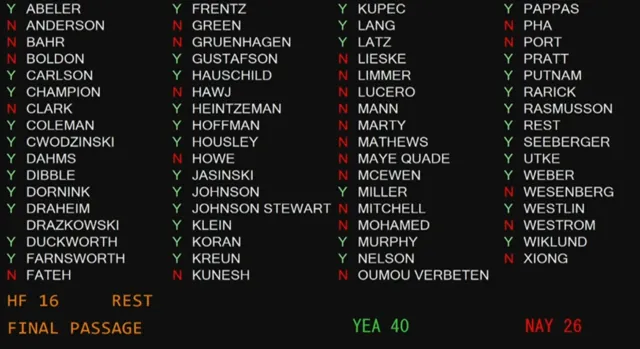
Senate vote in 2025 related to data centers bill
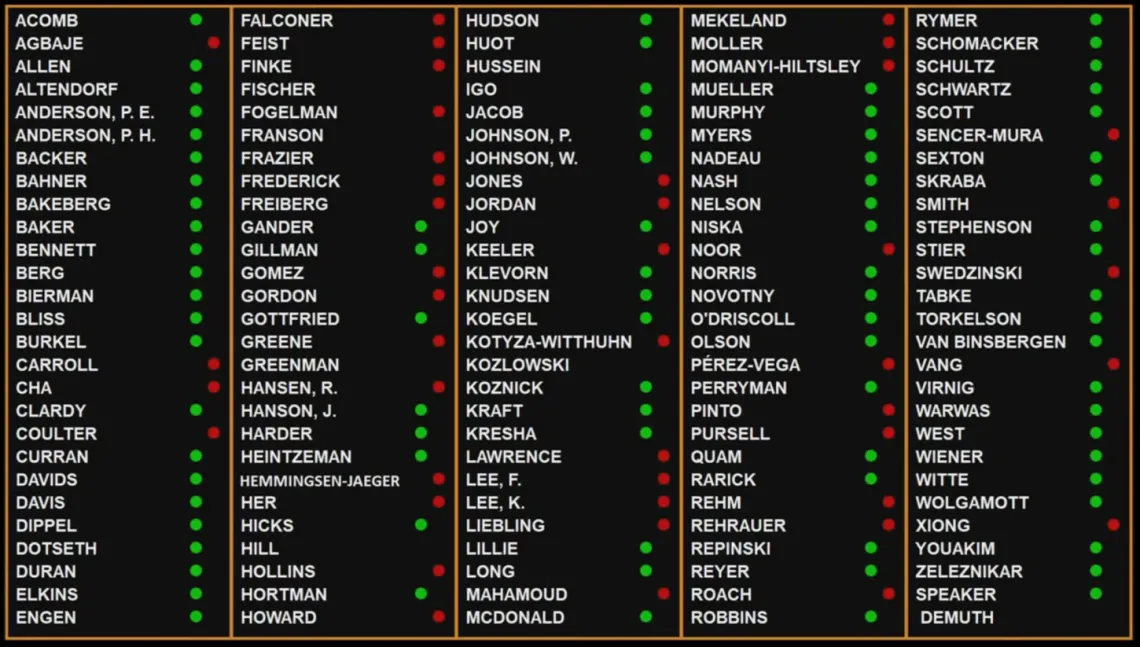
House vote in 2025 related to data centers bill