Rising utility costs
“Yes Virginia, there is a Santa Claus” means that Christmas is coming and eventually the cold will hit San Antonio. This is a good time to think about winterizing your home to reduce energy costs and greenhouse gas emissions.
But here’s your early lump of Christmas coal…the cost of staying warm in winter has risen, is rising, and will keep going up, having surged nationally 36% since 2021. Here at home we saw a CPS rate hike of 3.25% in 2022 and another of 4.25% in 2024, but get ready for sticker shock in 2026.
There are a number of factors responsible for why this is going to hit on your wallet:
- A major driver of increased costs is a sudden jump in power demand, largely from new data centers in the state and in San Antonio. Because of our lower energy costs, wide open spaces and amicable government, San Antonio has seen more than its share of this type of facilities. The burden of expanding the grid and modernizing it to accommodate the huge energy (and water) needs of these centers fall on all consumers, with large commercial clients actually paying less per kilowatt hour than residential users.
According to City Council Member Rick Galvan, District 7, with nearly 15 centers, has the highest concentration of these facilities. Currently, there are nearly 50 data centers either completed or planned to break ground in the San Antonio region. - Some say the biggest driver of the run-up in electricity prices over the past four or five years is the grid itself. While power plants get most of the political attention, it's the local distribution network — the "last mile" that carries electricity to homes and businesses — that has become a financial burden. CPS is investing upwards of $1.3 billion over the next five years in transmission and generation projects to support the rapid growth of these centers and is planning to build three new substations and 15 new or upgraded transmission lines over the next three to five years, Chief Energy Delivery Officer Richard Medina has said.
- Climate change is also a factor forcing utilities to rebuild infrastructure after hurricanes, wildfires or floods. In others cases, they're replacing decaying equipment. And increasingly, new lines must be buried underground or reinforced to prevent future disasters. Climate change is also increasing weather extremes, meaning greater heat and cold, requiring more energy consumption for comfort.
- Tariffs recently imposed by President Trump are affecting energy and infrastructure projects. Due to increased tariffs on equipment and materials essential to the construction and maintenance of projects, such as steel and aluminum, companies face higher construction and operational costs. Furthermore, the impact of the tariffs may lead to supply chain disruptions and higher costs that can cause delays in project timelines.
- America’s heavy reliance on natural gas for 40% of its electricity generation exposes consumers to rising gas prices. For CPS it’s 45%. US prices have surged 60% due to flat production growth and robust exportation of Liquid Petroleum Gas.
- The dismantling of renewable energy projects by Trump will further increase energy costs, in spite of the arguments by his administration that a heavy dependence on wind and solar power drives up electricity prices. Trump has repeatedly claimed that wind is the “most expensive energy ever conceived” and contends that “all green is all bankrupt.”
But analysis shows that states that embrace renewable energy are far more likely to save money for electricity consumers than those relying on fossil fuels or nuclear power. Joshua Rhodes, an electricity grid expert at the University of Texas-Austin, has found that renewable power has lowered electricity prices for customers in Texas, a state where wind and solar produce more than 30 percent of the state’s mix.
However, for states that embrace renewable energy, the same Trump imposed tariffs can be expected to have a significant impact on the energy and infrastructure industry. Renewable energy production in the United States relies on the importation of components such as solar panels, mounting racks, inverters, steel blades, and batteries from Southeast Asia, China, and the European Union.
Many of our top suppliers of these components, including Vietnam, Cambodia, and Thailand, are among the countries facing some of the steepest tariff rates. This development will raise the cost of construction and operation of many renewable energy projects within the United States.
Sorry, but there is no Christmas cheer here, as the outlook is dim (pun intended) until we rein in energy consumption, replace greenhouse gas emitting energy sources with renewable energy and create cities with reduced ecological footprints.
by John B. Hertz, Architect, Alamo Group Green Building Leader
Alamo Group Holiday Party & Pot Luck
Dear Friend of the Alamo Group,
Come and celebrate the joys of the season with the Alamo Group of the Sierra Club!
When
Tuesday, December 9th
6 - 9 pm
Where
At the home of Alan Montemayor:
152 Bluet Lane
San Antonio, TX 78213
Map to party
RSVP
to Alan at aldoprius60@gmail.com.
What to bring
This will be an “indoor/outdoor” party. Our hosts will provide plates, cups, napkins and eating utensils, and coolers with ice.
Please bring:
- A folding chair if you have one.
- Your favorite appetizer or “side” dish to share, and serving “tool” if needed.
- We ask please NO desserts.
- Bring Your Own Beverages.
- Dress appropriately for the weather, as well as the season!
- NOTE: Please do NOT bring any single-use plastic items. Any plastic you do bring, you will be asked to take back with you when you leave.
We look forward to having you join us!
Cibola National Forest, New Mexico: a Few Spots
On the Cibola National Forest website, top of the initial page 10/11/25: "The Radical Left Democrats shut down the government. This government website will be updated periodically during the funding lapse for mission critical functions. President Trump has made it clear he wants to keep the government open and support those who feed, fuel, and clothe the American people." This same text was present on every other US Forest Service website checked up to the US Department of Agriculture home page, USDA.gov.
Checked the USDA website 11/5/25, updated with more extreme details. National forest websites checked still had the prior text. Checked USDA.gov and some national forest websites again 11/22/25, the above texts were likely removed after the government reopening. The current US Secretary of Agriculture (head of USDA) was nominated by President Trump and confirmed February 13, 2025.
The home pages for National Park Service, Bureau of Land Management and Fish and Wildlife Service said nothing like the above. Only information about facilities and communications issues due to the shutdown.
My visit early October 2025 was only 5 days including driving from/back Kerrville, cut short due to severe flooding due to the hurricane in Mexico, some bits on that below. Still 3 fun loop hikes from 3 campgrounds.
Manzano Mountains Trail System
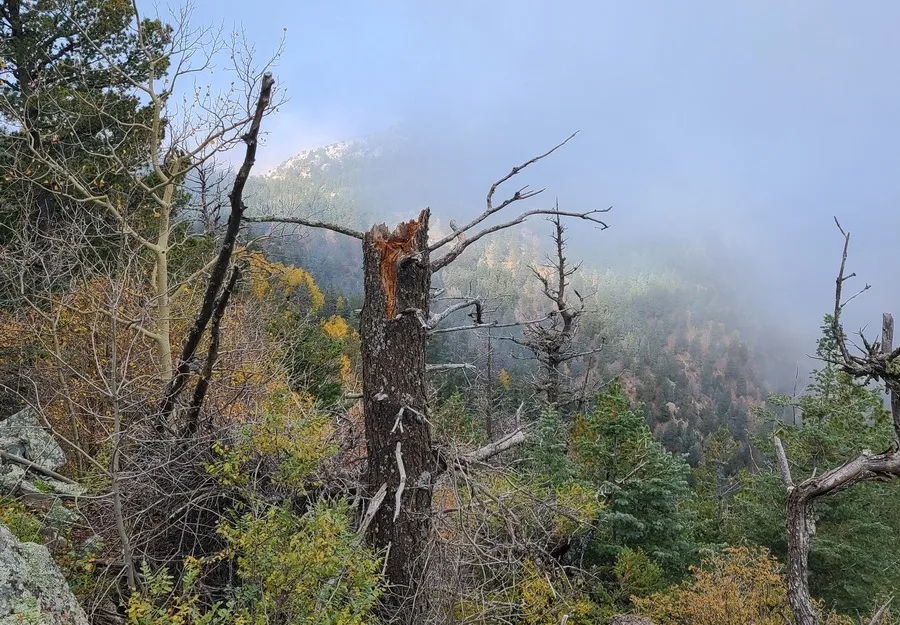
One enjoyable area is the Manzano Mountains (Wikipedia link). This is about 30 miles south-southwest of Albuquerque. We can download the trail map, PDF. Here I first went to Red Canyon campground, then hiked Spruce Spring/Crest/Red Canyon trails to the west, a 7.2 mile loop with 1900' elevation gain, first picture. Limited cell service here, no water.
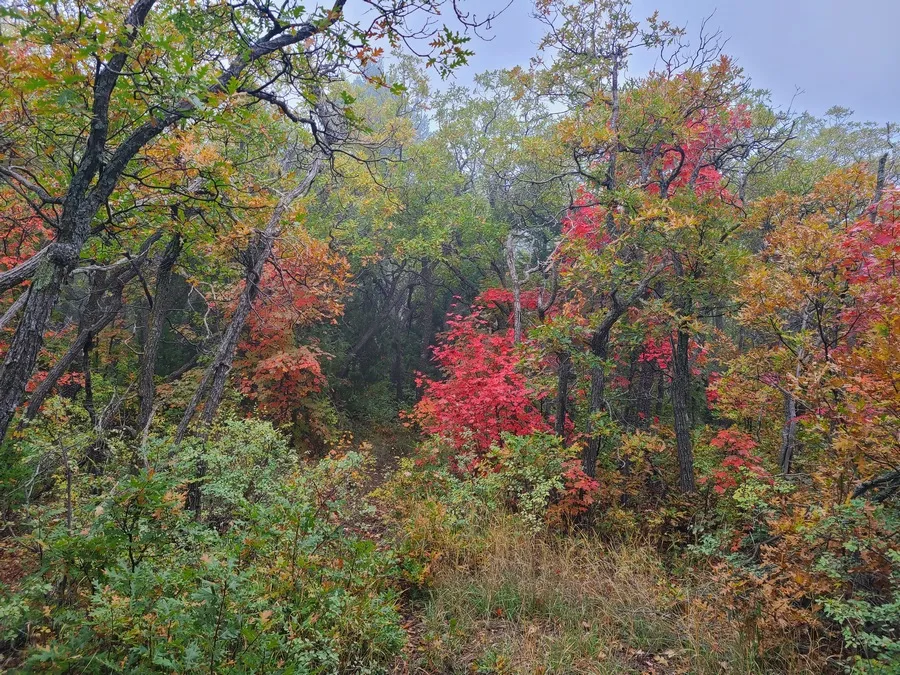
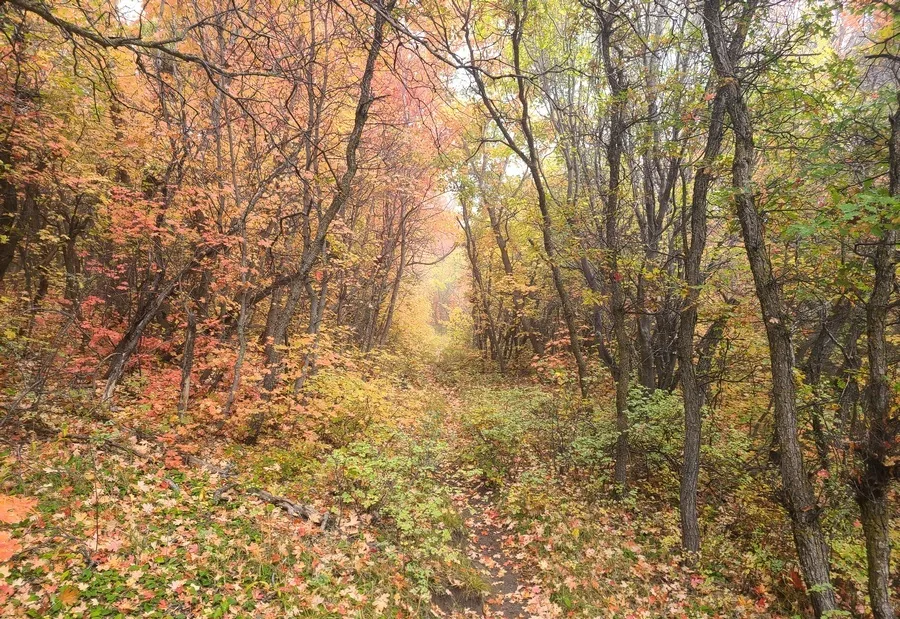
The next two pictures are on a loop west from the Fourth of July campground (no cell service or water), see at the north end of the Manazano Mountains map. 7.2 mi, max elevation difference 1400'. Both pics are at 8700'. All was fine till got to the crest trail where low vegetation was hanging over the trail (next pic), with lots of water on the leaves/twigs due to the low clouds.
So pants and shoes were soaked after a mile. Well wasn't cold, really a tiny challenge compared to what early explorers dealt with. Mentioned to the volunteer camp host, an excellent guy, good discussion. He will mention the trail challenge to staff when the shutdown is over.
Back at the campground October 8th at 3 pm there was a heavy rain/hail storm resulting from the hurricane in Mexico, NY Times article. Trench washed out across the campground road. Next morning drove out to the area mentioned next.
Manzanita Mountains Trail System
Another area north of the prior, just southeast of Albuquerque, PDF map. On this map lower left we can read about dispersed camping, lots of specific sites noted. The only paved road through here may be hwy 337, from Tijeras southeast. On the map we can see lots of trails; I had planned on hiking four loops, did one mentioned below.
Hardly mountains like the prior area, mostly fairly level excepting west of 337. I camped at 242DC1, most of the way east on FR 242, which runs west/east across the map center (labeled Juan Tomas road on on-line maps). Little bits about this campground and the road below. Good cell service at this campsite but no water of course.
On a prior trip I did a hike including Tunnel and Otero Canyon trails, on the west side. Can't find those pictures. Was going to do another there this trip.
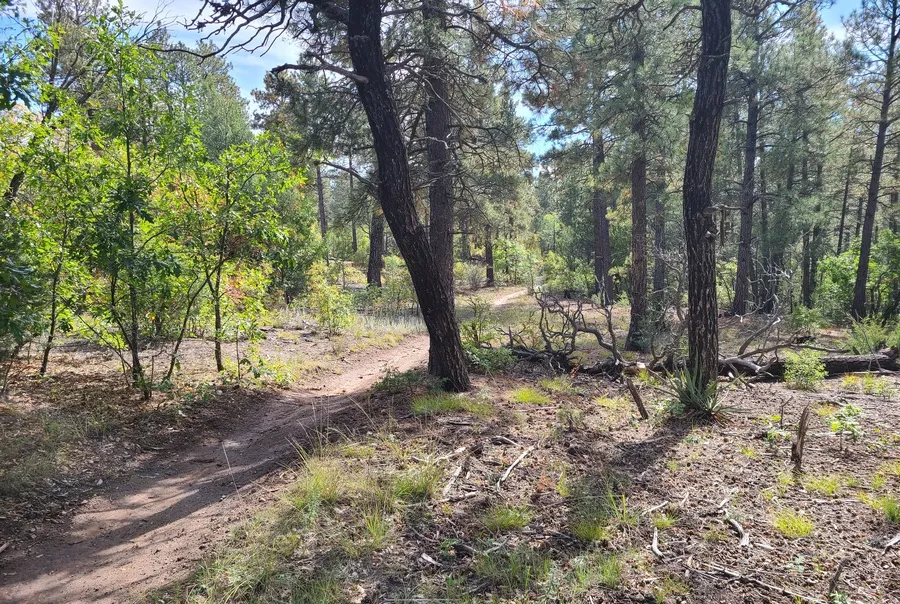
The next picture is on a loop south from 242DC1, Mahogany/Gamble Oak/Pokerchip trails. 6.7 mi, max elevation diff only 500'. Easy hiking though some trail sections were like ditches due to the heavy rain the prior day, but walked around or on trail edges. Scraped mud off shoes maybe 200 times on stones and tree roots. I had planned a loop hike north from this campground but canceled due to the mud, a shoe was coming apart and the other pair was still wet. Had boots also but this all seemed like an unusual challenge.
Road challenges
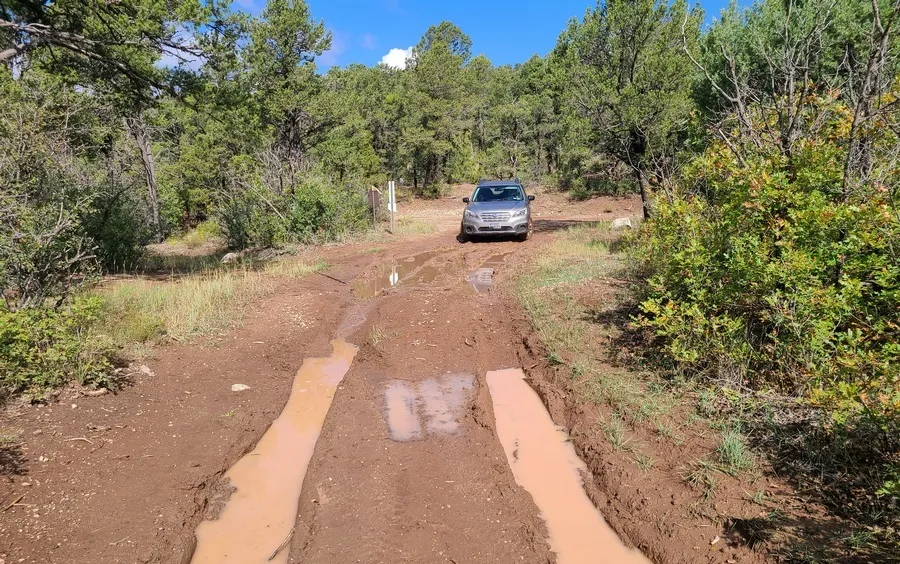
FR 242 was ok except for this last bit. Rougher than many roads in other national forests, some significant limestone rocks to drive around or over. AWD and high clearance highly advised. The road was mostly higher than surrounding land so the heavy rain the prior day had drained off, except for one interesting spot, only a couple miles to go before paved road, on the way home driving east.
This was October 10th at 6 am, total darkness, at a slight decline in the road. The rain had flooded the road here and a big puddle remained across most of it, totally mud of unknown depth. Understood now (next bit) certainly shouldn't drive though the puddle. There were ruts from trucks going through on the higher side, also realized shouldn't follow them. So drove across those deep ruts, ok thankfully again with AWD and high clearance.
Lesson learned arriving at 242DC1 October 9th (next picture). Turned in at one entrance that had puddles blocking the way. Now BIG MISTAKE! Due to old brain and used to TX Hill Country routes with limestone under puddles drove into the first small ones. Mud with only mud below, no telling how deep.
Thought get a truck driving by to pull me out with my tow bolt and strap; a truck passed just when I got stuck but didn't see another that day. So engaged my Outback's X-Mode (same function as limited slip differential on my 1970s Toyota Land Cruiser); drove back and forth like eight times with gas pedal to the floor. Finally backed out. Then went out and back in via another campground entrance, no problem.
by Kevin Hartley, Sierra Club Life Member
A Reaction to Bill Gates' Recent Opinion on Climate Change
Bill Gates recently sparked debate with an essay arguing that while climate change is serious, it “will not lead to humanity’s demise,” and urging policymakers to focus less on apocalyptic narratives and more on reducing human suffering. For San Antonio, where extreme heat is now a defining environmental, public health, and economic challenge, his message resonates in practical ways.
Our region’s rising temperatures already impact daily life, but they also carry a real financial cost. Gates’ call to focus on human well-being highlights the need for design solutions that also protect our local economy: shaded sidewalks that keep customers outside longer, cool transit shelters that support ridership, tree-lined commercial corridors that make retail districts walkable, and water or mist features that draw people rather than repel them. Heat-resilient design isn’t just environmental policy: it’s an economic development strategy.
For the San Antonio Sierra Club, the takeaway is clear: in addition to reducing greenhouse gas emissions, climate work must include heat-mitigation investments that help the natural environment thrive, people stay healthy, and keep the regional economy functioning.
by Bill Barker, Alamo Group executive committee member
Book: Beloved Beasts – Fighting for Life in an Age of Extinction, Then Inspiration from Rachel Carson and Stewart Udall
The book in this title is mentioned below, includes key bits about two people. Rachel Carson was a marine biologist and conservationist, then a famous writer; about her books below. Stewart Udall was Secretary of the Interior under presidents Kennedy and Johnson, he established four national parks, fifty wildlife refuges, and eight national seashores.
We can read further about Udall and Carson on their Wikipedia pages (links). Carson's page lists her books,Under the Sea Wind, 1941; The Sea Around Us, 1951; The Edge of the Sea, 1955; Silent Spring, 1962. At the end of the Carson page there is a list of her works done for US Fish and Wildlife Service, downloadable PDFs, many about specific refuges.
The words below by Carson (1907-1964) were read by Stewart Udall at a 2007 birthday celebration for her. She had selected this for her memorial service, for which Udall was a pallbearer. The words weren't used due to objection by Rachel's brother.
Contemplating the teeming life of the shore, we have an uneasy sense of the communication of some universal truth that lies just beyond our grasp. What is the message signaled by the hordes of diatoms, flashing their microscopic lights in the night sea? … And what is the meaning of so tiny a being as the transparent wisp of protoplasm that is a sea lace, existing for some reason inscrutable to us – a reason that demands its presence by the trillion amid the rocks and weeds of the shore? The meaning haunts and ever eludes us, and in its very pursuit we approach the ultimate mystery of Life itself.
Got started with all this via the book Beloved Beasts – Fighting for Life in an Age of Extinction by Michelle Nijhuis, in the Eagle and Whooping Crane chapter. Piles of very interesting stuff, easy to read.
There is the Wikipedia page about Silent Spring. From that:
Silent Spring is an environmental science book by Rachel Carson. … The book documented the environmental harm caused by the indiscriminate use of DDT, a pesticide used by soldiers during World War II. Carson accused the chemical industry of spreading disinformation, and public officials of accepting the industry's marketing claims unquestioningly.
In the late 1950s, Carson began to work on environmental conservation, especially environmental problems that she believed were caused by synthetic pesticides. The result of her research was Silent Spring, which brought environmental concerns to the American public. The book was met with fierce opposition by chemical companies, but it swayed public opinion and led to a reversal in US pesticide policy, a nationwide ban on DDT for agricultural uses, and an environmental movement that led to the creation of the US Environmental Protection Agency.
In 2006, Silent Spring was named one of the 25 greatest science books of all time by the editors of Discover magazine.
The SA library's website shows it has The Sea Trilogy, containing the first three of Carson's books listed above. And Silent Spring & Other Writings on the Environment, a composite of her fourth book and other works. And Man's War Against Nature, 20 chapters by nature writers, Carson's chapter is 19th. And Michelle Nijhuis's Beloved Beasts book mentioned above; she also has bits in some composites, in particular some of the annual The Best American Science and Nature Writing books.
by Kevin Hartley, Sierra Club Life Member
Climate Change Talk
Gary Poole will be doing his annual climate change talk at Hardberger Park on Saturday Jan 24th, 2026.
Saturday, January 24th
9:00 to 10:30 am
Phil Hardberger Park Urban Ecology Center Classroom
Map
About this talk
Please join us at Phil Hardberger Park (NW Military Entrance) to hear Gary Poole update us on the latest science on climate change. Please arrive by 8:45 to sign-in.
Trump Administration Seeks New Rules to Weaken Endangered Species Act
In a widely anticipated move from the Trump Administration, earlier today the Department of Interior announced its suite of draft ESA regulations. Though this move isn't surprising, it represents yet another serious attack by this administration on our nation's bedrock environmental laws and the ESA, including the many species the ESA protects. The move opens up a 30 day comment period, culminating on December 19th.
Specifically, the administration has proposed four separate draft rules:
- Inclusion of economics in listing and critical habitat determinations: Seeks to remove language that specified ESA listing decisions must be made “without reference to possible economic or other impacts of such determination.”
- Removal of protections for threatened species ("blanket 4d"): The current "blanket 4d rule" automatically gives all "threatened species" the same level of protection as species designated as "endangered". Under this proposal, every threatened species would require its own plan that could allow for more expansive allowances for "take" and would hinder the recovery of threatened species. Further, the development of individual plans would be resource intensive, and take away from the resources needed to ensure the recovery of other imperiled species.
- Critical Habitat: The draft regulation would limit the ability to designate critical habitat based on national security and economic impact categories - artificially impacting necessary habitat needs for imperiled species.
- Consultation: Weakening consultation regulations, threatening the ability of the Fish and Wildlife Service to address actions that negatively impact listed species across land management agencies.
You can find the Sierra Club's action alert in response to the draft ESA regs: here
Secondly, you can find our statement in response to today's ESA actions: here
Amplification of both of these would be greatly appreciated. I will be in touch in the coming days with a more expansive toolkit to aid in the effort to get comments to the administration, amplify our messages regarding the impacts of this threat to the ESA and ensure decision makers in Congress are aware of the public opposition to this measure.
And of course, we are working closely with the ELP team to determine our response and next steps. In the meantime, feel free to reach out with any questions.
by Ben Greuel, National Wildlife Campaign Manager, Sierra Club
Outings: The Call of the Wild
Visit the Alamo Sierra Club Outings page on Meetup for detailed information about all of our upcoming Sierra Club Outings.
The Alamo Sierran Newsletter
Richard Alles, Editor
Published by the Alamo Group of the Sierra Club, P.O. Box 6443, San Antonio, TX 78209, Website.
The Alamo Group is one of 13 regional groups within the Lone Star Chapter of the Sierra Club.
Changed your contact information?
If you're not sure whether the Sierra Club has your current email address, send an email to Member Services with your name and address and/or member ID (see Locating Your Member ID) so they can add your email address to your member record.
Have you moved? Let us know by sending your old address, your new address and your member ID to: address.changes@sierraclub.org.
Go online for the latest news and events
 |  |