The Second Life of an EV Battery
These automakers are giving EV batteries a second chance at powering the shift to renewables
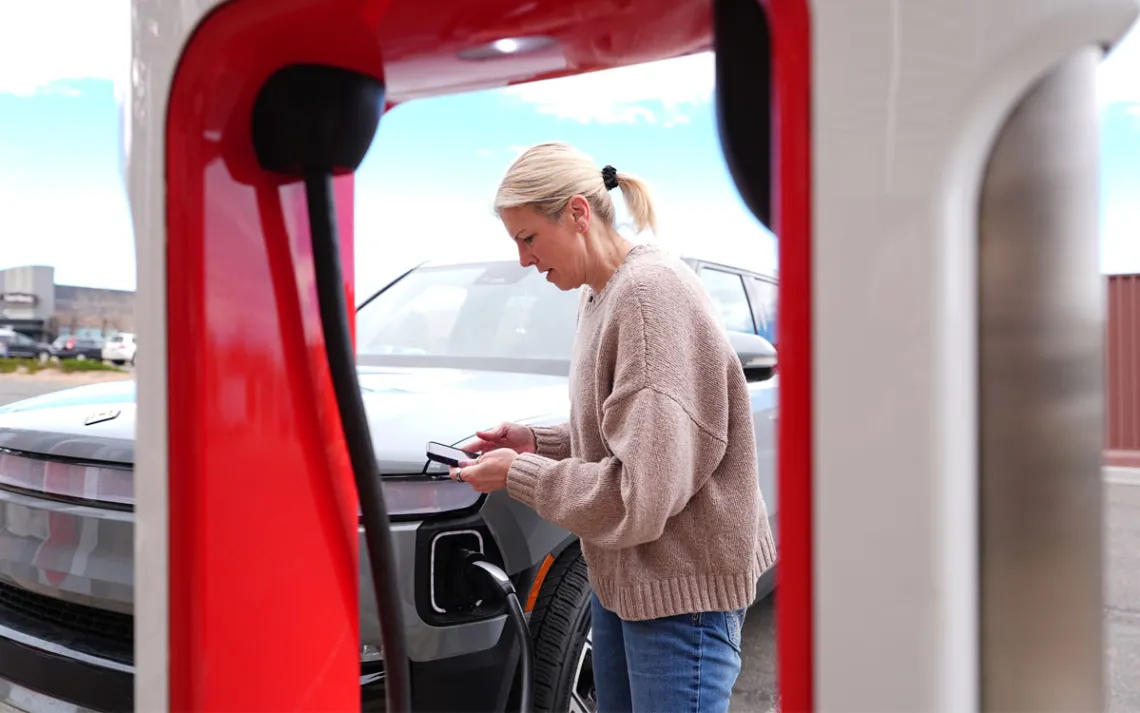
Avoiding the steep increase in price at the gasoline pumps, Cat Sutherland charges her Rivian R1T at a Tesla charging station on Friday, March 13, 2026, in Lakewood, Colorado. | Photo by AP Photo/David Zalubowski
Jayme Dyer’s 2012 Nissan Leaf still runs. The exterior is fine. The seats are adequate. The controls work. The only problem is the battery. It barely gets her across Durham, North Carolina. Her range has gone down from 80 miles on a full charge to maybe 22. "This whole car," she told me, "I'm going to throw away because the battery has degraded."
She won't, actually. And that battery has more life in it than she knows.
When Jayme eventually lets the Leaf go, most of it will be put to a second use. The steel and aluminum body will be melted down and reshaped into something new. The copper wiring will be recovered. The tires will be shredded and repurposed. And the supposedly useless battery won't be ground up for parts anytime soon. It'll probably be put to work.
That's not how most people imagine the disposal of their used EVs. Nearly half of Americans say they aren't confident that EV batteries are handled responsibly at end-of-life, according to a 2025 UL Standards & Engagement survey. That doubt feeds a stubborn myth: that electric vehicles just trade one environmental problem for another—tailpipe emissions for mining and battery waste.
However, the reality is more interesting, and a lot more hopeful, than most people know.
According to JB Straubel, founder and CEO of Redwood Materials, an American battery producer, "the massive amount of domestic battery assets already in the US represents a strategic energy resource," in a press release announcing the news. “This is a scalable model for how we add meaningful energy capacity in the near term."
Repurposed Instead of Recycled
Most people assume "battery recycling" means the whole battery gets broken down and rebuilt from scratch—like sending an aluminum can back to become a new one. Rivian and Redwood Materials announced a new project in April that's much simpler. The two collaborated to take more than 100 retired Rivian battery packs that were too degraded to power a vehicle and put them to work storing electricity at Rivian's manufacturing plant in Normal, Illinois.
The batteries went straight from one job to another. A battery pack that's degraded to 70 or 80 percent of its original capacity isn't enough power for driving anymore. But for holding a charge and releasing it slowly? It's plenty.
The new Rivian system currently stores 10 megawatt-hours of on-site power (enough to power roughly 330 average American homes for a full day) for the factory to draw from during peak demand periods, saving on energy costs and taking load off the regional grid. And it can scale as more retired batteries come in. It's faster and cheaper to get set up than recycling—which matters a lot, because the US needs an estimated 600 gigawatt-hours of storage by 2030 just to stabilize growing electricity demand. That’s the equivalent of the Hoover Dam running for two months straight.
GM and Redwood Materials announced a similar second-life partnership last July. And a Los Angeles startup called B2U Storage Solutions has been running second-life grid storage in California for the past five years, using retired Nissan Leaf and Honda batteries. The company broke ground on four new facilities near San Antonio last August, too.
The Rare Win-Win
The timing of these projects isn't accidental. Electricity demand in the US is growing faster than the grid can keep up with. Right now, when energy demand spikes, the grid's answer is to fire up natural gas peaker plants. While most solar farms are more efficient, cheaper, and more eco-friendly, they can't store the energy they produce. Once the sun goes down, the power stops flowing. When demand spikes, they can only put out whatever the weather permits.
Battery storage bridges that gap and might be the key to making renewable energy reliable enough to actually compete with gas and nuclear power around the clock. We need a lot of it, and we need it faster than new infrastructure can be built. According to the North American Electric Reliability Corporation's most recent grid reliability report, battery storage is already improving stability in regions where it's been widely deployed.
Most clean energy projects spend years waiting on federal permits, zoning laws, interconnection queues, and subsidy approvals before anything gets built. Second-life efforts only have to deal with a fraction of those hurdles. Doing the right thing and doing the profitable thing don't always go hand in hand, but when they do, change moves faster than any policy could push it.
The demand for domestic battery storage is now so undeniable that even Ford—in the middle of scaling back EV production—is converting an idle Lightning plant in Kentucky to manufacture new utility-scale storage systems. "Electricity demand is growing rapidly. We can choose to meet this by doubling down on the less efficient systems of the 20th century, or we can harness the full lifecycle of the battery technology already sitting in our driveways," Andrew Peterman, the director of advanced energy systems at Rivian, told Sierra. "By treating the EV as a foundational pillar of the grid, we can ensure that the next era of American innovation is not just cleaner, but more affordable and resilient for everyone."
And Then, Eventually, Recycling
Second life isn't the end. When a battery pack finally wears out as a storage device (typically after another decade of use) it moves to recycling. First, the packs get shredded, the shell is separated and recycled. Then the internal material gets processed into what the industry calls "black mass," and the lithium, cobalt, nickel, and manganese inside get refined back into battery-grade materials for new cells.
About 95 percent of a battery's material is recoverable this way, generating roughly 60 percent fewer emissions than mining those same elements from scratch.
The auto industry has done this before. The lead-acid battery sitting under the hood of every gas car on the road has a 99 percent recycling rate in the United States. It's one of the most successful recycling programs in American history, and it works because of disposal bans, a deposit system that rewards return, and an industry that built the infrastructure around both. The lithium system is trending in the same direction, but it's not there yet.
Lithium battery recycling is more chemically complex, and the gap between lab and factory is bigger than it sounds. In a controlled setting, researchers at places like Clausthal University of Technology in Germany can recover more than 99 percent of cobalt from black mass. But end-of-life batteries aren't uniform. Each pack varies in degradation, chemistry, and impurities, and industrial systems can't adjust on the fly the way a lab can. "The laboratory already shows us what is chemically possible," said Luka Mettke, a researcher at Clausthal. "The industrial challenge is making that performance reliable, stable, and cost-effective in the face of real-world complexity."
Li-Cycle was once one of North America's most prominent battery recyclers. The company filed for bankruptcy and was acquired by mining giant Glencore after lithium carbonate prices crashed more than 80 percent between 2022 and 2025. When commodity prices move that fast, recycling margins don't have time to adjust.
The system is still forging ahead, but it's fragile in ways a press release tends to skip over. The current battery recycling system is constantly responding to commodity prices for the recycled materials and the fact that there's no standardized process for recycling. It's hard to build the kind of safe, consistent, scalable infrastructure the system needs with these swinging variables and, in many recycling facilities, a lack of startup capital.
Some states are beginning to step in with regulatory frameworks to address this gap. Colorado's General Assembly just passed Senate Bill 26-003, landmark end-of-life battery management legislation that creates safety standards and a market-based recycling pathway for high-voltage batteries reaching automotive recyclers (the first stop for most end-of-life vehicles). The bill still awaits the governor's signature, but it signals something important: in the absence of federal standards, states are starting to build protocols themselves.
Giving batteries a second life before they need to be fully deconstructed and rebuilt buys time. Every year a battery spends on the grid is a year the recycling system has to catch up.
What to Do With Your Battery
EV owners who are unsure what to do with a degraded battery or an end-of-life vehicle can contact their dealer or manufacturer directly. Every major automaker either runs its own battery take-back program or works with certified partners who handle the routing. The battery won't end up in a landfill. It gets evaluated, and if it still has usable capacity, it gets a second life before it's ever recycled.
Back in Durham, Jayme is still driving the Leaf for short trips. She's looked into aftermarket battery replacements that would restore most of the car's original range, but notes that they're quite pricey. She hasn't decided what she'll do with it yet.
“It would help me feel a lot better about retiring our Nissan Leaf to know that parts of it could be recycled, particularly the battery,” she said. “Knowing about the recycling programs changes the way I think about its end of life. Rather than donating it, I would make a concerted effort to make sure that it goes through the Nissan recycling program.”