 The Magazine of The Sierra Club
Indiana Communities Suffer Under Trump’s Coal Ash Rollback
A rule proposed this spring threatens decades of progress cleaning up coal’s toxic byproducts
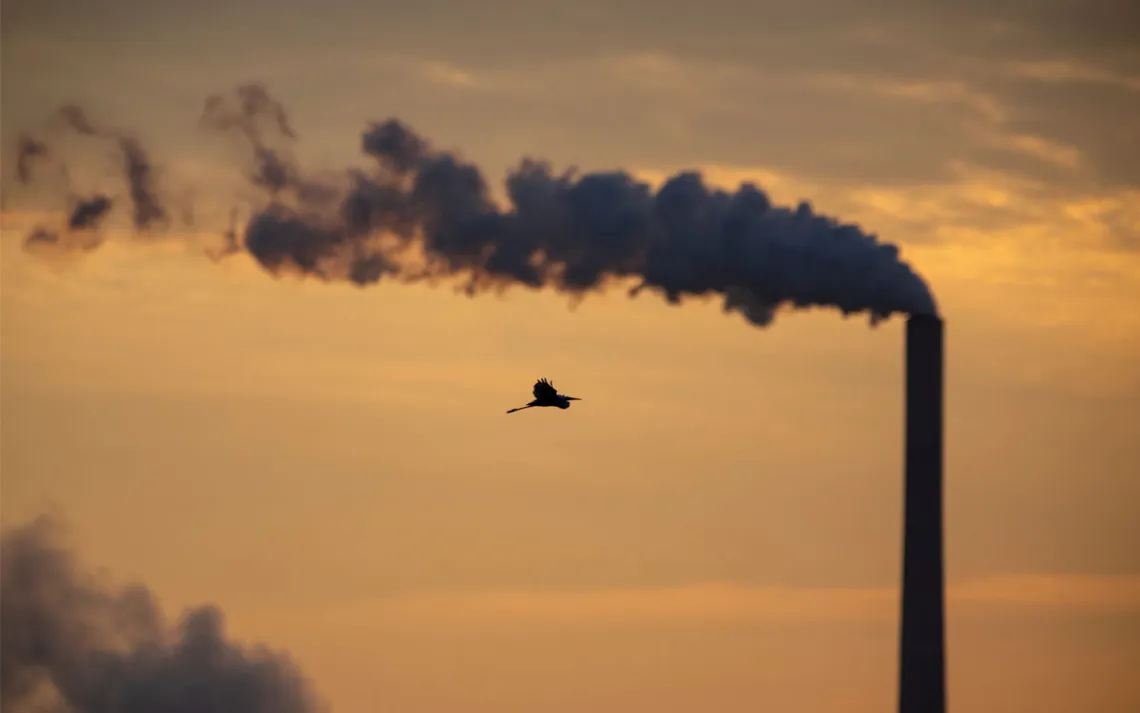
Pollution and steam rise from the Miami Fort Power Station in Lawrenceburg, Indiana. | Photo by Jason Whitman/NurPhoto via AP
Every weekday while she was growing up, Barb Deardorff rode the school bus past the mountain of coal ash at Northwest Indiana’s coal-fired Schahfer Generating Station.
“I’d watch the pile get taller and taller over time,” Deardorff said. “It was part of my youth.”
Except for college and a stint studying Spanish abroad, Deardorff has always lived in sight of the Schahfer plant, which is owned by the Northern Indiana Public Service Company, or NIPSCO. Its smokestacks loom over Indiana’s rural Kankakee Township, population about 4,700.
“The plant has always been on my western horizon,” Deardorff said.
Some days, Deardorff would see a pall of haze discoloring the sky to the west. But the most visible sign of the coal plant’s waste was the ash landfill whose perimeter the school bus traversed daily. Unbeknownst to her then, toxins from coal ash were likely already leaching into groundwater underneath NIPSCO’s property.
It took over two decades for the federal government to step in to protect communities like Deardorff’s from health threats posed by coal ash. After years of litigation by the Sierra Club and partner groups, in 2015, the Environmental Protection Agency announced the nation’s first comprehensive coal ash rule. Among its requirements was that utilities test for contamination under coal ash storage sites and make the data public. In 2018, toxins such as lead and arsenic were detected beneath many Indiana coal ash ponds—including at Schahfer.
“That got my attention,” Deardorff said. “All the homes here have private wells connected to groundwater that could become contaminated.”
The Obama-era coal ash rule mandated utilities clean up unlined ash ponds found to be leaking. Yet, the rule also had fatal weaknesses. Ponds with no leakage detected could operate as usual, while those that stopped receiving ash before 2015 were exempt.
“The 2015 rule was a step forward,” said Robyn Skuya-Boss, director of the Sierra Club's Hoosier Chapter. “But it left behind many communities.”
Correcting this took almost another decade and more Sierra Club lawsuits. Only in 2024 did the Biden administration release an updated coal ash rule closing loopholes in the original version. Then came the second Trump administration.
In April, Trump’s EPA proposed rollbacks to coal ash regulations that would delay cleanup at many sites while exempting others altogether. It’s a blow for communities like Deardorff’s.
“We already know contamination could be getting into our water,” Deardorff said. “It’s a very concerning situation.”
A toxic legacy
Indiana burns more coal than any state but Texas, consuming almost 26 million tons in 2024. Every year, that combustion produces some 5 million tons of coal ash, and it’s no surprise the state has the country’s highest concentration of coal ash disposal sites. Many are unlined ponds, while others are defunct landfills that don’t accept new ash but still pose health threats.
“Coal ash doesn’t get less toxic with time,” said Ashley Williams, executive director of Just Transition Northwest Indiana. “And at many sites, it’s in active contact with groundwater.”
Williams grew up in Ottawa, Illinois, where she got involved in the movement to defend her community from companies mining sand for the fracking industry. Later, as a Loyola University student, she organized with Chicago residents opposing BP’s storage of the oil-refining byproduct petcoke on Chicago’s Southeast Side.
“I realized environmental organizing was what I wanted to do,” she said.
Williams moved to Indiana in 2017, originally to work on the Sierra Club’s Beyond Coal campaign. She helped win a commitment from NIPSCO to stop burning coal at the Schahfer plant in 2025 and the utility’s Michigan City Generating Station by 2028. In 2020, she founded Just Transition Northwest Indiana, with the goal of cleaning up coal ash sites.
The Michigan City station has burned coal for almost a century and sits on a foundation made partly from coal ash used as construction fill. Its multiple ash landfills are separated from Lake Michigan and nearby Trail Creek by a deteriorating seawall, which had to be reinforced last year. A failure in the wall could mean disaster for Lake Michigan.
“Repairing the wall is like slapping a Band-Aid on the problem,” Williams said. “We need the ash to be dealt with.”
Best practices for cleaning up coal ash involve removing it and burying it in a secure, sealed landfill away from lakes and rivers. The EPA’s 2024 rule would have triggered this type of removal at sites throughout the country, but Trump’s rollbacks throw a wrench in these plans. At Michigan City, this means a heightened risk of arsenic, lead, thallium, and other heavy metal toxins seeping into groundwater and the adjacent Great Lake.
“Some of those metals are carcinogens,” said Indra Frank of the Hoosier Environmental Council. “Others are toxic to the brain and nervous system, while some interfere with the development of unborn children.”
The consequences of failing to deal with coal ash’s toxic legacy are brought into stark relief in Town of Pines, Indiana, where ash from the Michigan City Generating Station was used as landscaping fill in the 1970s. Town of Pines became a Superfund site after the EPA found toxins from coal ash in dozens of residential wells in the early 2000s. Contaminants were later found in soil, and in 2016 the EPA began a major cleanup effort.
“Town of Pines residents have been left wondering how long they may have been drinking contaminants before the situation was discovered,” Frank said.
Absent federal action, dozens of Indiana communities near coal ash sites and hundreds more throughout the country could experience similar public health disasters.
“There’s a growing fear that at sites across Northwest Indiana, coal ash toxins will turn up in people’s drinking water,” Williams said. “It’s really not if, but when.”
Promises made, promises broken
Nationwide, more than 740 coal ash sites have received testing in compliance with the 2015 rule, according to data compiled by Earthjustice. More than 91 percent of those facilities have contaminated groundwater with toxic substances at levels exceeding federal safe standards. Over two dozen sites in 14 states are known to have contaminated private drinking wells. Indiana, with its high concentration of coal ash sites and long history of burning coal, is at the center of this crisis.
Today, Indiana is undergoing an energy transition, with over a dozen coal plants in the state having closed since Beyond Coal began tracking this information. The Trump administration—which ordered two Indiana coal plants, including Schahfer, to remain open past their planned retirement dates—is fighting this transition tooth and nail and may succeed in delaying it. However, the long-term trend is clear.
What’s less certain is what happens to the tens of millions of tons of toxic waste those coal plants leave behind.
“When the EPA, after a rigorous process, strengthened its coal ash rule so sites that had been overlooked could get cleaned up, that represented a promise to communities,” said Skuya-Boss. “The current administration is breaking that promise.”
Parts of the Trump EPA’s new regulations are vague, and precisely how each coal ash site is affected will likely be settled in courtrooms. In the meantime, communities in Northwest Indiana face the prospect that cleanup efforts will, at the very least, be delayed.
“By rolling back rules for coal ash, the federal government is signaling they don’t care about clean water, full stop,” said Nicole Chandler, a Beyond Coal organizer in Indiana. “It says to affected communities that they aren’t a priority.”
For Deardorff and others living in the shadow of NIPSCO’s Schahfer coal plant, the administration’s actions threaten to derail years of progress toward holding the utility accountable for its mess.
“In some ways, NIPSCO is a neighbor like any other,” Deardorff said. “But they’re a big neighbor, and what happens at their site has a very big impact.”