Climate Reality in San Antonio: Why Preparing for Heat, Drought, Flooding, and Wildfires Can’t Wait
In recent years, residents of San Antonio have experienced a sobering reality: the impacts of climate change are no longer distant projections. They are here, now, and intensifying. Record-breaking heat waves, prolonged drought, flash flooding, and rising wildfire risk are reshaping daily life across the 13-county Alamo region.
At the same time, global greenhouse gas emissions, which are the primary driver of climate change, continue to rise. According to the United Nations Environment Programme, the world emits over 50 billion metric tons of greenhouse gases annually. By comparison, emissions from the entire San Antonio metropolitan area are about 30 million metric tons, or about 0.06% of that total. Even if our region eliminated all local emissions tomorrow, it would not measurably change global temperatures or the trajectory of extreme weather we are now experiencing.
That is not an argument against reducing emissions. Far from it. Transitioning to clean energy, improving efficiency, and reducing waste are essential for long-term global stability. But for San Antonio, there is an equally urgent reality: we must rapidly and aggressively prepare for the climate impacts already locked in.
San Antonio has already seen a dramatic increase in extreme heat. The year 2023 brought a record 75 days above 100°F. Surface temperatures on asphalt on a summer afternoon can exceed 156°F which can instantly destroy human skin. Heat is now the leading weather-related killer in the United States, according to the National Weather Service.
The region’s population and ecology dependence on the Edwards Aquifer makes it especially vulnerable to prolonged drought. Sierra Club lawsuits led to the formation of the Edwards Aquifer Authority to manage aquifer withdrawals. However, droughts are reducing aquifer recharge, causing higher evaporation rates, and increasing demand for water supplies across Bexar County and surrounding areas. The 100th meridian through Central Texas that defines the dry West, and moist East is noticeably shifting toward the East.
Ironically, drought does not reduce flood risk. Central Texas sits in the nationally-recognized “Flash Flood Alley,” where intense rainfall events are becoming more frequent. Warmer air holds more moisture, leading to heavier downpours that overwhelm infrastructure and threaten lives. Flood risk is hyper-concentrated in specific corridors, especially along the Guadalupe River system. Tragically, with as many as 119 deaths, Kerr County in the Alamo region accounted for nearly 90% of all Texas flood deaths in 2025.
Hotter, drier conditions increase wildfire risk, particularly along the wildland-urban interface. Areas like the Camp Bullis Sentinel Landscape highlight the growing overlap between ecological vulnerability and human development.
/2Mile_18yr_20231024_Maroon.jpg)
by Bill Barker, Alamo Group executive committee member
How do we effectively communicate climate science when faced with an "onslaught of disinformation"?
This meeting will present a live, one-hour webinar featuring two distinguished voices in the field of climate change communication: renowned climate scientist Katharine Hayhoe and Climate Central’s Bernadette Woods Placky.
Tuesday, May 19th
5:45 pm
Meeting schedule
| Informal get-to-know-you & announcements | 5:45 pm to 6:00 pm |
| Program: WEBINAR | 6:00 pm to 7:00 pm |
| Discussion | 7:00 to 8:00 pm |
Venue
This is an in-person only meeting at:
William R. Sinkin Eco Centro, 1802 North Main Avenue
Map
Program topic
This webinar, hosted by Climate Action Now, should provide practical, actionable advice for climate educators. We believe these insights will help us to sharpen our messaging when engaging with community leaders, media, elected officials, and the public.
We look forward to discussing with you how we can apply these tools to our outreach efforts. For those unable to attend or wishing later access to the recorded webinar, register at the Talking Climate in the Age of Disinformation! Action Party event page.
Next month, Bill Hurley will continue the discussion of this crucial topic, particularly his strategies for communicating with audiences resistant to the concept of climate change.
About the speakers
Katherine Hayhoe is an atmospheric scientist and physicist. She is currently Chief Scientist for The Nature Conservancy, and Texas Tech University Distinguished Professor and Endowed Chair in Public Policy and Public Law and associate in the Public Health program of the Graduate School of Biomedical Sciences. More information is at her website.
Bernadette Woods Placky is the chief meteorologist and Climate Matters director at Climate Central. More information is at her bio on the American Meteorological Society website.
The Alamo Group of the Sierra Club holds its general meetings the 3rd Tuesday of most months. They're always free and open to the public.
Understanding Anasazis/Ancestral Puebloans, Their Future, and a Good Book
We can start with the Wikipedia page about Ancestral Puebloans, which began in the 12th century BCE. The name in the early Navajo (Diné) language means terms including "ancestors of our enemies" but now largely "ancient people". Now these are included in the classification Ancestral Puebloans, about which there are maps and lots of details on the web page.
They began as hunter-gatherers. Then from 10,000 to 5,000 BCE moved as small bands now named Paleo-Indian hunters, having spears and atlatls with projectile points on the shafts. Those points included chert; similar chert points and tools have been found around the hill country. The population of what is now New Mexico averaged like 4,000 people, or one person per 40 square miles or so. Yucca roots were an important vegetable. In periods with drought and low food collection people died younger, women couldn't produce milk so their children died and groups had to reduce the number of pregnancies.
Then corn was brought up from Mexico by the Mogollon people, that allowed the establishment of real communities, but by itself resulted in serious nutritional deficiencies. Some skeletons were found with major erosion of bones and fracturing due to loss of calcium, not provided by corn. The introduction of beans, squash and other grains was very important. Then the communities started building stone and earth dwellings around 700 CE. From the initial Wiki page, "Ancestral Puebloans attained a cultural 'Golden Age' between about 900 and 1150." Then the Great Drought began around 1130 and lasted 300 years. Next section on a few of the dwellings ruins in the major sites.
The Pecos Classification of Ancestral Puebloans was done in 1927. Nine periods beginning with Archaic–Early Basketmaker. Through Pueblo V (1600–present). Each with detailed web page links.
Major Ancestral Puebloan sites
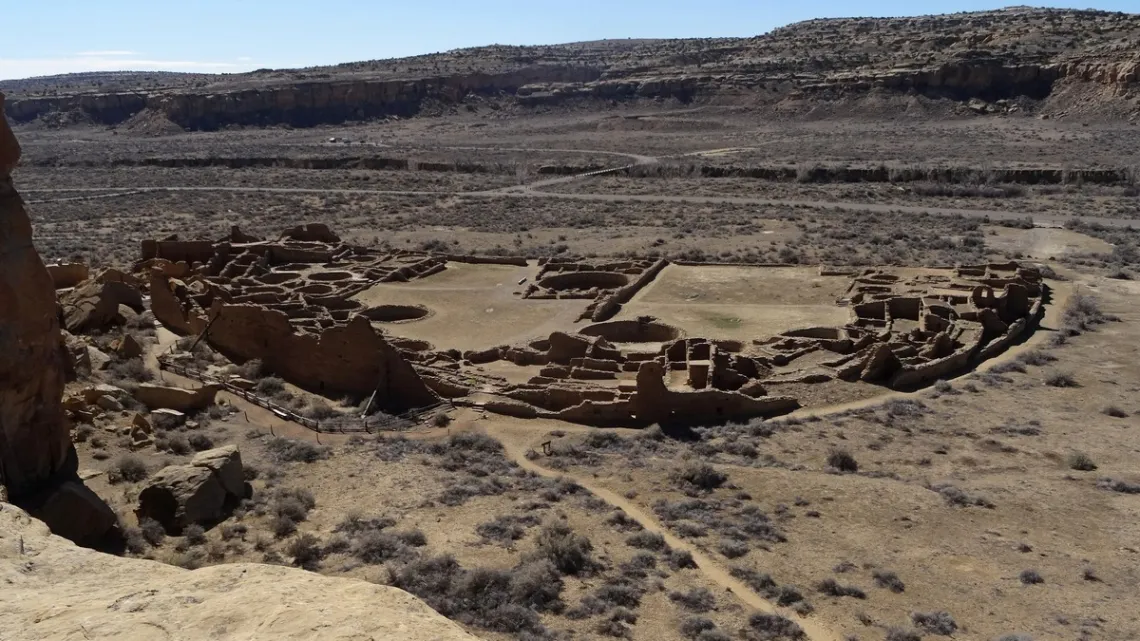
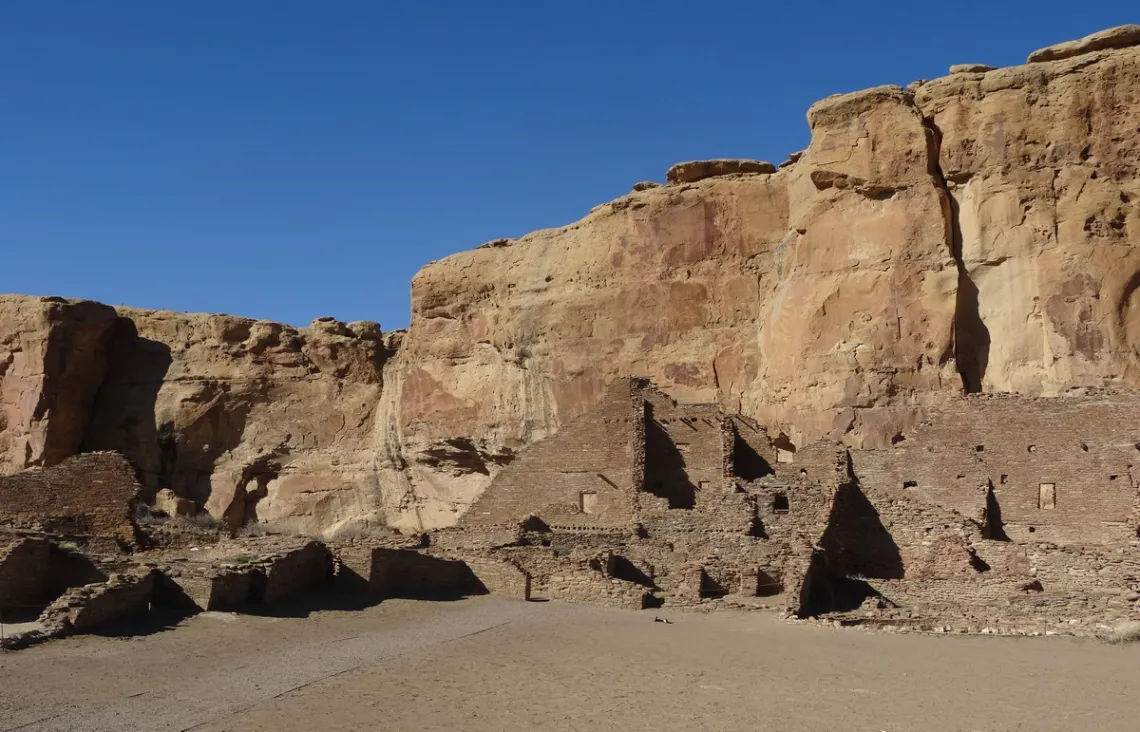
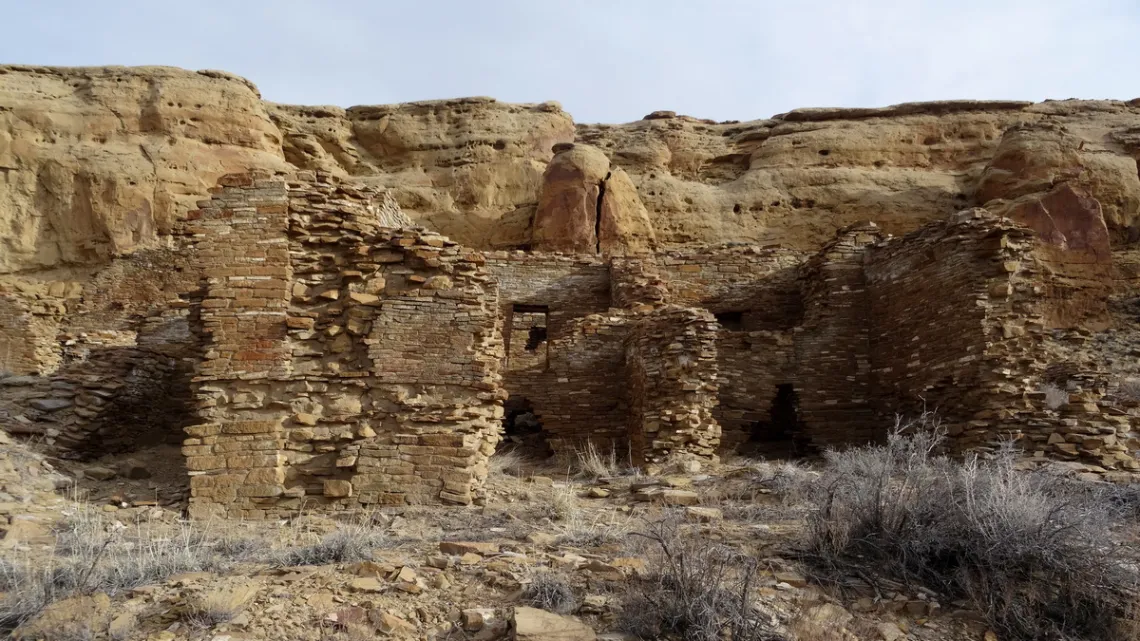
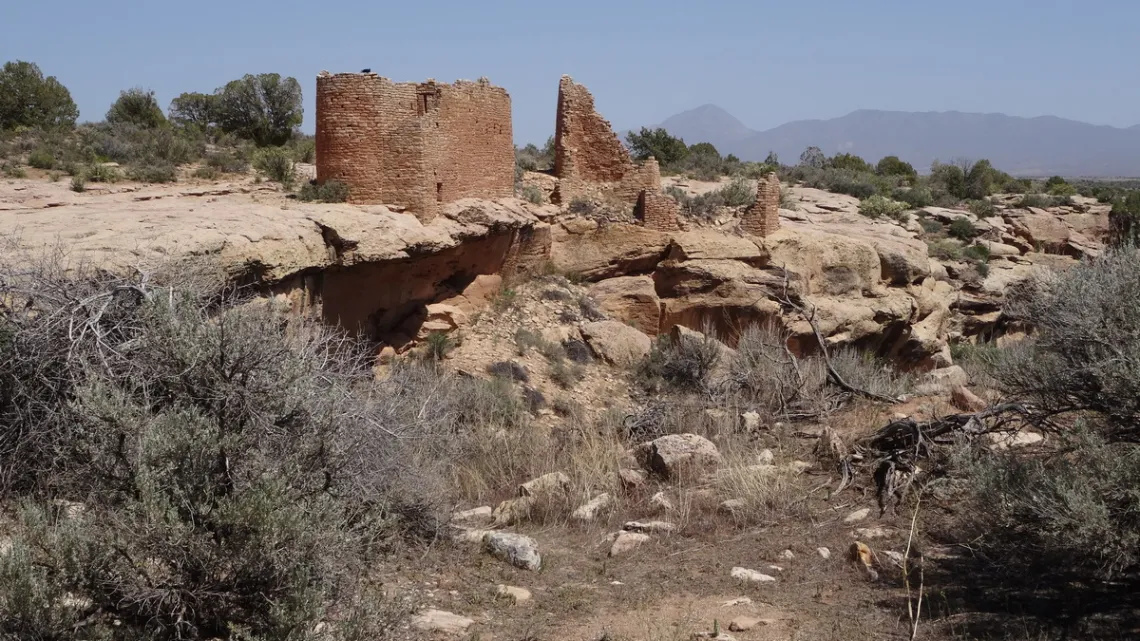
The initial Wiki page above has a map of the major Ancestral Puebloan sites in the four corners area. These include Chaco Canyon, next paragraph. Canyon de Chelly, due west of Chaco in Arizona. Mesa Verde, southwestern Colorado. Aztec Ruins, northwestern New Mexico, (article in this newsletter October 2024). Hovenweep, last picture below, is north off the map, southeastern Utah.
There was an article about Chaco Culture National Historic Park (NPS page) in October 2019 issue. The first Pueblo Bonito picture below was originally used in that article. Another great Wikipedia page is about Pueblo Bonito, here's a quote attributed to NPS: “Pueblo Bonito is the most thoroughly investigated and celebrated cultural site in Chaco Canyon. Planned and constructed in stages between AD 850 to AD 1150 by ancestral Puebloan peoples, this was the center of the Chacoan world." The Wiki article mentions the collapse of a canyon wall section in January 1941, destroying part of the ruin. The result of this can be seen at the left edge of the picture. Also in an aerial photo on the Wiki page.
Book: Anasazi America by David Stuart
This is about these people, published in 2000 by University of New Mexico Press. The SA library has a copy. Stuart was an archaeology professor at UNM. Much of the info in the first section of this article was provided by this book.
The book includes chapters on the roots of the Anasazis, the development of agriculture and the results of that, development of communities and construction of the many stone structures and the resulting Puebloan society. In particular, chapters: The Chaco Phenomenon. The Upland Period; communities returned to areas such as Mesa Verde, cooler with more water. The Creation of Pueblo Society. Enduring Communities, including how these developed and where the people are distributed now. Photos with good captions in most chapters.
We might wonder how were conclusions reached, like regarding ages and nutritional deficiencies from skeletons? Societal aspects? There are footnotes, determined people could research. And Recommended readings and references are provided.
What periods of these people are we most interested in, resulting from this book and the web pages? Well the most recent are pleasing as their communities mostly did well and cultures/traditions were preserved in many respects. But the most ancient include simple bits about the success and development of the communities, but also challenges and suffering resulting in very limited group size and deaths. We might imagine ourselves dealing with something similar due to widespread destruction/serious shortages of supplies including vehicles, fuel, electricity, potable water, food etc. Resulting from enormous volcanic eruptions, whatever, or problems we cause ourselves?
by Kevin Hartley, Sierra Club Life Member
Trump Administration Moves to Expand Drilling Near Chaco
The Trump administration recently moved to to increase oil and gas drilling around Chaco Canyon, a landscape considered sacred by Pueblos and Tribes. In its statement opposing the drilling, the Rio Grande Chapter of the Sierra Club said:
Opening up the Greater Chaco region to oil and gas drilling threatens the health and safety of nearby communities and the integrity of this sacred landscape. The people who call this place home have made their voices clear – they want this place protected, not sold out. Revoking protections for Chaco Canyon would damage relationships with Tribal Nations and sacrifice cultural and historical resources to boost corporate profits. We stand with local communities who continue to ask for permanent protections for this special place.
We encourage you to oppose this drilling by sending a message to Congress using this easy form.
According to Source New Mexico:
New Mexico’s federal delegation and tribal officials … accused the Trump administration of rushing the process to reverse a federal ban on oil and gas drilling around Chaco Culture National Historical Park by only allowing a week for limited public comment.
Alamo Sierra Club Life Member Kevin Hartley commented:
Protection of this area is very important. Chaco Canyon was the center of the Ancestral Puebloan civilization, there are hundreds of ruins all around, some still buried. This oil-gas development project would be a disaster.
Likewise, indigenous groups have blasted the proposed drilling. Take action today; tell Congress to urge the Trump administration to not attack national monuments.
by Richard Alles, Alamo Group newsletter editor
From the e-Mailbag
From time-to-time, the Alamo Group receives messages concerning local environmental issues. If you have thoughts on any of these issues, send us a message and we'll forward it to the writer. The views and opinions expressed here are those of the individual authors and do not represent the views or opinions of the Alamo Group or its members.
Transmission Lines Threaten Hill Country
To Whom It May Concern, according to your web site the Sierra Club's purpose is to protect wildlife and wild places. I wanted to reach out and invite you to learn about the fight we are currently in to save our pristine ecological areas, sensitive river basins, Golden-cheeked Warbler and other wildlife habitat.
There are 77 different proposed 765-kv power line routes that will bring electricity directly from San Antonio to the Permian Basin. These towers are among the first of this size and capacity in the State of Texas. CPS Energy and AEP Texas have recommended alternative route 9 to the Public Utilities Commission of Texas (PUCT), but it ultimately up to the PUCT to determine the route they will use. Many of the routes go through Real, Uvalde, Edwards and several other counties in South and West Texas.
Hill Country Preservation Coalition represents local landowners and residents and they support route 9 as the least harmful route. The reason for opposition to this project include: our economy's dependence on nature tourism, our pristine river stream segments, among some of the best and last in Texas, delicate contributing and recharge zones of the Edwards aquifer, local property values being negatively affected by these enormous lines carving up our canyons, our area being a part of the crucial migratory routes for birds and butterflies traversing North and South America, our dark skies, which could be marred by lighting on these towers, depending on aerial assets and localized airport runways along the route and our historic sites and rich history.
If you would like to join us in the fight to protect our local wildlife and ecologically sensitive area, please let me know and I can put you in touch with the appropriate person to provide the full details.
submitted by Jeralyn H.
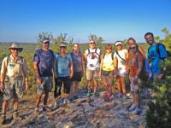
Outings: The Call of the Wild
Visit the Alamo Sierra Club Outings page on Meetup for detailed information about all of our upcoming Sierra Club Outings.
The Alamo Sierran Newsletter
Richard Alles, Editor
Published by the Alamo Group of the Sierra Club.
The Alamo Group is one of 13 regional groups within the Lone Star Chapter of the Sierra Club.
Changed your contact information?
If you're not sure whether the Sierra Club has your current email address, send an email to Member Services with your name and address and/or member ID (see Locating Your Member ID) so they can add your email address to your member record.
Have you moved? Let us know by sending your old address, your new address and your member ID to: address.changes@sierraclub.org.
Go online for the latest news and events
 |  |