To put it mildly, 2025 was a bumpy year at the N.C. General Assembly. A months-long battle over emission-cutting promises and energy bills, ongoing internal party and leadership fights, and an unapologetic electoral power grab dominated lawmakers' work and left important governance needs unaddressed.
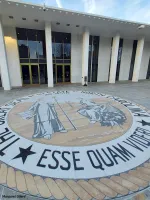
Your N.C. Sierra Club, bolstered by new staff and re-energized volunteers, was a regular presence at the Legislative Building. We're grateful to all of you who stepped up to speak truth to power, and we're getting ready now for the 2026 "short session" that starts in April. Stay tuned for ways you can help!
Power tussles set the tone
Infighting among party leaders hampered much of the legislature's work, leaving North Carolina in the ignominious position of being the only state to fail to pass a budget in 2025. Overall, the session was one of the least productive in recent memory as chamber leaders quibbled over a variety of bills.
Democrats opened the session with a leadership tussle in the Senate. Dan Blue, D-District 14 and a former House Speaker when he served in that chamber, was unseated as Senate minority leader. Sen. Sydney Batch, D-District 17, was elected in his stead, leading to a session-long feud in that caucus.
Across the aisle, the latest iteration of Republican infighting left us with a state budget stalemate. The Senate's budget proposal left a funding gap that many believed was intended to force acceptance of casinos in the state – a pet project of Senate President Pro Tempore Phil Berger. The House version filled that gap by delaying already approved tax cuts, which Senate leadership dismissed as a bad faith proposal. The chambers' majority party leaders unapologetically gave up on hopes of a compromise as the year drew to an end.
We fought for ratepayers, sound regulations
With a Republican supermajority in the Senate and an effective supermajority in the House, it was a tough year to stop bills that eroded environmental protections or pass any that benefited our air, land, water and communities. That didn't stop us from trying.
From April through July, the N.C. Sierra Club threw our organizing and lobbying efforts into a fight against Senate Bill 266, the misleadingly named Power Bill Reduction Act. The measure freed Duke Energy from a promise – codified just four years earlier in bipartisan-supported legislation – to lower its carbon reductions by 70% of 2005 levels by 2030.
S266 also put ratepayers on the hook for covering volatile fuel prices and "construction work in progress" or CWIP. Under similar legislation in other states, ratepayers are still paying for delayed or even scrapped power plant construction. Though S266 didn't touch Duke Energy's promise to reach zero emissions by 2050, we expect that target to face challenges in coming sessions.
The broken carbon reduction pledge was initially offered in Senate Bill 261, filed in March. When that measure stalled, the Senate put the S261 language into its budget proposal. As budget proposals became snared in chamber infighting, the House gutted S266, which originally focused on Hurricane Helene recovery and had been passed by the Senate, inserting S261's language and the additional sections on ratepayer burdens for fuel and construction costs. The Republican majority, joined by a handful of Democratic defectors, passed the rewritten S266 in both the House and Senate in June.
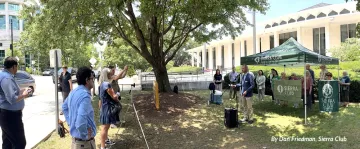
The N.C. Sierra Club and allied groups fought back strenuously from the time S261 was introduced. As the damaging proposals jumped from bill to budget to bill, we responded with thousands of constituent calls and emails, a lobby day of visits to key legislators, and a news conference (pictured) – ultimately persuading Gov. Josh Stein to veto the bill in early July. Over the coming weeks, we threw ourselves into making sure every Democrat who initially voted for S266 would stand behind their party’s Governor. Our efforts yielded some success - but not enough. At the end of the month, despite strong pushback from the people they represent, three House Democrats joined the Republican majority to override the veto.
On that same day, the General Assembly also overrode Stein's veto of House Bill 402, Limit Rules with Substantial Financial Cost, creating a major setback for all agencies with regulatory programs including the Department of Environmental Quality (DEQ). The bill was North Carolina’s version of the REINS Act (Regulations from Executive In Need of Scrutiny Act), legislation filed in multiple states. The North Carolina version requires a cost-benefit analysis of any new executive rule regardless of its benefit, and requires executive boards to vote unanimously in order to pass rules with a projected financial impact of more than $10 million over five years. Read our recap of the veto session.
Another blow to sound environmental regulation was tucked into Part 4.3 of Senate Bill 449, Continuing Budget Operations Part IV. It allowed for the Environmental Management Commission (EMC) to hire its own staff, separate and independent from the scientists and subject matter experts employed by DEQ who have traditionally staffed the EMC. Because this bill also made technical corrections to many of the programs funding Hurricane Helene recovery, it received overwhelming bi-partisan support.
We saw a small victory in the passage of Senate Bill 706, County Waste Management Assistance. The legislation restored scrap tire tax proceeds, diverted during an economic downturn, to the fund that helps counties handle scrap tire disposal.
In the coming "short session," we'll be supporting House Bill 369, Parking Lot Reform and Modernization Act. This bill will change regulations regarding parking lots to reduce their disastrous impact on the environment, particularly when it comes to uncontrolled runoff. Catawba Riverkeeper is leading the charge on this effort with our support, and has found common ground with a host of non-conservation groups who also have issues with parking lots. The bill passed the House in 2025 and we eagerly anticipate its movement in the Senate this year..
Ending the year on a sour note for democracy
Lawmakers capped the year's work with an October session to draw new congressional district maps. Senate Majority Leader Phil Berger bluntly stated that the session was called to do "everything we can to protect President Trump’s agenda, which means safeguarding Republican control of Congress." Berger, R-District 26, is facing a strong primary challenge from Rockingham County Sheriff Sam Page; Trump endorsed Berger's campaign after the redistricting vote. Read our statement on the redistricting session.
The new maps mainly make District 1 in northeastern North Carolina slightly more favorable to a Republican candidate. Current U.S. Rep. Don Davis, a Democrat, is running to retain that seat, optimistically pointing out that voters chose him even though a Republican could have been elected to the seat before the map was redrawn.

Subscribe to our Letter from Jones Street for our reports when the General Assembly is in session and opportunities to take action at the legislature.
The full list of bills we tracked in 2025 (For details on any measure not linked above, use the search function at the N.C. Legislature website):
- H171, Equality in State Agencies/Prohibition on DEI – Vetoed
- H352, Bid Requirements/Permitting/Inundation Maps/CAMA – In Senate Rules Committee
- H369, Parking Lot Reform and Modernization Act – In Senate Rules Committee
- H376, Various On-Site Wastewater & Well Provisions – In Senate Rules Committee
- H402, Limit Rules With Substantial Financial Cost – Veto overridden, passed into law
- H569, PFAS Pollution and Polluter Liability – In Senate Agriculture, Energy, and Environment Committee
- H570, Responsible Firefighting Foam Management Act – In Senate Rules Committee
- H592, Toxic-Free Medical Devices Act of 2025 – In Senate Rules Committee
- H605, Definitions for Advanced Recycling – In Senate Rules Committee
- H694, Regional Water Study/IBT Subbasin/TMDL – Passed into law
- H729, Farmland Protection Act – In House Energy and Public Utilities Committee
- H765, Local Government Development Regulations Omnibus – In House Finance Committee
- H768, Emergency Communications Code Exemptions/Sanitary Board/401 – Passed into law
- H850, Interbasin Transfer Moratorium/Study – Passed into law
- H870, Sedimentation Act & Other Environmental Changes – In Senate Rules Committee
- H926, Regulatory Reform Act of 2025 – In Senate Rules Committee
- H976, Uniform Partition of Heirs Property Act – In House Rules Committee
- H1012, Disaster Recovery Act of 2025 - Part II – Passed into law
- S257, 2025 Appropriations Act – In conference committee
- S261, Energy Security and Affordability Act – In House Rules Committee
- S266, The Power Bill Reduction Act – Veto overridden, passed into law
- S391, Department of Transportation Omnibus – Passed into law
- S401, NC Farm Act of 2025 – In conference committee
- S472, Coastal Regulatory Reform – Passed into law
- S513, Modify Requirements for Wind Energy Facilities – In Senate Finance Committee
- S554, Farmers Protection Act – In House Rules Committee
- S639, North Carolina Farm Act of 2025 – In Senate Rules Committee
- S706, County Waste Management Assistance – Passed into law
- S730, Expand CEPS/Nuclear and Hydro – In House Rules Committee
- S766, Confirm Secretary of DEQ – Adopted