By Lisa Hazirjian
Legislative & Political Director
Warren County, North Carolina, is widely recognized as the birthplace of the environmental justice movement. Some say it started in 1978, with the discovery that polychlorinated biphenyls (PCBs) had been illegally dumped in Warrenton, and the formation of the Warren County Citizens Concerned About PCBs (WCCC), an interracial group that feared the economic and environmental impacts of PCBs and opposed plans to build a toxic waste dump nearby in Afton.
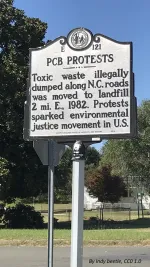
Others put the start of the movement in the summer of 1982, when WCCC lost its legal challenges and asked Black religious leaders to play a larger role in stopping the dump. With their help came greater involvement by civil rights organizations, and a greater focus on the inseparable links between structural racism and environmental degradation.
Black History Month invites us not just to lift up Black heroes like Dollie Burwell and Rev. Ben Chavis – both central figures in the Warren County struggle – but also to learn from that history. For example, as we grapple with how to respond to federal assaults on environmental protections, we should recognize that these changes disproportionately harm communities of color.
We can learn much more if we reach further back in Black history to the modern movement’s roots in resistance to slavery.
Most of us cannot begin to fathom what it felt like to be enslaved. But I challenge you to take a moment to imagine yourself at the end of a sweltering day, clay dirt baked into the cracks of your bare feet, bits of tobacco stuck to your body, dizzy and nauseous from dehydration and nicotine exposure. The strenuous physical labor was only part of the lived experience of enslaved people, for women and girls were subject to additional gender-based violence. Slaves lived every day under the terror of never knowing when the whip would fall, and never knowing when a family member would be sold off and taken away.
These horrors were everyday realities.
And yet, enslaved people were resilient, finding joy in acts of resistance.
They sang, danced, laughed, and worshiped together. They married and had children conceived by love rather than brutality. Some defied white rule by learning to read, others through simple acts of resistance like enjoying fresh fruit that tasted a bit sweeter knowing it was pilfered from the Big House kitchen. They splashed in lakes, picked flowers, and gazed up at the night sky, awed by the vastness and lured by the North Star, which pointed the path to freedom for those who dared to attempt an escape.
Taking joy in nature, in community, in everywhere we find it is one of the essential ways we sustain ourselves, even under the most oppressive conditions. I often quote Alice Walker, who wrote that “resistance is the secret of joy.” And yet, it seems equally true that joy is the secret to sustaining our resistance. Today, as we navigate what many of us are experiencing as particularly challenging times, we can benefit from remembering to make space for joy in nature and in collective resistance.
And resistance is what these times demand. The abolitionist leader Frederick Douglass declared in August of 1857 that “power concedes nothing without a demand,” and those words hold just as true today. We risk failure if we depend solely on the soundness of our reasoning to influence public policy. Rather, we need to exert pressure on policymakers in order to persuade them. That’s why it’s so important to the Sierra Club’s work that we are a membership organization with the ability to mobilize thousands to raise our collective voices, fight back against polluters, and make our case for protecting our natural world for all to enjoy.
For abolitionists, resistance meant opposing slavery. At times, it seemed like they disagreed about most everything else. What methods should they employ to bring about the end to slavery? Who should be allowed to speak at abolitionist meetings – and who should decide what they would say? What should become of former slaves?
We see questions not unlike these divide people within the environmental movement today. At times, these disagreements can feel depressing and debilitating. But there’s an easily overlooked bright side. Resistance is stronger when we can bring together people with widely divergent priorities and worldviews by uniting in opposition to a shared threat.
As members of an environmental organization, we may not share the same beliefs about other issues – and we don’t have to in order to achieve our goals. Nor do we need everyone who joins our campaigns to embrace our full agenda. As we witnessed in last year’s fight to stop the N.C. General Assembly from rolling back Duke Energy's carbon-cutting pledge and passing on construction costs to consumers, we’re stronger as a movement when we invite people who don’t yet view themselves as environmentalists to join us in resisting corporate powers who disproportionately hurt low-income households and communities of color.
Regardless of what brings you into this work, there is power in collective resistance, community care, and shared joy. As we continue our efforts to advance environmental and racial justice, let us build upon the lessons of Black history to create a future where we all can enjoy the natural world not just as a refuge, but as a fundamental aspect of our collective freedom.
Want to learn more about Black History? Read the full address, “If There Is No Struggle, There Is No Progress,” by Frederick Douglass, then visit the virtual exhibit We Birthed a Movement or watch Our Movement Starts Here to delve deeper into history of the environmental justice movement in Warren County.