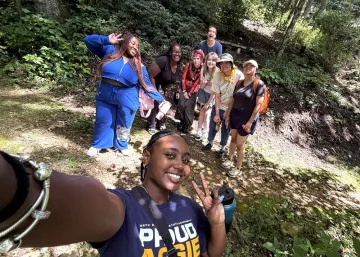
Being able to walk into a workspace and see someone who looks like you, understands where you come from, and shares similar experiences can make any job, internship, or fellowship feel more meaningful. Two of our 2026 summer fellows, Genesis Ibrahim-Balogun and Kierra Southerland, came from “opposing” HBCUs (historically Black colleges and universities). But over their time working with the N.C. Sierra Club, they turned what could have been a rivalry into a genuine friendship. Through their shared pride, appreciation, and love for their alma maters, the Eagle and the Aggie found common ground in sisterhood, growth, and environmental advocacy.
Kierra’s POV:
When I accepted the fellowship position with the N.C. Chapter of the Sierra Club, I had no expectations. I had recently graduated from North Carolina Central University, had a plethora of options to enrich my summer and, to be quite frank, a strong desire to make money. I chose the N.C. Sierra Club because the work appeared to be the most rigorous and offered a compelling opportunity to explore a field that was completely different from what I was used to.
The fellowship focused on conservation policy and environmental sustainability – two topics that, before this summer, I knew very little about. I decided to do the fellowship anyway, knowing that each day would be an uphill battle. I would have to rely on the skills I had already developed while simultaneously learning an entirely new field, understanding unfamiliar terminology, and developing an appreciation for issues that I had never really considered before.
And somewhere in the middle of learning about environmental policy, navigating a professional environment, and picking up new social cues and nuances, I gained something even more important to me than professional development: a friend.
Throughout the fellowship, I spent a considerable amount of time with a fellow from my rival HBCU, North Carolina A&T. While that was, admittedly, a major flaw I had to overcome in order to pursue this friendship, Genesis’ wit, kindness, respect, support and honesty ultimately outweighed her incorrect selection of a North Carolina HBCU.
Beyond the friendships and professional relationships I built, my fellowship gave me the opportunity to engage directly with communities through three outings, each centered around encouraging Black people to interact with the environment and become more involved in environmental advocacy. This work also connected directly to the subject of my white paper.
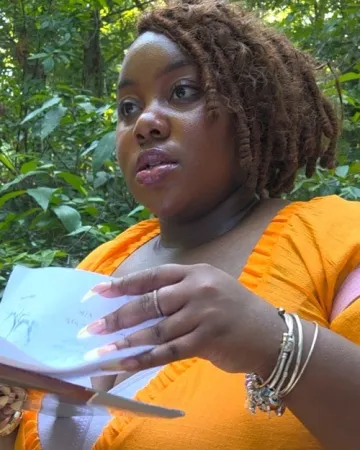
My first outing was at Historic Yates Mill County Park outside Raleigh. The outing centered around teaching participants about native and invasive species and exploring how Black and Indigenous populations who lived around Yates Mill – which was built before the American Revolution – historically used plants in their daily lives. It was an opportunity to connect environmental education with history and demonstrate that our relationship with the environment has always been present, even when that relationship is not traditionally highlighted.
My second outing was at the Piedmont Wildlife Center in Durham. The goal was to encourage Black and Brown community members to visit a wildlife conservation center, learn about conservation efforts happening in their own backyard, and understand why conservation should matter to them and their communities.
My final outing was a collaborative event with the other fellows at the Sierra Student Coalition's regional Summer Program – or "SPROG". Genesis and I teamed up to deliver a series of games and activities focused on environmental impact. It was one of my favorite experiences because it allowed us to combine education, creativity, and community engagement while working alongside people I had grown so close to throughout the fellowship.
What I will remember most about this experience, however, is not a specific policy, outing, or assignment. It's the people.
Being surrounded by a group of people who accepted me where I was in life, while still believing in me enough to recognize where I could be brought, continues to give me hope. I will cherish every conversation, lesson, laugh, challenge, and connection that I made throughout this fellowship. I entered the N.C. Sierra Club expecting to learn about conservation policy. I left with a broader understanding of environmental advocacy, a deeper appreciation for community engagement, new professional skills, and friendships that I hope will last far beyond the fellowship.
As I move forward, I'm pursuing my Master of Public Administration and have secured employment as a Business Operations Coordinator at Xponance. I've also been fortunate enough to receive an assistantship that covers the full cost of my master’s degree.
I didn't know what I was walking into when I accepted this fellowship. I just knew I wanted to challenge myself. Looking back, I am grateful that I did. Sometimes the opportunities that teach us the most are the ones we initially know the least about.
Genesis’ POV:
During my time with the N.C. Sierra Club, I was introduced to so many amazing people who helped shape my fellowship experience. Coming from California, it was especially meaningful to work closely with North Carolina natives and learn about the places, communities, and stories that matter most to them. Through their perspectives, I was able to see North Carolina in a different way and gain a deeper appreciation for the environmental work happening across the state.
My peer fellows were a major part of that learning experience. Luke, Kierra and I each brought our own passions, background, and purpose into the fellowship. Being around them allowed me to better understand how advocacy and policy work can look different depending on a person’s lived experiences. Their passion challenged me to think more deeply about my own goals and the kind of impact I want to make in environmental work.
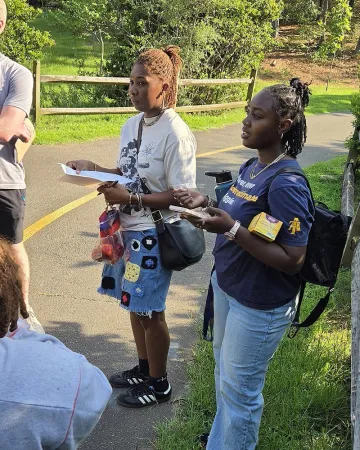
My outings were centered on using nature as a space for reflection, connection, and community care. I felt incredibly supported by my fellows and others during my first outing at the Cary Tree Archive. The outing included a tour through a community space filled with rich history and a deep appreciation for the trees planted there. We also participated in a reflection walk with journaling sections, which gave everyone time to slow down and connect with nature in a more personal way.
My second outing was smaller, but it carried a sense of intimacy that made it just as meaningful. It was a garden tour through the North Carolina Botanical Garden at UNC Chapel Hill, followed by yoga in the garden. Having friends from Greensboro attend made the experience even more special. It gave us all a chance to enjoy nature, recenter ourselves, and be reminded that rest can also be a part of environmental engagement.
Lastly, Kierra and I hosted an event called SPROGlympics, where we hiked, played games and led a water filtration simulation, creating a safe, welcoming, and fun environment for the young adults attending the SPROG retreat conference. It was a full-circle moment because it allowed us to combine education, teamwork, and joy while introducing environmental topics in a way that felt engaging and accessible.
On the drive to SPROG, Kierra and I reflected on our summer experience and where life is taking us next. One of the most rewarding parts of this fellowship has been the friendship that blossomed between me and my North Carolina HBCU sister. From holding each other accountable, to showing up ready to support one another, to sharing meaningful laughs and conversations, our friendship became one of the most unexpected and valuable parts of the summer.
When asked what gives me hope for the future, I can honestly say that it's fellowships like this one. This experience brought me some of the best connections, lessons, and memories that I will carry with me, even across distance. As I prepare for my next journey in New York, I will hold every lesson, every person, and every moment from this fellowship near and dear to my heart.