Luke Bernsen
2026 Stanback Fellow
I was first introduced to the Sierra Club in my youth by my grandparents – avid members of the Missouri Chapter.
A Sierra Club sticker headlined their vintage yellow kitchen fridge for decades, alongside a 2008 Obama "HOPE" poster and a "bikes not bombs" pin, only underscoring the age of the appliance. They would often bring me along for Club outings where, generally, I was the youngest person there.
But the age gap never bothered me; I enjoyed the community. These outings were rich in experience and devotion to the outdoors. The Sierra Club community has always been, first and foremost, about bringing people together over a shared passion — one I took to almost instantaneously. Looking at where I stand today, I can't help but attribute some of my gravitation toward the environmental movement to those moments.
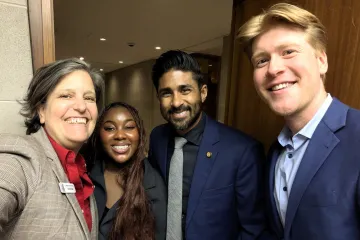
I came into this summer's fellowship with the N.C. Chapter fresh off my first full year of graduate school, looking to fill in gaps lingering on my resume and hoping to make more professional connections. I knew I had interest in environmental advocacy, but had little real experience in the sector outside of coursework and general knowledge picked up over the years. The N.C. Sierra Club stood out in part because of its unique position as an advocacy organization that works to influence policy.
My fellowship began right as North Carolina's General Assembly entered its summer session, and my orientation overlapped with our Chapter's response to Senate Bill 730, the still-pending "Ratepayer Protection Act," which would have extended the lifetime of coal-fired power plants in the state. On my second day, I jumped at the opportunity to speak with state representatives about the bill's flaws.
Adapting in real time became a theme of this fellowship. On the first outing I ever led, a trip to the Duke Lemur Center, I had to respond to a participant's medical emergency caused by excessive heat. When the entire Chapter mobilized to oppose another bill that would have allowed hardened structures to be built along our coastlines, I helped send messages to thousands of our supporters to guide them in contacting their representatives and derailing the legislation.
The most meaningful lesson I'm taking away from this fellowship, though, is something that isn't as relevant on a resume. I've been thinking a lot about the role of community, both in the environmental movement and in our daily lives.
Increasingly, my perception of the world and the people in it comes from an algorithm flashing images at me through my phone. I've felt more isolated and powerless against the backpedaling on environmental issues unfolding around me.
To be honest, it became easy to lose sight of why I joined the environmental sector in the first place — reasons that felt so clear when I was surrounded by my grandparents all those years ago.
That's why the biggest surprise of this fellowship was watching hope arise out of solidarity. I think back on hours of conversation with our other two summer fellows, Genesis and Kierra, and the Chapter's staff about the challenges affecting us all, and I'm grateful for the range of knowledge I picked up that I wouldn't have otherwise.
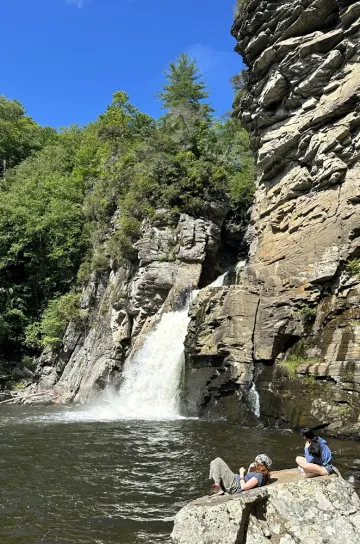
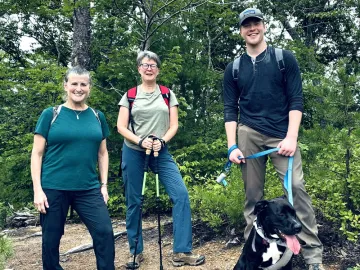
I think about the hikers I led along the Appalachian Trail one afternoon, who shared their lifelong journeys and their experiences living through Hurricane Helene. I think about networking with other environmental professionals, like Matt Abele from the N.C. Sustainable Energy Association, who donated his time to share his expertise on North Carolina energy policy with me.
These moments reminded me most of the passion I shared with my grandparents in my childhood, and of the hours spent on those Sierra Club outings. That's because the change the Club is working toward will always be most successful when it comes from the grassroots up.
This experience met my expectations for delivering strong professional opportunities, but it was the people who had the most profound impact on me. Looking ahead, I see myself continuing to engage communities in this work. Whether through policy, communications, or organizing, I'll always have the Sierra Club to thank for making that clear.
So as I move forward, I'll ensure I prioritize community, because doing this work alone doesn't give us much reason to keep doing it. Thanks for a great summer!
__________________________________
Luke Bernsen is a Master's of Environmental Management (MEM) Student at Duke University's Nicholas School of the Environment, concentrating in Energy Economics and Policy. The St. Louis, Mo., native earned his bachelor's in Environmental Economics from Xavier University in 2025 and brings experience working in the Environmental Protection Agency's acquisition division to support agency-wide environmental work and doing policy design work for the cities of Cincinnati and Raleigh.
About Us: The Sierra Club is America’s largest and most influential grassroots environmental organization, with tens of thousands of members and supporters in North Carolina. We help people from all backgrounds explore nature and our outdoor heritage, and work to promote clean energy, protect wildlife, safeguard the health of our communities, and preserve our remaining wild places through grassroots activism, public education, lobbying, and legal action.