UPDATED: Nov. 18. Scroll to the bottom for updates and actions.
If you live in Portland, you live on land that is at high risk of liquefaction. When the Cascadia Subduction Zone earthquake hits the ground beneath our feet can behave like a liquid. Now, imagine 90% of Oregon's fuel supply—over 388 million gallons of gasoline, diesel, and jet fuel—stored in aging tanks sitting directly on that unstable soil, right next to the Willamette River.
This isn't a scene from a disaster movie. This is the reality of Portland's Critical Energy Infrastructure (CEI) Hub.

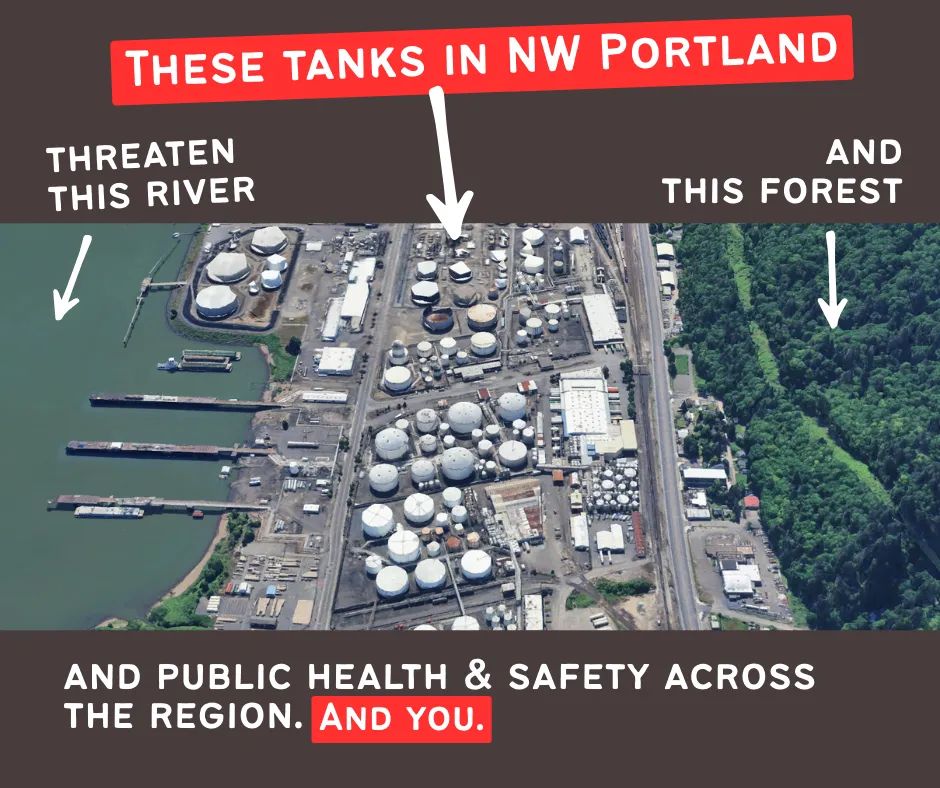
The CEI Hub (picture above) is a six-mile stretch of industrial land in northwest Portland along the Willamette River. It serves as a hub for the storage and distribution of liquid fuels that provide 90% of Oregon’s liquid fuel supply.
The City of Portland’s Bureau of Planning and Sustainability (BPS) is updating the Comprehensive Plan land use policies and zoning code to regulate fuel facilities in the Critical Energy Infrastructure Hub. BPS is accepting public comment right now on a "Discussion Draft" that outlines four potential update paths. After a thorough review, one thing is frighteningly clear: none of the four update paths come close to addressing the scale of the catastrophe we face. The city's proposals are a collection of half-measures that protect corporate interests and a fossil fuel economy far more than our lives and our environment. We have an opportunity right now to tangibly reduce the dangerous health and safety risks of the CEI Hub!
What can we do? Keep reading to find out or jump to the bottom for actions.
The Risk We Can't Ignore
A 2022 study commissioned by Multnomah County and the City painted a grim picture. A major earthquake would almost certainly cause catastrophic tank failures at the CEI Hub. The immediate economic damage is estimated to be as high as $2.6 billion, but the report admits the true cost would be "many multiples" of that, devastating our economy for decades.
Fuel would pour into the Willamette River, spreading downstream through Washington state and into the Pacific Ocean, poisoning fisheries and wildlife. The city knows this. They’ve had reports, like one from the Oregon Department of Geology and Mineral Industries (DOGAMI), outlining these exact risks for over a decade. Yet, the plans on the table today are shockingly timid.
Four Flawed Alternatives, No Real Solution
The city’s discussion draft offers four alternatives that are filled with weak, non-committal language. They ask companies to "encourage" seismic retrofits rather than requiring them. This is unacceptable for critical infrastructure that is, on average, 70 years old and was built with no seismic standards.
Worse, the plan presents key safety measures as mutually exclusive choices. The four options are all titled, "alternatives."
- Alternatives 1, 2, and 3 are unacceptable. They fail to reduce the catastrophic risk posed by the CEI Hub.
- Alternative 4 is the bare minimum starting point, but it must be strengthened with a more aggressive and rapid drawdown of fuel storage capacity, based on safety, not market projections.
- Center the health and safety of people and the environment, not the profits of fossil fuel companies. This is a historic decision that must prioritize our community's future.
This forces a question: Why isn't there an option that combines the strongest elements of each? Where is the alternative that requires seismic upgrades for all tank replacements, mandates a significant and ongoing drawdown of fuel, and prohibits any new expansion of risk? The city has failed to present a truly comprehensive safety-first approach.
Portland Can't—and Shouldn't—Do This Alone
This crisis is bigger than Portland. A catastrophic fuel spill will not stop at the city limits, and the economic fallout will cripple the entire state. With 90% of Oregon's fuel supply concentrated in one vulnerable location, this is a statewide emergency waiting to happen. Our neighbors in Washington State, who share the Columbia River, must also be brought to the table as key stakeholders.
Our city and county leaders must demand action from Salem. The state legislature needs to pass bills that require fossil fuel corporations to be fully insured for the damage they could cause and create a plan to geographically diversify our fuel reserves. This burden is too great for Portland to bear alone.
Your Voice is Critical: A Call to Action
We are running out of time. BPS is accepting public comments on this draft through October 17, and it is crucial they hear from residents who demand a real plan. We cannot allow bureaucratic inertia and corporate lobbying to lock us into a future where our city becomes the site of one of the worst environmental disasters in American history.
Here's What You Can Do Now:
- The Proposed Draft Plan has been published! You can read the entire plan here. We will share our main takeaways soon.
- Join us for a virtual panel discussion on Dec. 4: What can be done to secure a safe, reliable fuel supply?
- Here's the upcoming project schedule. When there's a related action we'll include it here and let you know:
- Planning Commission Hearing & Vote - December 16th
- Planning Commission Work Session - January 13th (for adjacent projects, eg. Economic Opportunity Analysis)
- Planning Commission Recommendation to City Council - February 10th