by Redwood Chapter Forest Committee members Patricia Damery and Matt Banchero
The beloved valley oak in Napa’s historic Dry Creek Pioneer Cemetery, whose generous boughs have graced our lavender field for many years, is not leafing out. We feared her demise. Last year when a branch died abruptly, an arborist diagnosed Mediterranean Oak Borer (MOB). We cut the infected bough, irrigated the drip line intermittently in the hottest part of the summer, mulched with 3-4” of fresh arborist mulch and hoped that the tree’s vitality would carry her through. When another branch died, we had it cut as well. The tree, once beautiful with its great limbs sweeping the heavens, became a shadow of itself. Our attempts to save her have only made her smaller and odder.
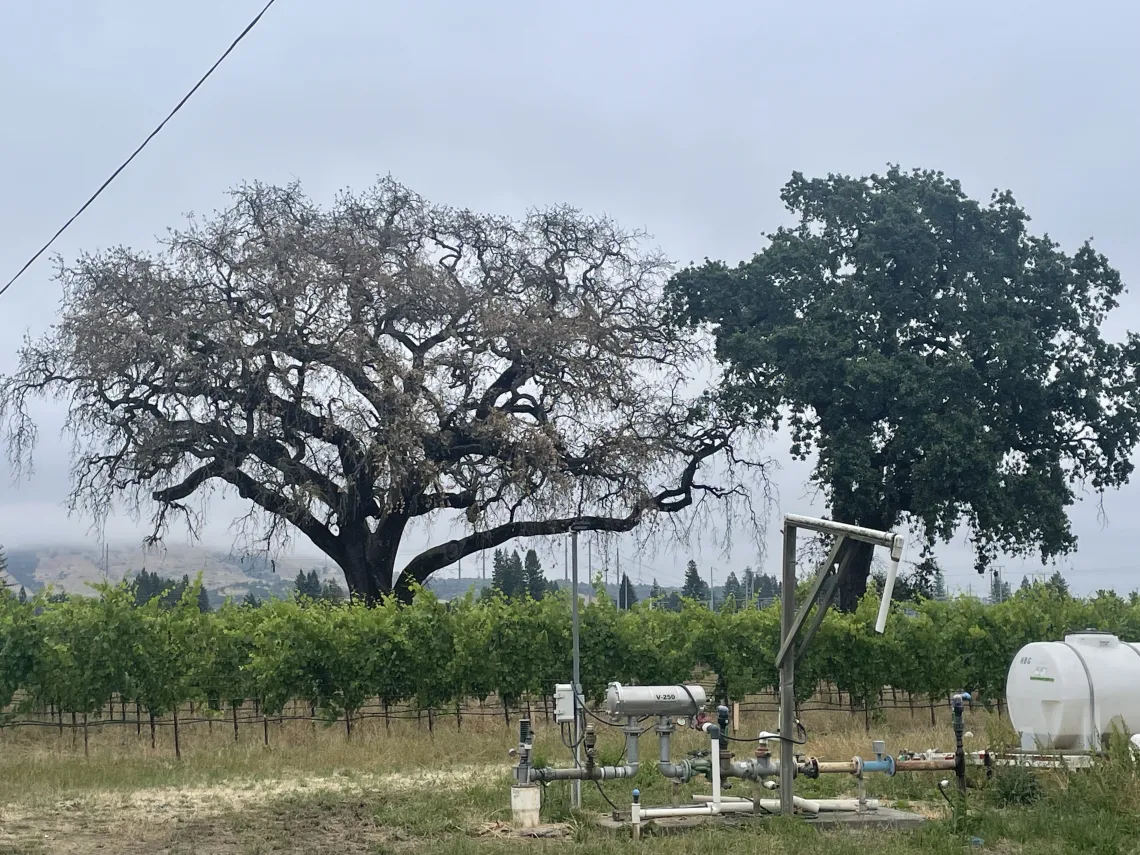
A dying oak tree infected with MOB next to a healthy oak in a vineyard. Redwood Chapter Forest Committee.
Our iconic valley oaks are showing signs of stress and dying. Those ancient trees have defined Napa Valley for centuries. Sadly, 98% of these Napa Valley oaks have already been cut for agriculture and development. Now those remaining are threatened by MOB.
This past January, two members of Redwood Chapter’s Forest Committee spoke with Mike Jones, Forestry Advisor with UC Cooperative Extension, about the latest research he and Curtis Ewing, a CalFire entomologist, are conducting on MOB. MOB has been identified in California for about 7 years but may have been here much longer. MOB is an invasive species; we are only now learning about its habits. It favors the oldest oaks in a population first. This is a particular problem in urban forests where the largest and most charismatic trees are often the only ones retained during urban development. It makes the loss of these historic trees more emotionally poignant and financially painful.
MOB is an ambrosia beetle. A multitude of ambrosia beetle species are found around the world including native California species. Within native ranges, ambrosia beetles find stressed or damaged trees and are a contributing factor to tree mortality. In a healthy system removal of a few older, stressed trees makes room for young vigorous growth. However, we live in a globalized world where small, innocuous decomposers can become epidemics threatening whole tree populations.
MOB is tiny, smaller than a grain of rice. It can fly miles when aided by wind. MOB typically is attracted to the upper tree canopy. It chews through the bark into the sapwood where it inoculates the wood with a mix of fungal spores from an organ located under its jaws. MOB farms the fungus to feed to its young. Over a dozen identified species of fungus are associated with MOB; two of them are toxic to our native Oaks. When MOB reach maturity and temperatures are above 75 degrees, fledgling beetles fly to other parts of the same tree or find new trees to infect.
Jones says the latest research is examining chemical control of high-value trees. Currently, recommendations for treating trees with trunk injections of insecticide and fungicide are based on the relative success with treating Invasive Shot Hole Borers (ISHB) in Southern California. (ISOB is another nonnative invasive ambrosia beetle targeting a variety of native and ornamental trees common in urban California forests.)
Phosphorous Acid, a topical bark spray, commonly referred to as Agri-fos (systemic fungicide) and used to treat Sudden Oak Death, is also being tested.
Use of chemicals may be a double-edged sword. Hopefully, these chemicals, when properly applied, may save oaks. However, little is known about the impact these chemicals may have on the diverse ecosystem associated with our California oaks. Moths, butterflies, Gaul wasps, and a multitude of other invertebrate may be impacted by the chemicals intended to save these trees.
Stressed trees are at greatest risk, and all of our valley oaks are stressed. Valley oaks have traditionally thrived as part of river/flood systems. Elimination of beaver dams, salmon runs delivering ocean nutrients inland, lowered water tables, increased impermeable surfaces, interruption of low intensity fires reducing competition, and cycling nutrients have all contributed to stress on older trees in the last 175 years. We’re also on a warming planet, and in California, that means more severe cycles of drought and flooding. The severe drought from 2012 to 2016 stressed our oaks and likely made them more vulnerable to MOB. The most important thing we can do is keep our valley oaks healthy. Jones suggests mulching under the tree’s drip line to cool the soil and retain moisture, sanitary pruning, and irrigating at the dripline before summer heat events may also help reduce stress on the trees.
Regular monitoring of trees by arborists or educated tree lovers can detect early signs of upper canopy infections. When caught very early, sanitary pruning practices can remove infected branches. However, chemicals used prophylactically, before trees are infected, is the only option showing any promise of saving individual trees in high MOB population areas.
But what do you do if a valley oak, like the one in Pioneer Cemetery, is obviously stressed and dying, and an arborist gives you the MOB diagnosis? Field evidence suggests the tree is too far gone to be helped. By the time trees show significant signs of infection including dead portions of the crown, leaf wilt, and beetle frass (sawdust) visible on the lower trunk, they should be removed.
Removing a large valley oak in an urban setting costs anywhere from $5,000 to $50,000 depending on logistics.
The next question is, what to do with the wood? Chipping, grinding, burning, or burying the wood is recommended. Many large tree companies and compost yards have high-capacity industrial wood grinders. Ideally, MOB infected wood should be prioritized for immediate grinding to a fine consistency to limit beetles escaping the logs.
Many small to medium sized tree services use mini excavators or compact track loaders to handle large wood from removals. There are many options for modular attachments to these machines that can break down larger logs to fit into traditional tow behind chippers. Wood screws and wood crackers are well proven technology in this industry, but many small companies are unwilling to invest in the equipment. There is little incentive to follow best practices for managing waste material when there are no county or state quarantines and the best practices are not enforced by any agencies.
Air curtain burners are portable/semi-portable insulated fire boxes with powerful fans that keep smoke and most particulates inside the burn chamber until fully combusted. Air curtain burners are a true wood disposal system. Grinders make undesirable bulky wood waste into usable mulch products, but don’t reduce overall mass of unwanted material. Wood mulch still requires hauling to a final end-use destination. Air curtain burners reduce whole trees to ash leaving only 2-3% of the original mass. Siting and permitting for air curtain burners can be difficult. The number of Air curtain burners in use are increasing annually to deal with forest debris and storm damage. However, local political will is needed for finding and funding appropriate sites and overcoming perceived air quality control concerns. Air curtain burners have been run in every California county so permitting is possible though sometimes onerous.
On large properties just digging a big hole with an excavator and dropping the wood in and covering it with at least a foot of soil can be done relatively cheaply.
Burying wood for sequestering carbon and building soil is a well-known technique in Europe known as hügelkultur. When done with intention and skill, mounds of buried wood can be used to prevent surface water run-off, create privacy berms along highways, and be planted with native flowering or edible plant species. Bulldozer operators cutting fire lines will often blade soil over dry vegetation to reduce flammability so burying wood should not be looked at as a revolutionary idea.
The choice of what to do with the infected wood is contextual based on the setting, available tools, and local ordinances.
City/county municipalities must budget for care of trees and designated disposal areas for chipping or burning infected wood. MOB has escaped into our environment; other pests are on the horizon, and many more that we’re not even aware of yet.
Cost-effective wood disposal options are a requirement for tree health and dovetails with wildfire mitigation efforts. Inexpensive disposal keeps this wood out of commercial firewood lots.
Moving firewood is the most significant cause of spread. DON’T MOVE FIREWOOD.
Most of all, we need to plant more oaks and protect existing young oaks from deer and livestock browsing. MOB is targeting older trees. We need to replace them with younger ones that may show resistance for many years. While MOB has escaped into California, the population of MOB will hopefully decline over time giving younger oaks a chance to thrive. MOB’s impact will take at least 100 years to stabilize. When looking at protecting valley oak as a species, not just charismatic individuals, planting and protecting the next generation of trees must be a priority.