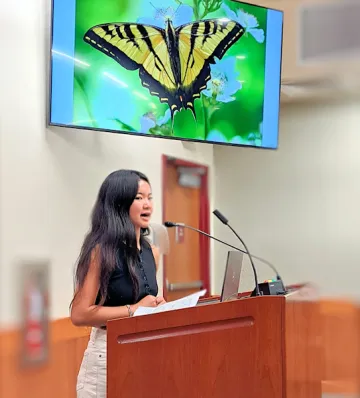
Our student intern, Kate Bit, recently spoke before the American Canyon City Council about the urgent need to preserve local wetlands in the face of sea level rise caused by global warming. The American Canyon native joined a presentation led by Mark Stevenson of the Napa-Sonoma Audubon Society, who outlined the severe impacts climate change poses to hundreds of species that depend on wetlands for survival.
In her remarks, Ms. Bit explained how the Bay Area is already experiencing flooding from high tides, storm surges, and increasingly intense storms. The consequences are profound: natural habitats that once protected shoreline communities are under threat, transportation networks face disruption, untreated wastewater is pouring into the Bay, and parks and open spaces risk submersion. “We are already seeing the costs of inaction,” Ms. Bit told the council. “If we delay, the choices left to us will only get harder, and the future for our communities and wildlife will be way less secure.”
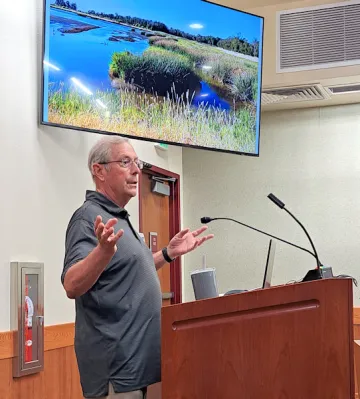
She also highlighted the importance of the Regional Shoreline Adaptation Plan (RSAP), adopted last year by the San Francisco Bay Conservation and Development Commission (BCDC) and the California Coastal Commission. This regional framework guides the Bay Area’s response to rising seas. Under state law, local governments—including American Canyon—are now required to develop Subregional Shoreline Adaptation Plans that align with the RSAP and submit them for approval.
In closing her presentation, Ms. Bit quoted directly from the RSAP:
“Put nature first whenever possible. Prioritize natural infrastructure solutions that benefit ecosystems and the health of the Bay as well as people, especially in the near-term. Adapting to rising sea level will require a mix of green and gray infrastructure. Working with nature, instead of against it, can produce better results for both people and wildlife.”

Reflecting on the experience afterward, Ms. Bit said: “It was both exciting and a little daunting to stand before the City Council, but I felt it was important to press the urgency of wetlands protection. If local governments don’t act soon, the problems we face today will seem like nothing compared to what’s coming, especially during my lifetime.”
We are deeply proud of Ms. Bit’s determination and her clear, passionate advocacy for protecting the wetlands that safeguard both people and nature.