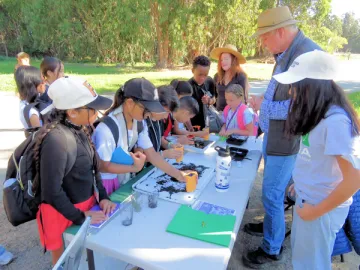
(Note: all 4th Grade students had a signed waiver to use their images for this article.)
What can a handful of mud teach a fourth grader?
Quite a lot, it turns out.
At a recent Wetlands Explorers Program field day hosted by the American Canyon Community & Parks Foundation, local students rotated through the Napa Sierra Club station to investigate a big question: How do wetlands help protect our planet? Rather than simply telling students the answer, we challenged them to figure it out themselves.
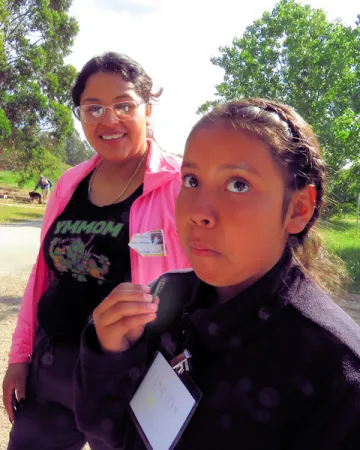
Students explored how carbon, climate, and rising seas are all connected—and how wetlands help protect life, including our own.
For two days in the fourth week of March several of the Napa Group’s Executive Committee members and student interns helped with navigating the various hands-on lessons. (For a look at the lesson plan, please click here. If you're an educator, feel free to use it.)
Students began by examining a small clump of marsh mud and considering an unexpected idea—that this ordinary-looking material might play an important role in slowing climate change. From there, they tested whether wetlands can actually protect communities from rising seas.
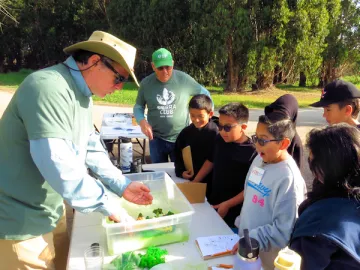
Using a hands-on wave demonstration, students compared two model shorelines—one with wetlands and one without. We asked them to hypothesize what might happen if a large storm or tide hit. All answers were accepted. As waves rolled in on the model town we had constructed, the difference was immediate. Without wetlands, the “homes” flooded. With wetlands in place (using two large sponges), the waves were slowed and absorbed. The conclusion came quickly: wetlands act as natural shields against storm surge and sea level rise.
“The plants stop the water before it hits the houses,” remarked one bright-eyed young student. “They absorb the waves,” explained another. “That’s so cool.”
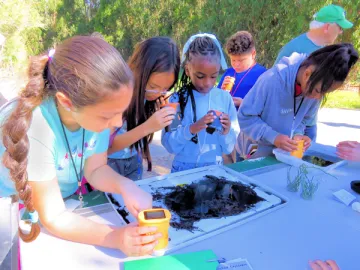
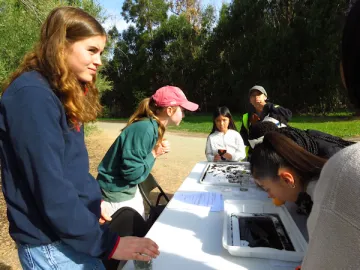
Next, students explored the “secret life” of wetland mud using handheld microscopes. They searched for pieces of plants breaking down beneath the surface and discovered a key concept: in wetlands, dead plants are buried in mud instead of decomposing in the open air. This process traps carbon in the soil rather than releasing it into the atmosphere. Through this simple observation, students connected wetlands to climate—less carbon in the air means less warming, and slower sea level rise.
“So the carbon gets stuck in the mud instead of going into the air,” exclaimed another young student scientist.
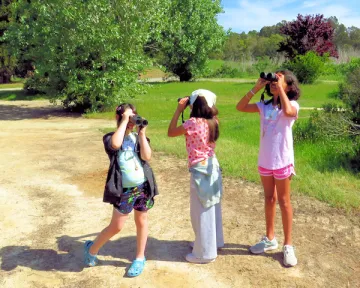
The investigation continued with a bird-spotting activity, where students scanned the marsh for signs of life. From the water’s edge to the mudflats and marsh grasses, they began to see wetlands as “wildlife cities,” providing food, shelter, and nesting areas for a wide range of species.
Finally, the group participated in an interactive food web demonstration. Students took on the roles of plants and animals and quickly saw what happens when wetlands disappear: the entire system collapses. When wetlands were “restored,” the ecosystem came back to life—an immediate and memorable illustration of how interconnected these habitats are.
One student, who had been quiet for most of the lesson, shouted, “If the wetlands go away, everything else goes away too. Maybe even us!”
By the end of the session, students were able to articulate the three “superpowers” of wetlands:
• protecting communities from flooding
• storing carbon and helping slow climate change
• supporting diverse plant and animal life
More importantly, they understood how these functions are connected.
Programs like this remind us that environmental education doesn’t have to be abstract. With the right mix of hands-on investigation and clear storytelling, even complex issues like climate change and sea level rise can become tangible—and meaningful—for young learners.
And sometimes, it all starts with a little bit of mud.