By Katie Davis
After Santa Barbara County passed a Climate Action Plan in 2024 that left out oil and gas facilities—one of the major sources of emissions and the primary diver of climate change—there was an outcry from the environmental community.
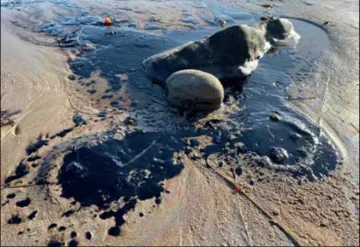
County Supervisors remedied this omission by asking staff to return with a plan that included oil and gas facilities, such as following the lead of jurisdictions like Los Angeles County and phasing out oil drilling. UCSB researchers prepared a report on the economic, health and environmental benefits of an oil phase out.
On May 13, 2025 Supervisors voted to have staff return with a plan to phase out oil drilling, and on October 21, 2025 Supervisors approved the plan.
Staff are to return in six months with an ordinance to prohibit new oil projects. After that, the County can begin the process of studying how to phase out existing oil production.
Oil production in the County has been declining, but the financial risks to taxpayers have increased as oil companies have sold their assets to smaller, speculative ventures that are at higher risk of going bankrupt.
Meanwhile, oil production is becoming more expensive and polluting.
As a Stanford report explains, “the days of gushers are long gone, leaving behind substantially depleted oil fields containing heavy crude oil … that is difficult to extract. Today’s drillers typically inject steam or hot water into the reservoir to lower the oil’s viscosity and increase its flow, a process often fueled by burning natural gas.
Those enhancement techniques are “energy-intensive and expensive.”
REVENUE
Revenues to the County are now just $1.7 million in property taxes or approximately 0.1% of county revenues. Compare that to the $36 million it cost taxpayers to plug 171 HVI Cat Canyon/Greka orphaned wells after its bankruptcy.
Despite declines, oil production remains a significant source of air pollution. A report found that oil and gas production in 2023 generated 132,356 MtCO2e (metric tons of carbon dioxide equivalent), which is roughly 11% of the estimated 1.2 million MtCO2e total tracked in the county Climate Action Plan, more than that contributed by electricity use in buildings.
According to the California Air Resources Board, oil production is also the largest facility source of health-damaging air pollutants such as PM 2.5, a pollutant that can enter people’s lungs and bloodstream leading to increased risk of heart disease, aggravated asthma, diabetes, and premature death, VOCs, which can cause difficulty breathing, damage the central nervous system, and increase cancer risk, and benzene, another known carcinogen. In Santa Barbara County, 40% of oil and gas wells are within one mile of sensitive areas such as schools, hospitals, and residential areas.
IT COULD GET WORSE
Oil projects proposed over the past decade illustrate what could happen if we do not have a phase-out plan in place.
In 2016, the County denied Pacific Coast Energy’s proposal to drill up to 144 new cyclic steam injection oil wells on Orcutt Hill, due to unavoidable impacts to water quality and endangered and sensitive species.
They found that the company’s existing steaming operations had resulted in ninety-nine oil seeps requiring emergency permits for capping and controlling the oil seepage, explosive well-casing failures, and surface heaving and cracks related to steaming. An environmental review of the project concluded that it could cause additional seeps and spills into creeks and watersheds.
In 2020, several projects totaling 760 oil wells in the Cat Canyon oil field were withdrawn after facing opposition. They proposed drilling through the Santa Maria Groundwater Basin, the primary source of drinking and agricultural water.
Each project would have used around seven million gallons of fresh water per year. The projects required trucking in oil to mix with the tar-like, heavy oil to keep it liquefied, and trucking the combined oil back out again, resulting in hundreds of tanker truck trips on local roads.
Trucks spill more than pipelines and have six times the fatality rate. Finally, the energy-intensive form of production would have dramatically increased greenhouse gas emissions in the county, generating 759,968 MtCO2e -- five times the 2023 oil and gas emissions.
IT COULD GET BETTER
In voting to phase out oil, the Supervisors’ majority cited the devastating costs of climate disasters, such as the wildfires and the Montecito mudslide that killed twenty-three people, the backsliding and climate denial under the Trump administration. Also, the health savings and other benefits of phasing out oil pollution near people’s homes.
Just as setting 100% renewable energy goals and joining Central Coast Community Energy has allowed Santa Barbara County to participate in a planned and affordable transition to renewable energy, setting a goal to phase out fossil fuel production will help the County plan an orderly transition away from oil and gas.
Workers are needed to plug oil wells. According to analyses by RFF and Sierra Club, capping the 2,348 active and idle wells in the county could create between 564 and 1,268 jobs.
And landowners and industry can turn to other productive uses for their land, such as housing or renewable energy projects, instead of costly proposals that conflict with County efforts to protect our air, water, health, and climate.