Can a Water Renaissance Put California on a Sustainable Path?
The state's dependence on imported water is threatened by climate change and aging infrastructure
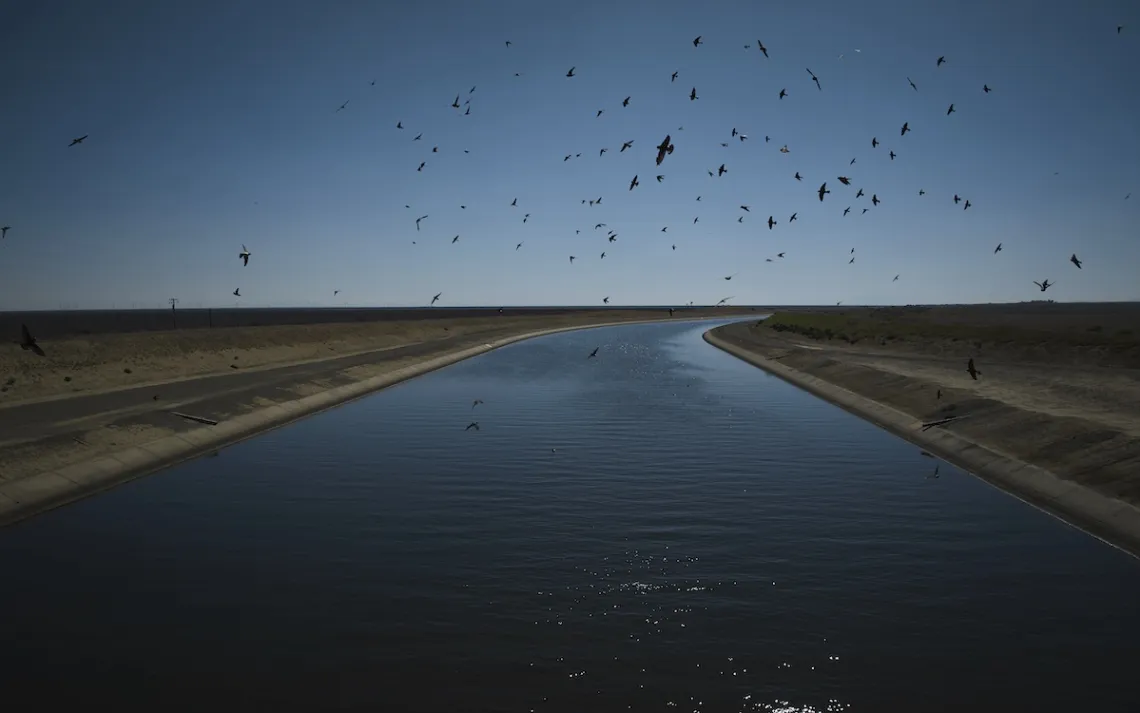
The San Luis Canal in California. | Photo by Jae C. Hong/AP
Southern California imports over half its water from other watersheds. About a quarter is diverted from the Colorado River; some comes from the Eastern Sierra. Nearly a third originates in the northern Sierra and is diverted with massive pumps in the Sacramento–San Joaquin Delta.
Climate change and aging infrastructure are making these imports less reliable, as ecosystems buckle under the strain. Following a record-low snowpack in the Rocky Mountains, the Colorado River is flowing far below normal. The water level at Mono Lake, in the Eastern Sierra, is “dangerously low.” The delta suffers from chronically degraded water quality and suffocating algae blooms, and fish runs are crashing.
Governor Gavin Newsom and state water agencies want to build a new tunnel that would divert water from the Sacramento River past the delta to feed communities to the south. The Delta Conveyance Project would cost at least $20 billion and take 15 to 20 years to complete.
According to Frankie Myers, a Yurok Tribe member and cofounder of Fix the World Consulting, the tunnel project will take the state further down an unsustainable road. “This idea that we can steal and share and divert water however we want with no consequences has got to end,” says Myers. “We have to see a shift in our communities.”
Myers is part of a coalition of environmental groups, tribes, fishing groups, water policy experts, and environmental-justice advocates who say they have an alternative plan that would help restore ecosystems and create jobs while substantially reducing reliance on imported water.
The Water Renaissance Plan calls for a collective commitment to developing local water supplies. It outlines eight priority recommendations, from policy reforms to the creation of new sources of funding, such as a general obligation water bond focused on local water supplies. The group, composed of a variety of nonprofit and advocacy organizations, including the Sierra Club, claims that sustainable technologies like stormwater capture, wastewater recycling, and conservation could yield between 1.8 and 2 million acre-feet of local water supplied by 2045, at a lower price tag than the delta tunnel. And local water is much more reliable in the face of climate change.
Climate change is undermining the reliability of imported water. Declining snowpack, longer and hotter droughts, and atmospheric river storms that dump huge volumes of water in short periods are “driving not only reductions in water availability, but also our capacity to capture water due to when it's received,” says Ben Bass, project scientist at UCLA’s Center for Climate Science. Models predict at least an 8 percent reduction in imported water supplies by 2050. “Because of this, the most reliable source of water in the future is local water,” says Bass.
Can they convince lawmakers and state agencies that have long favored engineered solutions?
Getting local water in cities
The good news is that many Southern California communities have a head start on local water.
Los Angeles County uses around 1.2 billion gallons of water a day, 60 percent of which is imported. The county has pledged to boost its share of local water from 40 to 80 percent by 2045.
Getting to that goal will require “finding” 400 million gallons of local water per day.
“It's the old famous reduce, reuse, and recycle—just add restore to the end of it—reducing water waste through conservation and efficiency,” says Bruce Reznik, executive director at LA Waterkeeper, a coalition member.
Wastewater recycling represents the largest source of untapped local water and could eventually supply up to three-quarters of what’s needed. But wastewater recycling projects are expensive and take years to build.
Other strategies will be needed to close the gap. Many of these also come with benefits to neighborhoods and the environment. Programs modeled after LA County’s, for example, could fund “green infrastructure” like bioswales, rain gardens, and underground cisterns that temporarily capture and clean stormwater before it is released to replenish aquifers.
“If it were up to me, all of our schools [would have] big cisterns underneath that you're driving water to when it rains or urban runoff and you're treating, filtering, and then storing it,” says Reznik.
Groundwater that’s been contaminated by industry and agriculture could be cleaned as it’s pulled out of the ground. Desalination could remove salt from coastal groundwater basins that have turned brackish. Among conservation measures, converting lawns to native plants would have the biggest impact.
“We really need to be focusing on the transformation of our lawns into native habitats and rain gardens and all those things,” says Reznik. “And it really needs to be done at a major, major scale.”
Besides reducing water use, native landscaping would eliminate the need for pesticides and herbicides while creating habitat for pollinators and other wildlife. Such a transformation will only happen at scale with funding, including “prebates” that help homeowners make the switch.
“You’ve got to change the mindset, but I think one way you can do that is just making the economics so much easier to do the right thing,” says Reznik.
A healthier delta
In lieu of a costly new tunnel that would further degrade the ailing delta ecosystem, the coalition recommends restoring existing infrastructure.
“To date, recommendations around restoration of the delta—from levee upgrades to use of tribal ecological knowledge, restored flows, and local restoration practices around land management—have taken a backseat in water planning to infrastructure that will not hold up to the climate change scenario,” says Barbara Barrigan-Parrilla, executive director at Restore the Delta.
In the valleys, excessive groundwater pumping has caused land to sink, reducing how much water canals can carry.
In the delta, some 1,100 miles of aging levees are at risk of failing, threatening islands of farmland, infrastructure, and human communities. Massive flooding could also compromise the intakes that allow water to flow to the southern part of the state. Climate change and subsidence, which occurs when peat soils are exposed to oxygen and begin to break down, are worsening the flood risk.
Restore the Delta is supporting legislation that would create a dedicated fund to shore up canals affected by subsidence and repair aging delta levees.
“Our philosophy is, 'Look, this is the way the system was built,'” even if it was planned in an era before environmental repercussions were considered, says Barrigan-Parrilla. “We've got to make it efficient and workable and protect people along the way.”
About 95 percent of the tidal wetlands that once fringed the delta have been lost to development and agriculture. Rice farming and tule restoration could help check and even reverse subsidence. Sushi rice thrives in this region, and though there are only about a dozen active rice farms now, Barrigan-Parrilla would like to see more.
“When you keep the fields flooded for rice production, it actually stops the erosion of the soil and it creates this balanced equilibrium behind the levees,” says Barrigan-Parrilla. Birds also flock to feed on the rice stubble.
Area tribes could play a key role in restoring tidal wetlands by planting tule and other native plants, which help filter pollutants, sequester carbon, and provide habitat for wildlife and birds. Reimbursement projects could help incentivize these practices.
“People forget that people have always farmed in river deltas,” says Barrigan-Parrilla. “Some of the best soil for farming requires the least amount of pesticide use or fertilizer use because of the quality of the soils, and its river flows that have created those soils.”
A matter of priorities
The vision laid out in the Water Renaissance Plan is not a pipe dream, says Reznik. “What's different now is we really do see the projects there.”
Examples are already flowing. Orange County hosts the world’s largest wastewater recycling plant, using the 130 million gallons per day of treated wastewater to replenish aquifers. San Diego’s Pure Water recycled water program is on track to supply close to half the city’s water by 2035.
Cities and counties in Southern California have aggressive goals. “It really does honestly come down to the money,” says Reznik. “We just need to find the resources to get this done.”
It will take a combination of federal, state, and local funding together to make the Water Renaissance vision a reality. For this reason, the coalition is not just advocating for the solutions they want to see.
“If Metropolitan Water District puts $40 billion into the Delta Tunnel, there's no way they're going to build local water projects; they're not going to have the money,” explains Reznik.
A century ago, California spearheaded audacious water projects. Now the state has the opportunity to do the same thing, but for local water, only it will be better for people, the economy, and the environment in the long run.